

 日本語
日本語 English

How Japan’s Inheritance System Is Creating Abandoned Architecture
When the owner of real estate such as land or buildings dies in Japan, ownership of that property is normally inherited by the deceased person's spouse, children, parents, grandparents, or siblings. However, when there are no eligible relatives, or when all heirs formally renounce their inheritance rights, the estate—including any real estate without heirs—may ultimately become state property if assets remain after legal liquidation procedures have been completed.
However, this does not happen automatically when it becomes clear that no heirs exist or when all eligible heirs renounce inheritance. Instead, a spouse or relative who has renounced inheritance, or an interested party such as an acquaintance or creditor of the deceased, must file a petition with the family court requesting the appointment of an estate administrator, a person responsible for organizing and disposing of the remaining assets.
The problem is that applying for the appointment of an estate administrator involves considerable cost and effort. As a result, many land parcels and buildings are simply left untouched without any application being filed. This aspect of Japan's inheritance system has contributed to the deterioration and abandonment of land and buildings throughout the country. In this article, I will explain this issue in more detail.
When a petition for an estate administrator is filed with a family court, the court appoints a qualified professional—often a lawyer and in some cases a judicial scrivener—as the estate administrator. Since these professionals must be compensated for their work, the person filing the petition is required to pay an advance deposit intended to cover the administrator's fees.
The amount of this deposit is determined by the court according to the condition and complexity of the estate being handled, but it is commonly said to range from approximately ¥200,000 to ¥1,000,000. If there are many properties involved or the legal rights associated with the estate are particularly complicated, the process becomes more complex and the required deposit can exceed ¥1,000,000.
Any profits generated through the liquidation of the estate are used first to cover expenses related to the process and the administrator's compensation. If those profits are sufficient to cover the administrator's entire fee, the advance deposit paid by the petitioner is refunded in full. Even if the estate profits are insufficient, the shortfall is covered by the deposit, and any remaining amount is returned to the petitioner.
Whether the deposit is refunded therefore depends on whether the estate can generate enough value to cover expenses and compensation costs. If the estate is small, if its assets cannot cover the costs involved, or if the deceased had debts that consumed the estate's value, it is not unusual for the deposit not to be returned. When the exact condition of an estate is unclear, filing a petition and paying the deposit can become a significant financial risk.
Normally, these petitions are often filed by creditors seeking to recover money owed by the deceased. However, because of the risk that the deposit may not be refunded, petitions are often not filed when the estate appears small or when the amount owed is relatively minor, such as around ¥1,000,000 or less.
There are also occasional cases in which people who have renounced inheritance file a petition because they wish to obtain only part of an estate or dispose of a remaining property.
Japan's inheritance system does not allow someone to inherit only selected assets while refusing others. If inheritance is accepted, someone among the heirs must also inherit the deceased person's liabilities. These liabilities include not only debts but also matters such as ongoing legal proceedings.
To avoid inheriting such obligations, heirs must renounce the entire estate. However, if someone wishes to renounce inheritance while still obtaining a particular asset from the estate, they may file for the appointment of an estate administrator and negotiate to purchase a specific asset during the liquidation process. In this way, it may be possible to both renounce inheritance and acquire a desired item from the estate.
However, since estate assets are generally sold through auction or similar procedures, there is no guarantee that negotiations with the administrator will ensure acquisition of a particular asset.
Regardless of whether owners or heirs exist, real estate such as land and buildings continues to be subject to property taxes and related taxes. If there is prolonged uncertainty regarding who is responsible for paying those taxes, collection becomes difficult. In some cases, local governments file petitions for estate administrators in order to recover unpaid taxes. However, if there is little expectation that the property can generate enough value to recover those taxes, the delinquency may simply remain unresolved.
If the property in question includes a building, it may remain unmanaged and gradually deteriorate, eventually creating safety risks for surrounding residents. Buildings considered dangerous due to the risk of collapse may be designated by local authorities as "specified vacant houses" under Japanese regulations. After corrective warnings are issued to owners, if conditions still do not improve, local governments may carry out demolition through administrative enforcement measures, and the cost may be billed to the owner.
If an heir had been living in and occupying the deceased person's property, some management responsibilities may remain even after inheritance is formally renounced, until responsibility is transferred to another party. However, in most situations, if inheritance has been legally renounced, former heirs can refuse demands to pay demolition costs associated with dangerous buildings.
Nevertheless, even if legal responsibility can be avoided through renunciation, the reality remains that abandoned buildings can still create risks and inconvenience for neighboring communities. Because of this, there are reportedly rare cases in which people who do not wish to inherit the deceased person's debts nevertheless use the estate administrator process because they want the building demolished so it will not become a burden to nearby residents.
Even when an estate administrator is appointed, however, buildings are not always successfully disposed of. For example, if no buyer can be found, a building may remain unsold and continue to exist. In other situations, the building may belong to the deceased while the land itself belongs to another landowner, or the building may be so severely deteriorated that demolition becomes necessary.
If the deposit and estate assets cannot cover demolition costs, administrative expenses, and the administrator's compensation, the building may simply remain standing. Estate administrators are not required to completely resolve every asset in an estate. Their actions are generally limited to what can realistically be handled using the available estate assets and deposited funds.
Even if unresolved assets formally become state property, the national or local government does not necessarily actively manage or utilize them, and there are cases where their future use remains undecided for long periods of time.
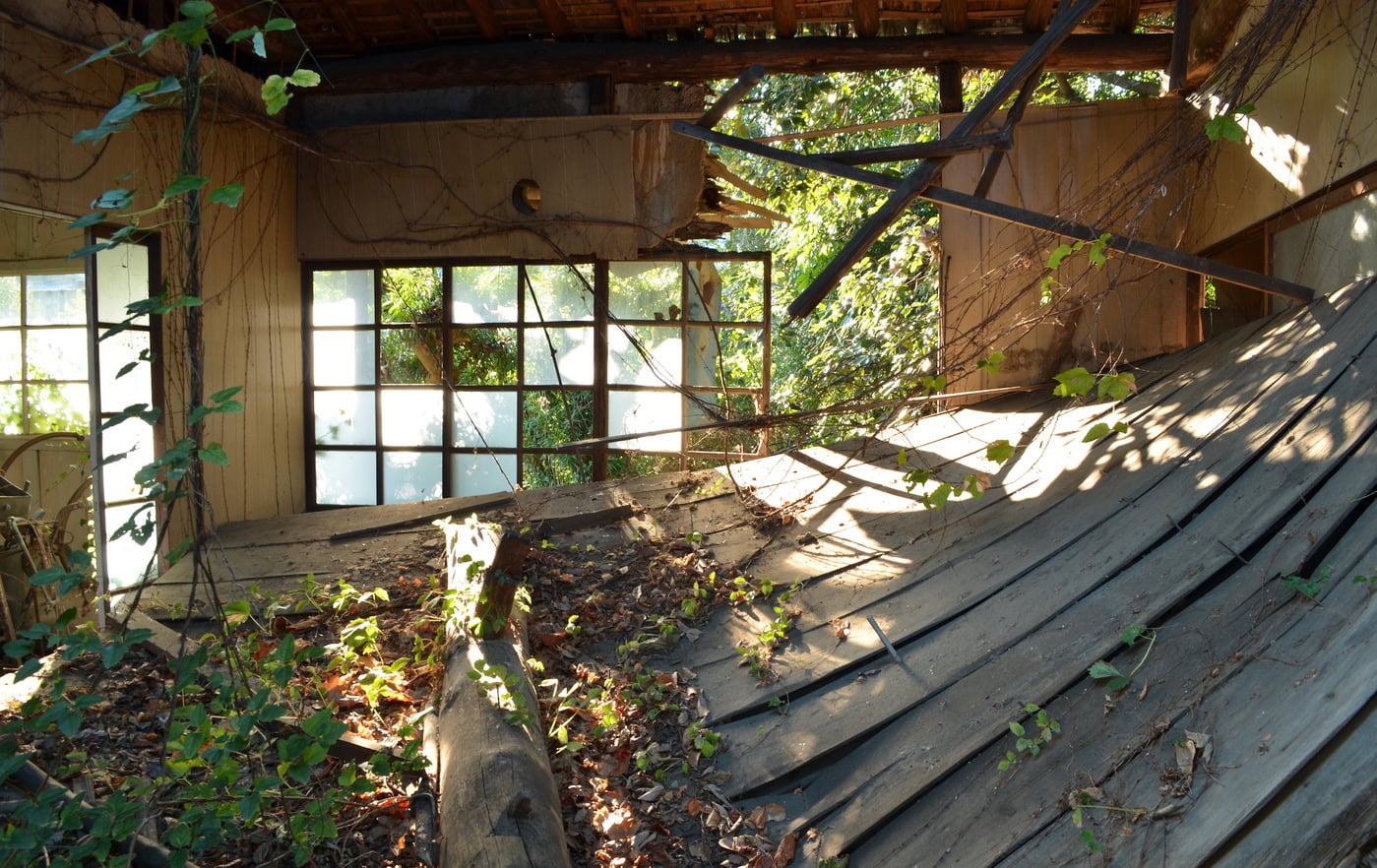
An abandoned house nearing collapse due to long-term neglect
As readers may already realize, applying for the appointment of an estate administrator carries significant risk because it requires paying a large deposit that may or may not be returned. In some cases, it may also require hiring a lawyer, and the entire process can take around a year, creating a high barrier to filing an application.
Even if a petition is filed, there is no certainty that creditors will recover what they are owed or that all assets will ultimately be disposed of. As a result, people may end up paying a large deposit yet still fail to achieve their original objective.
In Japan, this system is one of the important legal mechanisms for organizing real estate without heirs and potentially returning it to productive use. However, because of the high barriers described above—and because many people are not even aware that the system exists—it is rarely used in practice.
This situation is commonly seen in rural areas with declining populations and large numbers of vacant homes, but it can also occur in urban areas. Even properties in highly desirable locations may remain abandoned and unused under these circumstances.
When a deceased property owner leaves behind large debts, creditors are more likely to initiate the estate administrator process in an attempt to recover what they are owed, meaning such properties may still have some possibility of returning to the market. The greater challenge facing Japan is how to return the far larger number of abandoned properties that do not fall into that category back into productive use.
