

 日本語
日本語 English

We have long thought of buildings as extensions of ourselves: corridors sized for human strides, doorways that frame our gaze, ceilings that contain our reach. Yet the world is quietly changing. Increasingly, our spaces must accommodate intelligences that do not inhabit our bodies, feel our sensations, or perceive our world. Robots that move with algorithmic precision, synthetic organisms that respond to stimuli unfamiliar to us, and forms of artificial life that challenge every assumption about scale, movement, and perception—all demand environments designed on principles beyond human intuition. Architecture, in this emerging frontier, becomes a bridge between species of mind: a place where humans and non-humans coexist, where surfaces, volumes, and pathways are conceived not merely for our convenience, but for intelligences whose desires and needs are invisible to us.
Danya Deluca, CEO of Kakarobot ID based in Indonesia, imagines buildings for non-human entities by deliberately removing human bias from the design process.
“I don’t ask how a space feels, but how it functions—how an entity moves, senses, learns, and maintains itself,” said Deluca. “Instead of designing rooms or façades, I think in terms of flows, feedback loops, and operational efficiency. For me, architecture becomes a system that supports behavior and intelligence rather than comfort, and a platform that can adapt as the capabilities of the non-human entities evolve. In that sense, buildings are no longer passive structures but active participants in the intelligence of the system.”
The question is no longer simply how to build for people, but how to imagine a space that can think, sense, and respond differently, and yet remain habitable—a meditation on cohabitation in a world that extends far beyond human experience.
“If we were to design spaces for non-human intelligence,” said Kanika Parakh, a Feng Shui consultant based in the UAE, “the focus wouldn’t be on comfort or beauty; it would be on clarity. Spaces would need to be energetically neutral, free from excess, and responsive rather than expressive. This shift challenges designers to think less about how a space looks and more about how it behaves.”
The concept of designing spaces for non-human intelligences may seem futuristic, but elements of it already exist and can be extended in realistic ways. In modern warehouses, AI-driven robots navigate independently along precisely mapped floors, showing how circulation can be optimized for non-human users. Research laboratories often feature robotic arms that adjust workstations automatically, responding to the flow of tasks—an early example of buildings interacting with artificial life. Smart offices now monitor human movement, lighting, and temperature; these same systems could adapt to robotic schedules, changing lighting or airflow to suit machines’ needs. Even something as simple as a wall-mounted charging hub for autonomous delivery drones demonstrates how infrastructure can anticipate non-human presence.
Looking further, public spaces or transport hubs could feature adjustable corridors, sliding partitions, and modular surfaces that respond to robotic traffic patterns, or floors with embedded sensors that communicate with synthetic organisms to guide movement safely. Materials could be designed to interact with non-human sensors, reflecting light or texture in ways humans may not perceive, but which optimize non-human navigation. By examining these near-future adaptations, it becomes clear that architecture can gradually evolve from a purely human-centric practice into a shared environment that accommodates both people and artificial life.
In Amazon Robotics Warehouses worldwide, entire warehouse floors are designed for AI-driven robots that move shelves and goods autonomously. The layout, corridors, and charging stations are optimized for robotic efficiency, demonstrating how architecture can prioritize non-human traffic patterns while still accommodating human oversight.
The Autonomous Vehicle Infrastructure in Abu Dhabi’s Masdar City is a planned city with roads, walkways, and intersections embedded with sensors and dynamic guidance systems for self-driving pods. Buildings and pathways are designed to anticipate non-human navigation, integrating AI-controlled signaling and adaptable routes to optimize movement and safety for autonomous vehicles.
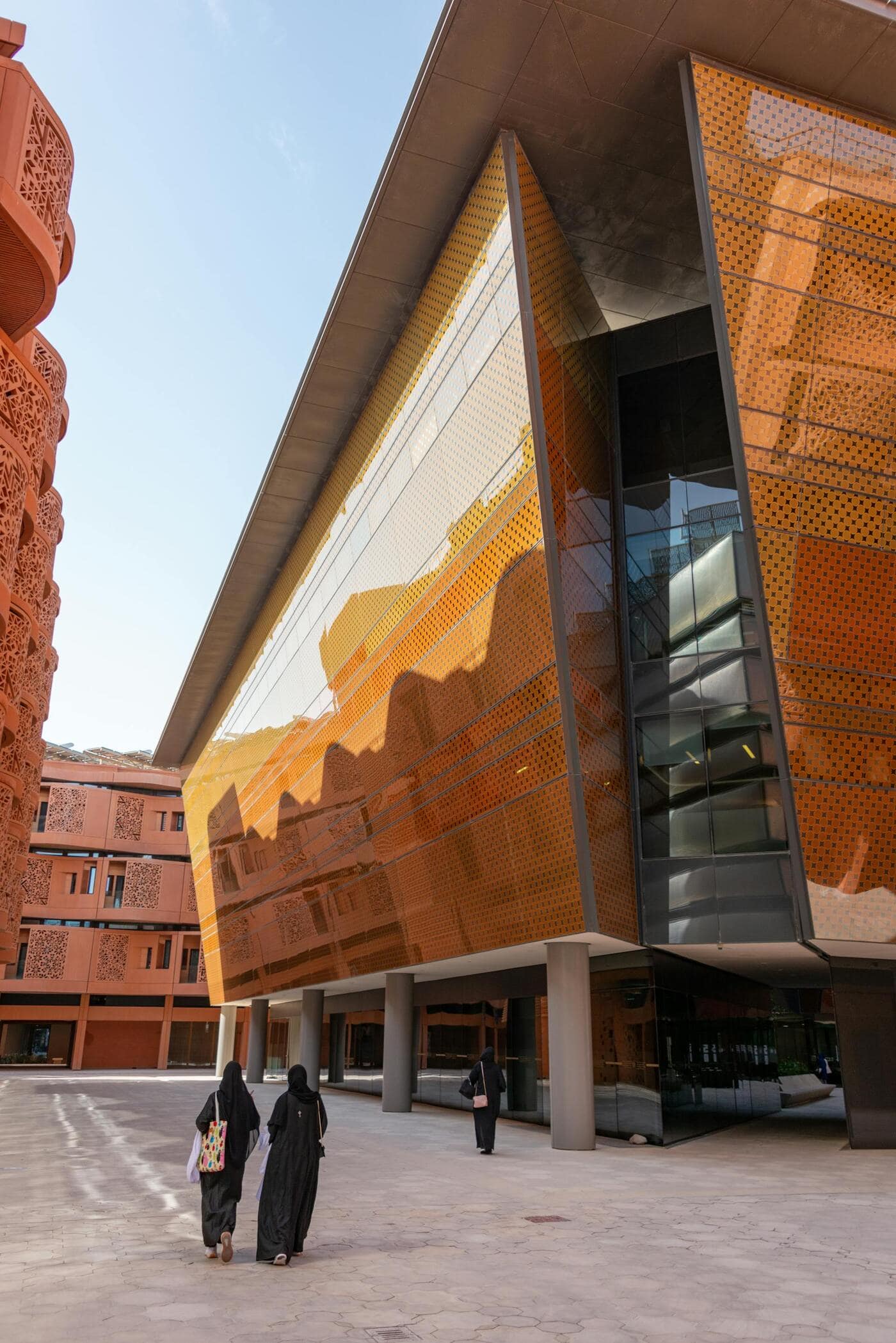
Women walking near a modern building in Masdar City
Ocado Smart Warehouse in Hatfield is a grocery fulfillment center that uses a massive grid system, where hundreds of AI-driven robots move goods on automated carts. The entire floor layout, including storage towers and retrieval paths, is designed for robotic efficiency, minimizing human intervention while maximizing robotic flow.
Toyota Woven City in Susono, Japan is a living laboratory designed for autonomous vehicles, robots, and smart infrastructure. Roads, sidewalks, and building interfaces are planned to accommodate both human residents and AI-driven transport, creating a real-world environment where humans and non-human agents coexist seamlessly.
Architecture is quietly awakening to forms of intelligence beyond our own. Warehouses, labs, and emerging cities already hint at spaces that respond to robots, AI, and synthetic life, reminding us that buildings need not serve only human bodies or routines. As designers experiment with surfaces, sensors, and shifting layouts, architecture begins to think alongside its inhabitants, creating a world where intelligence—human or otherwise—can coexist, converse, and even surprise. In this vision, our buildings do more than shelter: they extend our understanding of presence, perception, and what it means to truly inhabit a space.
Interviewees:
Danya Deluca, CEO of Kakarobot ID based in Indonesia 34,000 followers on instagram alone, her business account(Kakarobot ID) has 104,000 followers https://tinyurl.com/4pfwnj7b
Kanika Parakh, a Feng Shui consultant based in the UAE 30,000 followers on instagram alone https://tinyurl.com/2kcpnme6

![シビック・クリエイティブ・ベース東京[CCBT]が2026年度CCBTアーティスト・フェローを募集](https://www.adfwebmagazine.jp/wp-content/uploads/2026/03/adf-web-magazine-ccbt-2026-fellow-1-300x169.jpg)