

 日本語
日本語 English

A new ceramic museum, UCCA Clay, by Kengo Kuma
Conceived by Kengo Kuma & Associates, UCCA Clay is a new ceramic museum that serves as a gateway between the millennia-old heritage of Yixing ceramics and contemporary artistic experimentation with clay. The museum opened in December 2024, covering 3,437 square metres in the heart of the old industrial complex in Dingshu Town, Yixing, Jiangsu Province, just 2 hours from Shanghai by high-speed train.
The museum is part of a broader master plan to revitalize the small town and establish an international cultural hub dedicated to ceramics. The vision includes ateliers, workshops, and art residencies hosted in the spaces of the decommissioned industrial centre, formerly known as Yixing Zisha Craft Factory No. 2. This location was once a vital centre of Yixing’s ceramic tradition, renowned for its use of Zisha (紫砂), or purple clay, a locally sourced mineral, internationally known for its rarity and exceptional properties, especially in tea brewing.

UCCA Clay, Kengo Kuma Associates, ph. Amedeo Martines, April 2025

UCCA Clay, Kengo Kuma Associates, ph. Amedeo Martines, April 2025
The museum rises from the ground like an earthenware mound, echoing the contours of the surrounding hills and the ancient mining sites where locals once extracted Zisha, purple clay. A continuous, sculptural surface, what Kengo Kuma and his team refer to as “an inverted shell structure”, defines the building, acting as both roof and walls and imbuing the architecture with a sense of dynamic movement. High arches rise from this structure, offering visitors shade and shelter from the rain and framing a courtyard with a café near the entrance. Moreover, three small water basins punctuate the landscape, reflecting the building’s fluid geometry and further emphasizing the materiality of the construction.

UCCA Clay, Kengo Kuma Associates, ph. Amedeo Martines, April 2025
To further amplify this effect, 3,600 ceramic tiles cover the museum’s exterior, arranged in a pattern that recalls dragon scales or the stratified layers of a clay mineral lattice. The tiles vary in colour, ranging from bright oranges to red, with subtle shades of white and black, each meticulously crafted by local artisans. This approach embodies what Kengo Kuma and his team describe as the “warmth of craftsmanship,” emphasizing the uniqueness and artisanal quality of handmade earthenware tiles over the uniformity of industrial mass production. Furthermore, on one side of the museum, many tiles have been decorated by children and residents, with carved patterns and drawings embedded into the clay. This community-driven initiative invites younger generations to engage with Yixing’s ceramic heritage and strengthens a collective sense of belonging through the new museum.

UCCA Clay, Detail of the tiled wall, ph. Amedeo Martines, April 2025

UCCA Clay, Detail of kids drawing on tiles, ph. Amedeo Martines, April 2025
Upon entering the building, the museum’s supporting architecture is revealed: a wooden skeleton composed of four layers of lightweight yet robust lattice beams woven together. This innovative framework allows for remarkable structural efficiency, enabling open exhibition spaces free of obstructive columns or beams. Soft natural light filters through skylights, enhancing the warmth of the recycled brick flooring, which contrasts elegantly with the glass balustrades and grey concrete walls.

UCCA Clay, Indoor View 2nd Floor, ph. Amedeo Martines, April 2025
Currently on view until June 15 is The Jealous Potter, an exhibition that brings together the work of eleven international women artists working across sculpture, painting, installation, video, and community-based practices. While diverse in medium, all the works explore the profound and multifaceted relationship between women and ceramics.
The exhibition borrows its title from a book by French anthropologist Claude Lévi-Strauss, and examines ceramics through the lenses of history, materiality, and gender. It focuses on the technological and philosophical significance of pottery, containers and their uses. Specifically, long associated with femininity, pottery invokes themes ranging from fertility worship to domestic labour, linking the vessel to a dual symbolism of containment and concealment. At the heart of this transformation is fire, the elemental force that turns raw clay into a lasting form.

The Jealous Potter, Exhibition entrance, Helmet by Zhang Yibei, ph. Amedeo Martines, April 2025

The Jealous Potter, Second Floor, Icicle Flame Vessel by Heidi Lau, ph. Amedeo Martines, April 2025
Ceramics have been used for thousands of years across cultures worldwide, but their characteristics and quality vary significantly depending on the raw materials and firing techniques. In Dingshu Town, Yixing, ceramic production in the area dates back around 7,000 years, to the mid-Neolithic period, when early pottery featured simple striped and dotted patterns. The discovery of Zisha (紫砂) during the Song and Yuan dynasties (circa 960–1368 AD) marked a turning point, laying the foundation for Yixing’s famed teaware tradition.
Today, a comprehensive master plan revitalizes Dingshu Town, Yixing, and its ceramic heritage. Many ancient clay mines, once shut down due to over-mining and ecological damage, have been transformed into green parks and public spaces. These sites now invite visitors to walk restored paths, discover the unique properties of Zisha, and engage with educational displays that celebrate the region’s rich ceramic legacy.
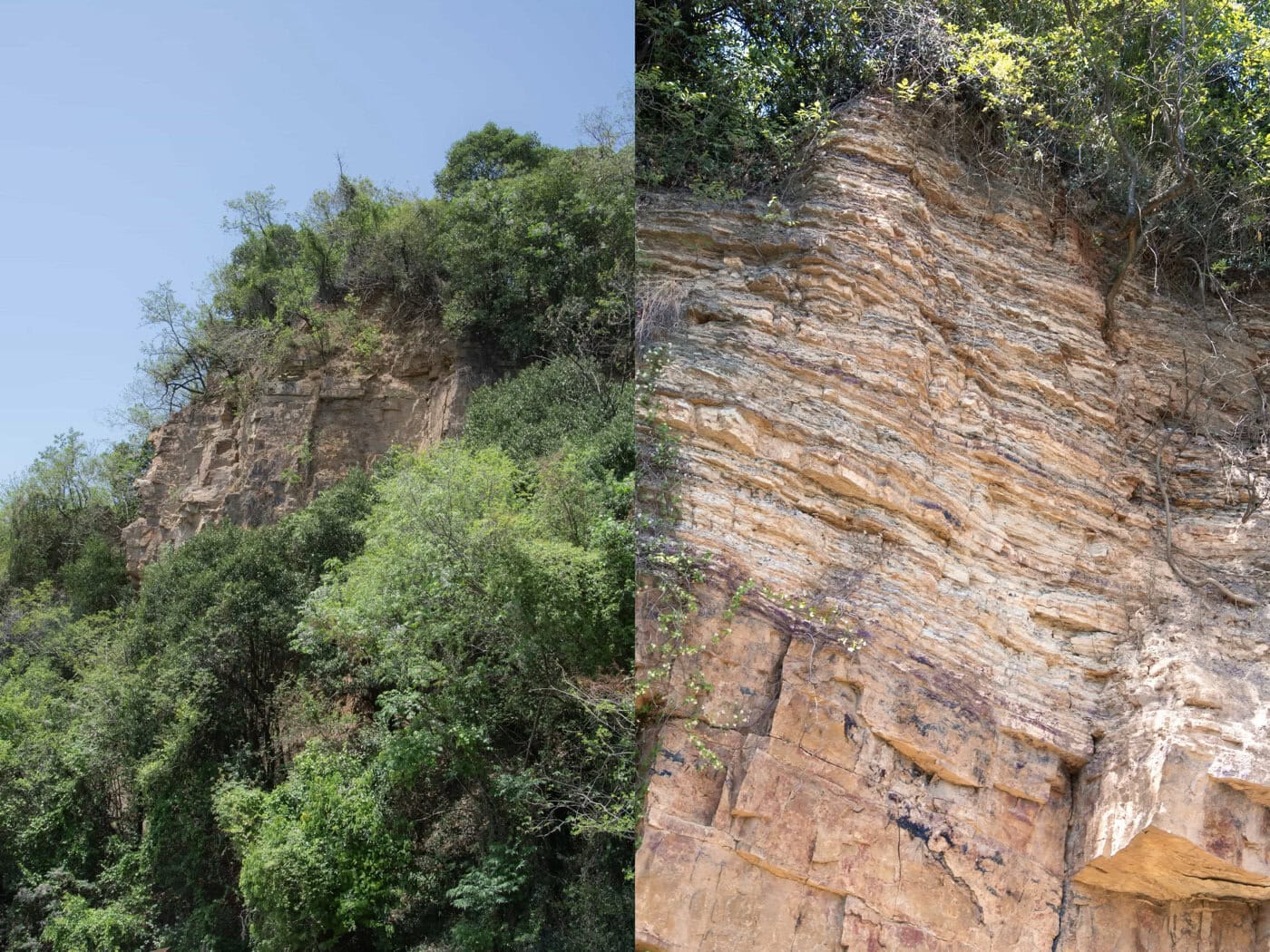
View of Huanglongshan, Different coloured layers of Zisha, purple clay, ph. Amedeo Martines, April 2025
Huanglongshan (黄龙山) stands as the most important and historically significant source of purple clay. Known as the original mountain (Benshan, 本山), it provided the most prestigious purple clay used by generations of artisans. Mining stopped in the early 2000s, but the site recently reopened as a public park. Visitors can walk past the entrances to the old mines and examine the original tools and equipment once used to refine the clay. A raised walkway guides visitors through the landscape, circling a large mine lake and skirting exposed rock faces where visible clay seams reveal the striking geological layers and colours that define Zisha.
Just nearby, the newly opened Purple Clay Mineral Museum (紫砂矿物博物馆), designed by Atelier XÜK, offers an in-depth look at the material from a scientific perspective. On both tactile and analytical levels, visitors can engage with the clay material through instruments, such as microscopes and hands-on experiences with test tiles. The museum offers insights into the relationship between clay and teapots, as well as the physical and chemical phenomena that constitute purple clay.

Inside the Purple Sands Mineral Museum by Atelier XÜC, Immersive and haptic exhibition, ph. Amedeo Martines,
April 2025
Zisha (紫砂), purple clay, is renowned for its variety of colours and physical properties, which depend on the depth at which this mineral is mined. The main types include Zini (紫泥), a deep purple-brown clay; Hongni (红泥), which ranges from orange to red; and Lüni (绿泥), a pale yellow to beige clay.
Additional variations of Zisha range from very dark to light hues, with colours spanning from grey to brown. These tones are typical of other ancient mining sites, such as Qinglongshan (青龙山), and contribute to the diverse palette of Yixing ceramics. Qinglongshan also holds historical significance in the development of Yixing pottery. Archaeological finds of proto-Zisha ware fragments, fired in traditional dragon kilns and dating back to the Song dynasty (960–1279 CE), reveal early techniques and materials that laid the foundation for the craftsmanship behind the iconic Yixing teapot.

View of Qinglongshan, mining carts and rails, ph. Amedeo Martines, April 2025
Regardless of colour, all purple clays share essential qualities once fired: natural porosity and breathability, excellent heat retention, and exceptional durability, traits that make them ideal for high-quality teaware. When combined with skilled craftsmanship and slab-building techniques, these unglazed teapots are fired at high temperatures, resulting in a porous structure that gradually absorbs the tea’s natural oils. Over time, this interaction deepens the teapot’s colour and enriches the aroma and flavour of the tea, often making it preferable to traditional metal teapots. As a result, tea connoisseurs often dedicate a single teapot to one type of tea, allowing the vessel to develop a distinctive patina, becoming truly invaluable.
Whether a ceramics enthusiast or a curious traveller, visitors will find Dingshu Town an ideal weekend escape from the hustle and bustle of metropolitan Shanghai. Despite its modest size, the town strikes a remarkable balance between nature and culture. Its mountainous landscape and recently opened parks invite visitors to explore unique geological formations and rich clay deposits on long, scenic walks.
Meanwhile, the newly opened UCCA Clay Museum, designed by Kengo Kuma & Associates, marks the transformation of a once-abandoned industrial site into a vibrant hub for contemporary ceramic art. The building itself is a striking architectural statement, drawing visitors from across China to experience its distinctive form and rediscover the legacy of Yixing ware.

UCCA Clay, Kengo Kuma Associates , ph. Amedeo Martines, April 2025
Links
UCCA Clay Museum, Kengo Kuma Associates: https://kkaa.co.jp/en/project/ucca-clay-museum/
UCCA Clay, The Jealous Potter, exhibition: https://ucca.org.cn/en/exhibition/the-jealous-potter/
Yixing Ceramic Residency: http://yxccca.com/gywm
Atelier XÜC: https://www.dezeen.com/2025/04/07/atelier-xuk-huanglong-mountain-zisha-mineral-source-museum/

