

 日本語
日本語 English

Creative project: “A Grain Of”
"A Grain Of" is a research-based creative project by Enza Migliore, who will be quoted here as EM, and Marcel Zaes Sagesser (here MZS), who met at SUSTech, School of Design in Shenzhen, China. Enza is a design researcher and educator exploring materials through interdisciplinary and empirical practices. Marcel is an artist and researcher investigating how humans are increasingly intertwined with their technologies, with a focus on sonic processes. They met when they were both Assistant Professors at the Southern University of Science and Technology, School of Design, Shenzhen. Enza continuously works in this function, building and growing her interdisciplinary research lab. Marcel is now professor in media at St. Pölten University of Applied Sciences in Austria. “A Grain Of” they established as a way to creatively explore their city, Shenzhen, in an idiosyncratic way that attends to their shared interests and skills. In late Spring, after several years of developing and internationally presenting results of the project, they decided to pause and together reflect on where the project is, why it might be a productive approach to sheding knowledge about a city, and where the project may go next. This conversation is in the spirit of this project about Shenzhen, as reflective moments between the two researchers had often occurred spontanously while they climbed a mountain, hugged a tree, or sat in a bar or a restaurant.

Left: Enza Migliore listening into a tree in Dongmen, Shenzhen’s historically densest market square (photo by the authors, Shenzhen, 2023)
Right: Marcel Zaes Sagesser conducting field recording in a fabric stall on Dongmen’s market (photo by the authors, Shenzhen, 2023).
Shenzhen, April 27, 2025
12:30 PM
Enza and Marcel
On a terrace of a typical restaurant in one of the many shopping malls.
Mosquitoes, heat, and tropical humidity.
MZS: “A Grain Of,” now a long-term project, has produced conditions for us to explore the city of Shenzhen, where we live and work. Our initial motivation stemmed from our curiosity in collaboration. With it, we wanted to define ways in which digital media and sound integrate with materials design and research. So, we started sampling the city based on our respective practices and research interests: we collected materials, digital artifacts, and sound in several locations around the city.
EM: It was August 2022, raining and very hot that day. Jason, who worked as a translator at the SUSTech School of Design at that time, accompanied us to help translate from Chinese in case we needed it. We considered how people would react to seeing two foreigners sampling water and soil from the street and fountains while recording public space with microphones. He also helped us take notes and record precise location data in our fieldnotes sheet. This is how our big data archive started. We couldn’t imagine it would grow to be as rich and extensive as it is now.

Photo: first sampling activities in Shenzhen’s Bao’an district during a hot August afternoon with heavy rain; visible is a street puddle that provides water, soil, and mixed industrial samples (photo by the authors, Shenzhen, 2022)
In retrospect, we were testing methods at that time. We identified soil and water as the materials carrying the “DNA” of the environments, including the city’s environment, and sound as the “unseen”, yet substantial matter of our experience and perception of the world. Also, at that time, we discussed the meaning of selecting locations for our fieldwork.
MZS: Sampling the city evolved from a preliminary methodological test into a large-scale practice that has come to define “A Grain Of”. Although we integrated scientific methods for conducting sampling, we never intended it to become a strictly scientific project. The main reason is simple: we are not scientists and were interested in open-ended exploration rather than falsifying hypotheses. We were driven by the aspiration to collect as much as possible and as many different types of data as possible: soil, water, and their sounds as foundational elements, along with a variety of natural and synthetic substances regularly encountered in urban spaces, such as environmental data including temperature, humidity, and media recordings. To date, we have created an extensive archive, and we could say our project is also about building a large-scale data collection about a single city, Shenzhen. Another part of the project is to explore ways to interpret and use the collected data in manifold ways.

Left: Fragment of pavement, collected in Shenzhen’s Qianhai: material sample from the “A Grain Of” archive (photo by the authors, Shenzhen, 2024)
Right: Water collected from a canal in Shenhen’z Qianhai: material sample from the “A Grain Of” archive (photo by the authors, Shenzhen, 2024)
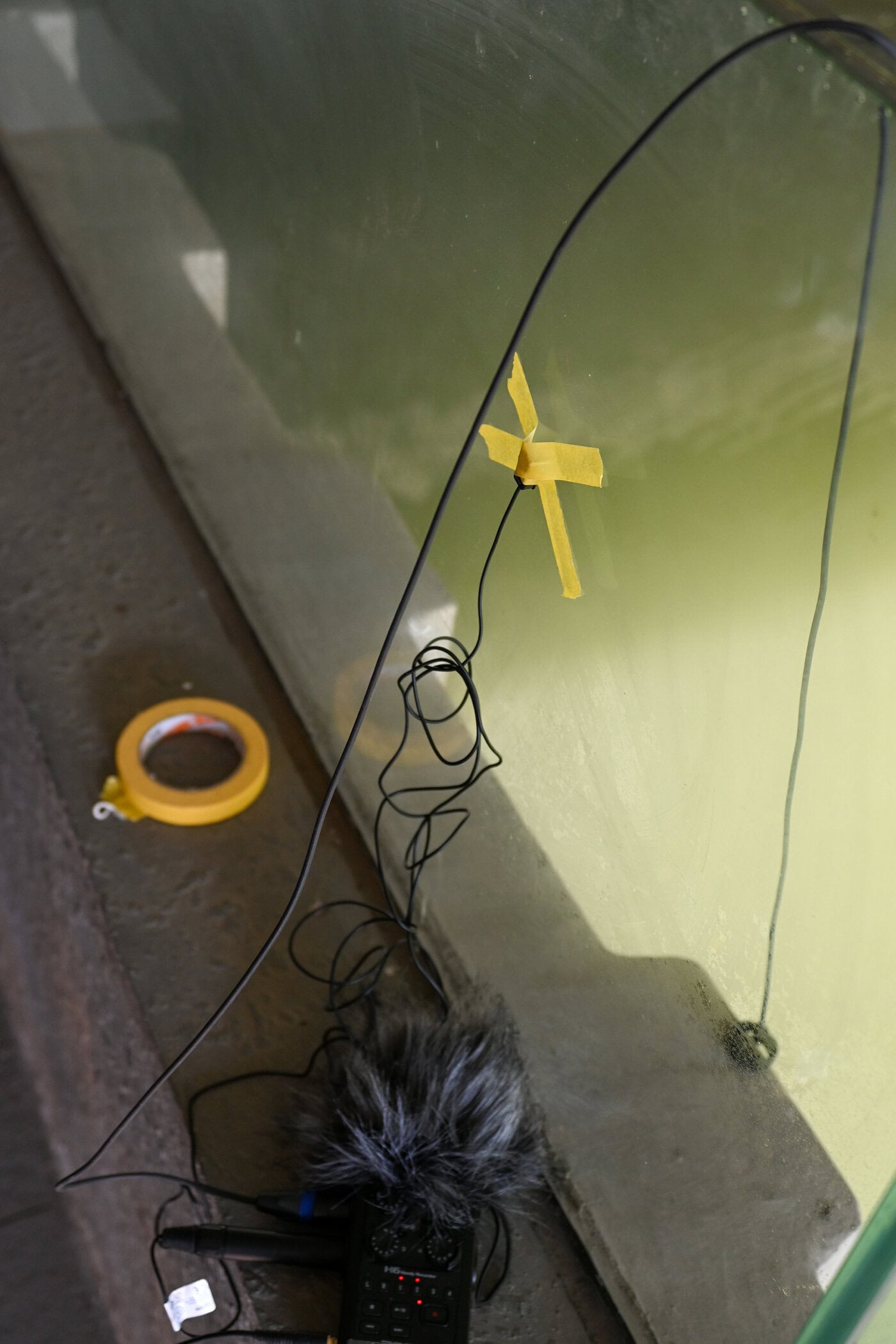
Contact microphone and underwater microphone, recording the sound of a canal under a bridge in Shenzhen’s Qianhai: part of data recordings of the “A Grain Of” archive (photo by the authors, Shenzhen, 2024).
EM: We could say that, once we realized we had built a large dataset and were looking for methods and perspectives on how to use them creatively, our study became an opportunity for epistemological reflection and conversation, together with a growing interdisciplinary team, composed of sound artists, designers, and media artists.
From the very beginning, we aimed at utilizing data to render the invisible, inaudible, and overlooked accessible through sensorial experiences. The first attempt focused on capturing the entanglement between the organic and inorganic nature of urban matter, especially in a city like Shenzhen, where tropical forests and high-tech parks coexist.
We consulted a scientist, Massimiliano Galluzzi, an expert on Atomic Force Microscopy from the Shenzhen Institutes of Advanced Technology, and analysed soil and water samples using an Atomic Force Microscope. This process made us realize our priority was interdisciplinary dialogue, approaches, and inquiry, rather than the data itself.

First data materialization of Sample #1, wet vegetal matter under decomposition (soil #1). The data obtained from the Atomic Force Macroscope are translated into 3D models through additive manufacturing. 3D printing, opaque white resin, 2022.
MZS: Once we had access to a material science lab with sophisticated machines to analyse our samples, a common scientific question emerged: what is the hypothesis that we try to validate? So, the project challenges standard scientific practices by intentionally dropping a fixed research question. Instead of pursuing specific answers, it adopts an open-ended, creative approach that is more common in art and design. By doing so, it acknowledges the layered complexity of urban environments, allowing their richness to emerge naturally rather than forcing them into predefined questions.
We sought to explore the natural and the urban, the hybridities and complexities within the city’s fabric, without imposing a rigid research framework. We invited scientists to analyze these samples without a specific question in mind, encouraging an open-ended examination to see what questions might emerge naturally from the processes themselves. We introduced gentle prompts for ourselves—centered around themes like nature, urbanity, and hybridity—to guide their examination. Our goal was not merely aesthetic outcomes but to facilitate a form of inquiry that remains open to unexpected discoveries, allowing the material to speak for itself, and, for example, to reveal the intertwined layers of urban and natural phenomena in our samples, and particularly, across the various media of our samples.
In essence, the project invites us to reconsider how knowledge can be generated—not solely by seeking answers but by embracing complexity, ambiguity, and the inherent questions embedded within urban environments themselves.
EM: “A Grain Of” is an approach that we have developed into a reproducible methodology. This methodology allows us to analyze and interpret the material aspects of the city in various ways, making its complex, layered qualities accessible and perceivable. The extensive archive comprehends tangible, original samples of materials (soil, water, industrial debris, etc…), sound recordings, media contents (photos, videos), 3D scans.
We have produced several speculative and experiential artifacts following the same methodology: data from selected samples have been transformed into objects that offer audible, visible, and haptic experiences of the city. A 3D model of the original substance is scaled and mapped with the sound recorded through it and close to it. The model is then 3D printed and extended with electronic parts, including speakers and sensors, to render an original experience of the urban matter. This methodology allows us to produce infinite experiences, depending on the sample selection and the design decisions: combination of original and synthetic sound, types of interactions, scale and numbers of the objects shown together.
In retrospect, we have questioned mainstream data visualization and quantification, instead exploring poetic, sensory, and hybrid approaches to presenting data.

Re-meshing of the 3D scan of the sample “No. 12/11 W4 102”, as presented at Shenzhen Design Week 20024 (screenshot from Blender, by the authors, 2024)

Spectrogram of combined environmental audio and vibration recording at a sampling location in Shenzhen, spectrogram made with Sonic Visualiser and then extrapolated into a 3D model in Rhino/Blender. Spectrograms were used to interface intangible sonic matter with material remains of the city; in software they were mapped onto 3D scanned artifacts (screenshot from Rhino, by the authors, 2023)
MZS: Ambiguity and fluidity are fundamental aspects of the project, whose aim is to challenge and go beyond traditional categories and dichotomies. However, it is all too easy to fall into narratives that oppose nature and the artificial, organic and inorganic, or humans against other living beings. Guided by a strong desire to distance ourselves from these binary stereotypes, we embraced the materiality of the city in its full ambiguity and complexity – or at least tried to deliberately avoid attempts at purification, simplification, or reduction. We engaged with data and materials driven by a fascination for their inherent ambiguity, presenting them as they manifest, with the sole aim of provoking curiosity, visibility, perceptibility – encouraging questioning and stimulating sensory engagement. Then, the question emerged, what is it that we are offering to our audience? Why should they look and experience the city through our project’s artifacts, instead of accessing the city directly?

A computational rendering of a 3D printed artifact from the series, presented under the title “Can We Still Hear the Ocean? How the Artifact Q4 #101 Translates Shenzhen Underwater Recordings into an Interactive System” at the “Designing Interactive Systems 2025 Conference” in Madeira, Portugal, 2025. Recordings of underwater sound recordings from a canal in Shenzhen’s Qianhai were transformed into an interactive artifact called “Q4 #101”, which features audio data rendered as an abstracted spectrogram, 3D-printed in transparent resin, and houses microelectronics and miniature loudspeakers emitting the sound in the exhibition gallery.
EM: We are offering a lens and a framework to interface the urban space, which has been defined through the accumulation of data, conversation, reflections, cross-disciplinary collaborations, large-team-work, a combination – or most likely a hybridization – of quantitative and qualitative methods. The main question, perhaps, is to whom? To the general public to discover and reflect on their cities, to the creative community of artists and designers to explore and rendering data, to the scientific community to open up new research questions, or cross-disciplinary perspectives?
MZS: Natural and social sciences provide numerous methods and tools for studying and understanding the environment. Ethnographic research, in particular, allows for a deeper understanding of the relationship between humans and their surroundings by observing, documenting, and engaging with people. Natural sciences adopt sampling methods to study specific aspects of our natural and built environments. Archeology combines methods of social sciences and humanities with techniques of natural sciences to study culture through material remains. Our approach adopts an even broader range of practices. We could say, we have been testing ways of accessing and sharing the unseen and unheard in Shenzhen through its tangible and intangible materialities.
EM: Our approach to sampling diverges from traditional fieldwork methods typically utilized in the natural sciences, which focus on quantitative specimen collection and laboratory analysis. Instead, we undertook the sampling of urban materials in a qualitative, humanistic manner. Moving beyond standard ethnographic inquiry, and incorporating both tangible and intangible elements—such as collected objects and soundscapes—we considered whether our process constitutes co-creation of narratives and experiences with the city itself. This prompts reflection on whether we have successfully established a distinct “qualitative sampling” methodology.
MZS: After three years, through international conference and exhibition presentations, our approach has been accepted in research and creative communities alike. Now, looking back as much as forward, what are the project’s main contributions and future prospects? One of the most significant impacts may have been on a personal level, as our idiosyncratic in-depth engagement with “our” city has provided unique insights. Next, there is potential for our approach to be applied to other cities as well and test whether it withstands iteration. It would also be valuable to see how others use our method in their own ways to study urban spaces.

Spectrograms of eight different audio and vibration recordings from a canal in Shenzhen’s Qianhai; underwater, contact, and ambient microphones were used alternatively; the waveforms show continuous noise intersected with temporary peaks indicating foreground activity both under and above the water surface (screenshots made by the authors, Shenzhen, 2023)

The landscape of one of the sampling locations, in Shenzhen’s Qianhai, close to one of the container ports, looking north towards the airport, at sunset (photo by the authors, Shenzhen, 2025)
Conclusion
“A Grain Of” is simultaneously a method, an approach, and a perceptual experience. As a method, it guides designers and artists to explore their surroundings through self-reflection and an open-ended process, translating their insights into a shared experience and vision. As an approach, it enhances interdisciplinary research done in teams and allows for the integration and sharing of diverse perspectives, thus it contributes to diversifying research practices. As a perceptual experience, it provides the general public with opportunities to engage with a city in poetic, multisensory ways, encouraging new and different ways of understanding the environment.

