

 日本語
日本語 English

A Paris exhibition explores how nothingness can carry beauty and truth
We humans instinctively tend to conceive the world around us through linear and progressive patterns: aiming for evolution, refinement, greater coherence or harmonisation, we trace trajectories that go from the periphery to the centre, multiplicity to unity, darkness to light... This is the principle behind many works of art, from Dante's Divine Comedy, where the journey of the soul ascends from the darkness of Hell to the bliss of Paradise, to Goethe's Bildungsromans, where man is a chaos that becomes order through contact with the experience of the world. In art history, Vasari’s Lives follows this same pattern: art climbs upward from Cimabue to its peak in Michelangelo, before falling into an inevitable decline. Many aesthetic theories shared this view, treating artistic movements as if they were living beings, each with a birth, maturity and decline, as if every era had its own inevitable life cycle...
But is this really the case? In the twentieth century, German art historian Wilhelm Worringer wrote a key essay, Abstraction and Empathy, where he argued that humans become artists to express a deep psychological need tied to how they see the world and their place in it, oscillating between two basic poles. The first pole, empathy, corresponds to identification, naturalism and figuration: it manifests itself when humanity feels in harmony with the world, secure, and confident in life and in their ability to affect reality in a positive way. This is the kind of art seen, for example, in classical Greek sculpture, or in Piero della Francesca's Urbino Diptych, where the compositional centrality of the two figures of the Dukes of Montefeltro reflects their confidence in the centrality of man in the cosmos, and his ability to govern it with rationality and moderation...

The second pole is abstraction, or the artistic expression experienced by man when he wishes to sublimate his anguish and disorientation towards a world that is perceived as chaotic and lacking meaning. The aim is no longer to represent reality as it is, but to pull away from it, reject it, or transcend it... This appears in the hieratic nature of Byzantine art, with its frontal, spiritual figures, and in many post-war movements, from Pollock's formless chaos to the figurative rarefaction and existential void in later movements... It is this last aesthetic category - emptiness - that is explored in an exhibition at the Orangerie in Paris entitled Dans le flou. In a Western culture that has often celebrated fullness and completeness, what place has emptiness in art?
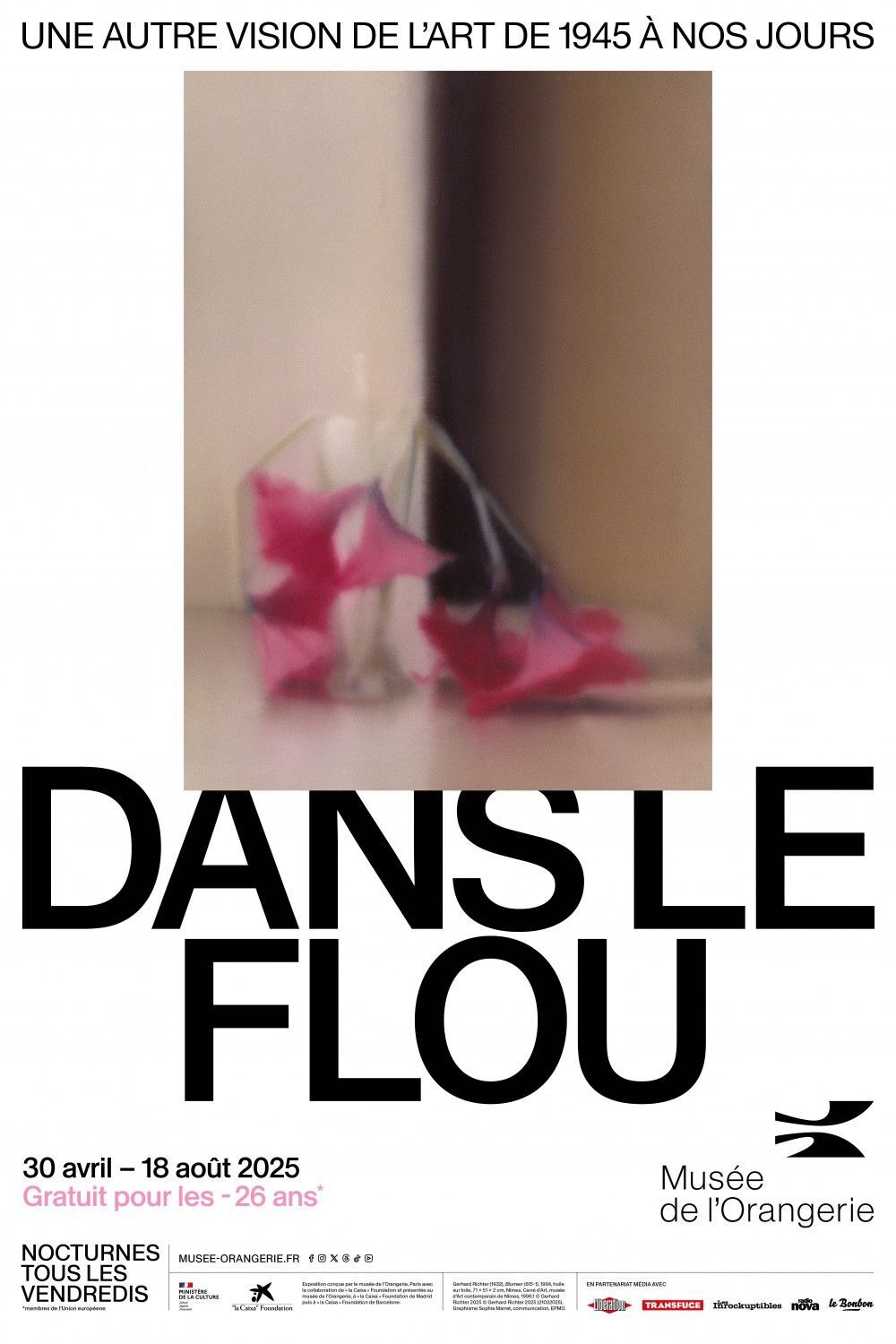
The exhibition at the Orangerie follows a thematic path rather than a chronological one. The first room focuses on early signs of the aesthetics of emptiness, which reach back well before the modern era. It suffices to think of Leonardo’s sfumato, set against an aesthetic tradition based on clarity of line, or the works of J.M.W. Turner, where paint dissolves completely in the fury of colour and light...

The real starting point, though, is the abstraction of Monet's Water Lilies, on view right in the Orangerie, where the viewer’s gaze sinks into water lily ponds stripped of all spatial anchors like edges or horizon lines, making the scene feel infinite, abyssal, detached from any recognisable link with objective reality - abstract, as Monet put it, as “an endless whole, a wave without horizon or shore”...
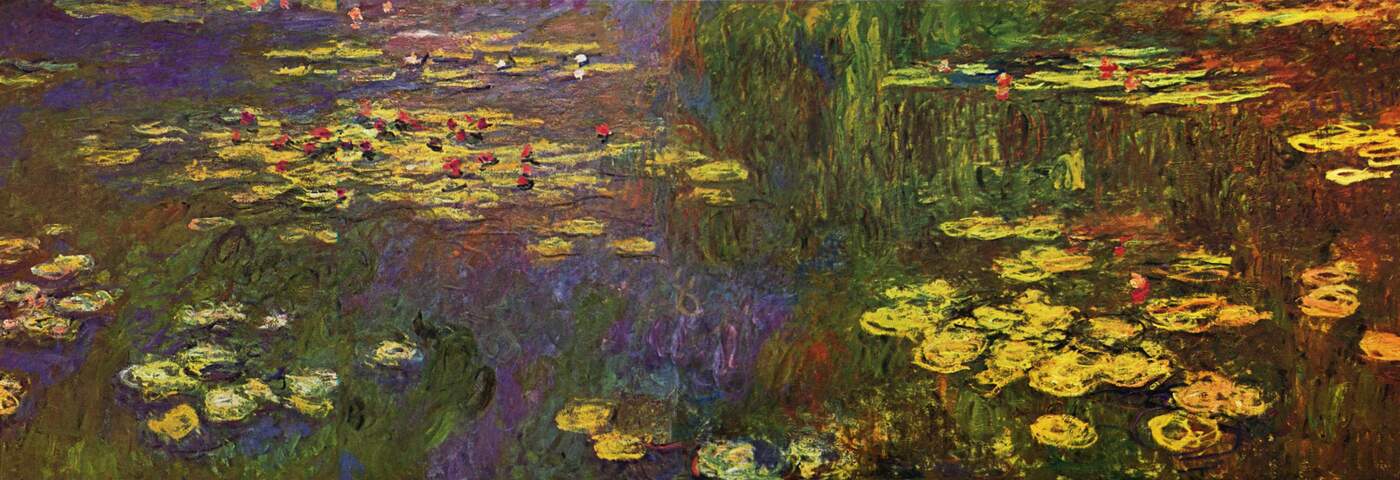
Monet’s abstraction, though, still carried a hopeful view of the world - he envisioned the Orangerie as a space for quiet contemplation and peace. But within only twenty years, the situation to be radically reversed: after the material and moral ruins of the Second World War, abstractionism, indistinctness and indeterminacy became the aesthetic categories best suited to express the erosion of the certainties of the visible. Emptiness, with its silent sublimity, became both a symptom and a remedy for a world hungry for meaning...
The human spirit, on the other hand, constantly seeks to push emptiness away. The English Romantic poet John Keats believed that a true artist is only someone who, in the spirit of negative capability, can stay “in uncertainty, in mystery, in doubt, without the impatience to run after facts and reason”. It’s a state that often makes us humans anxious, vulnerable and disoriented: for this reason, we want to build certainties, fill every empty space with explanations, structures, philosophies... But what if we learned to inhabit the void, without immediately saturating it, and allowing us to penetrate the depth of ourselves and reality? This is what many contemporary artists did, including Mark Rothko, who, with the lyricism of his deep, fluctuating fields of colour, chose to evoke instead of depicting...

Vincent Dulom, working with a single stroke of pigment pressed onto canvas, created images where forms slowly dissolve, blurring the line between presence and absence, figure and ground. In this way, Rothko and Dulom pushed the viewer to reconsider their own perceptual automatisms, bringing their gaze back to its origins, to its fragility, but also to its ability to embrace ambiguity and shadows: art, in this way, does not fill the void, but inhabits it, listens to it, transforms it a space of possibility.

Emptiness, therefore, can reach deep into our humanity - as individuals, but also as a collective body. In a century fractured by the discovery of the concentration camps, the detonation of the atomic bomb, and the need to represent what cannot be represented, emptiness took on a political weight and became an indispensable and necessary strategy. By questioning the status and value of the image, artists promoted a poetic and disenchanted vision of the tragedies of the 20th century, up to the most current crises. Art, in this sense, can become a tool to veil a reality that the gaze, and our spirit, cannot easily bear. This is the case in Six Seconds by Alfredo Jaar, where the Rwandan genocide is approached through the figure of a girl shown from behind. Her pain is so inexpressible that it translated into a final, sudden and definitive gesture: the refusal to tell her story to the photographer and to be represented, a silent distancing that speaks louder than any words...

At the same time, through emptiness, art can also force the observer to take note of the alienating mechanisms that humanity has set in motion, pushing us to reflection ... This is the case with Polvere by Claudio Parmiggiani, one of the greatest interpreters of Arte Povera, a movement that rejected the destructive processes of industrial and consumerist society by adopting poor materials and simple techniques, thus escaping the logic of mass production. In Polvere, Parmiggiani burnt a bookcase filled with books, letting a thin layer of soot settle across the shelves; when the bookcase was removed, a faint imprint remained on the wall, a fragile shadow of what was once there. The artist later commented on the work: “All that remained were the shadows of the vanished forms, like the shadows of human bodies vaporised on the walls of Hiroshima”...
 The exhibition can be considered in this way a eulogy to the indistinct, and an invitation to enter it fully and embrace its poetry. However much we try to de-fine it, making it finite, the world is in fact in-finite, both in time and space, filled by “endless spaces beyond that, and superhuman silences, and profound stillness”, as the Italian poet Giacomo Leopardi evoked in the 19th century. A space so vast in its extent and duration that “the heart is almost afraid”, and it is impossible to define it permanently and definitively... This holds true both in the macrocosm of the universe and in the microcosm of our inner self, which is fluid and constantly changing: we are no longer the people we were a year ago, nor those we were yesterday (panta rei!), in a state of indefiniteness that manifests itself in a constant state of change. Emptiness thus becomes a constant search for identity, as in Oana Hadjithomas' work Waiting for the Barbarians (2013), a video composed of hundreds of panoramic still images of Beirut, which, juxtaposed with a slight shift, generate a tension between immobility and movement, with an unsettling atmosphere that gets amplified by the synchronous reading of the poem Waiting for the Barbarians by Konstantinos Kavafis (1863-1933). In this work, emptiness is expressed in the layering of temporalities and spatialities, reinterpreting the past through the lens of Hellenic poetry to bring into focused the fractures of a present fragmented by violence, political upheaval and power struggles.
In conclusion, emptiness in art, suspended between what can be seen and what escapes the gaze, between what remains and what vanishes, is not simply a void, but becomes a fertile space for reflection, memory, contemplation and transformation. In it, we find a kind of questioning that brings the unseen wounds of our world into view and pushes us to embrace the indistinct and the unpredictable as fundamental, sometimes painful, but certainly fruitful conditions of our human experience. It is in this space, that we can inhabit and not reject, that the indefiniteness of existence unfolds, and with it, also the possibility of rebirth!

