

 日本語
日本語 English

Intimate Public Space - Rolex Learning Centre
Making news headlines in the design news section, Japanese architecture practice SANAA’s Taichung Green Museumbrary in Taiwan has taken center stage as one of the most anticipated building openings of 2025. Halfway across the world in Switzerland and completed sixteen years ago, the Rolex Learning Centre by SANAA was officially inaugurated in May 2010. Both projects were selected through international design competition routes; SANAA was announced as the winner for the Rolex Learning Centre in 2004 (project completed in 2010), whereas the Taichung Green Museumbrary announcement was made in 2013 (project completed in 2025). Incidentally, the inauguration of the Rolex Learning Centre coincided with SANAA’s receipt of the Pritzker Prize award. Last year, the practice led by Kazuyo Sejima and Ryue Nishizawa also received another industry award of recognition, the 2025 RIBA Gold Medal Award issued by the Royal Institute of British Architects (RIBA), further recognising their work in the architecture industry.
Rolex Learning Centre by SANAA. Image by Von Chua.
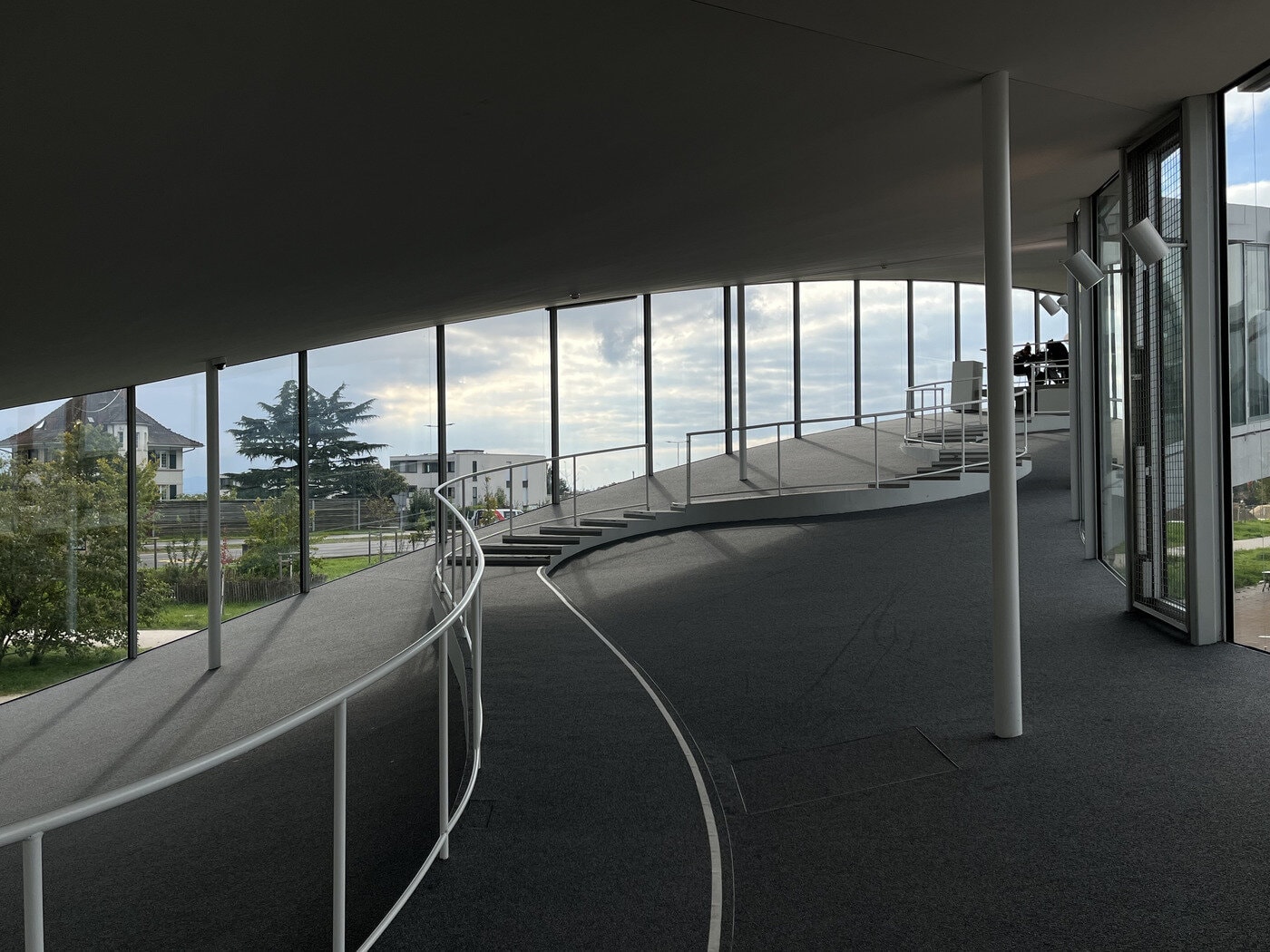
During the Rolex Learning Centre’s design competition announcement, the winning entry was described as an ‘intimate public space’. Having visited the Rolex Learning Centre in Switzerland a few months ago, one of the most unique perspectives of SANAA’s architecture is the public courtyard that one has to walk through, regardless of the direction of arrival. It is wide and open, welcomingly open yet sufficiently sheltered, located under the shade yet able to feel the cool autumn breeze. It left a deep impression on me as it provided a contrasting sensory change, much like when one enters a place of worship - typically opening a heavy door to enter a silent or acoustically-dampening space, a threshold that is typically low in lighting; the architectural transitions immediately creates a sound vacuum and contemplative lighting effect, especially when coupled with another set of sensory change - walking into a double or triple height volume spaces. The courtyard at the Rolex Learning Centre created a similar effect, in my opinion, in a barrier-free manner. Without touching a doorknob, SANAA’s architecture managed to evoke a heightened sensory change simply through a deliberate walk-in to the space that is meticulously designed. For now, I can only wonder what 15 additional years of experience and design intelligence may have been introduced into the Taichung Green Museumbrary project in Taiwan.
Despite its name, the Rolex Learning Centre actually has its roots in education. The building is part of the Ecole Polytechnique Federale de Lausanne (EPFL)’s library, learning hub and cultural center of the university. Costing 110 million Swiss Francs to build, it was funded by the Swiss government, as well as private institutions including Rolex, Nestle, Logitech, Credit Suisse, Novartis, Bouygues Construction, and SICPA. Located slightly out of the heart of Lausanne city, the building was easily commutable and surprisingly public in nature. Without a formal request to access the building, because it was a last minute decision, I tried my luck and just turned up at the building. Fortunately, the intimate public space agenda holds true from the moment one reaches the EPFL university’s grounds - it was easy to move around the university’s grounds, as well as the majority of the buildings. With a camera around my neck, my visitor status was no secret at all, but my presence was not questioned by any member of staff or students. It may not be the recommended route, but it is highly doable to visit it on a whim.
Measuring 166.5 meters by 121.5 meters, the key main materials used to construct the Rolex Learning Centre are concrete poured into timber for work, executed at a high level of precision. The use of concrete as a main material, which I was unable to confirm through my research whether it was a deliberate choice or not, is also a common technique to create an austere atmosphere that invites reflection and promotes an inward-looking, intimate moment. The floor is structural concrete, whereas the roof was made out of steel and wood. 1,400 formwork moulds were created for the concrete, highlighting the complexity of the building’s geometry. In addition, the concrete was also poured across two continuous days, in order to achieve the single continuous flowing floor space that we can see and experience today. In this design and the high level of execution, the Rolex Learning Centre provided a new spatial experience. Topologically interesting, the undulating floor / slopes across the 22,000 square metre space creates calm pockets of spaces for students to sit or lie on the ground. Moments like these would have been very welcome to contemplate at quiet corners. Alternatively, moments to engage with coursemates during collaborative exercises at some of the wide open but softly divided spaces or bookable glazed meeting rooms also offered the students a choice.
To the students who enrolled to study at the EPFL, it may not seem special to have an internal landscape within your university grounds, but perhaps one day, after the first-hand experiences of using the spaces in the Rolex Learning Centre, the unique qualities of the library that spatially challenges and facilitates collaboration and a choice of space for each user’s needs can be deeply understood. As a learning institution, cross-disciplinary collaborative discussions and research can make or break the intention of early findings. As a place of innovation, the design and its execution stayed true to its spirit in the offer of how one uses the building, how people work together, technological advancement, etc that SANAA’s architecture managed to embody.

