

 English
 日本語
日本語

A new community playscape has been built in a public housing development in the Bronx, New York
"Common Corner" is a newly revitalized playscape created within the Morris Houses, a public housing development in the Bronx, New York City. The project was co-created by The Urban Conga, a Brooklyn-based multidisciplinary design studio, in close collaboration with residents, the New York City Housing Authority (NYCHA), the Public Housing Community Fund, the Center for Justice Innovation, and the Jeffrey H. and Shari L. Aronson Family Foundation.

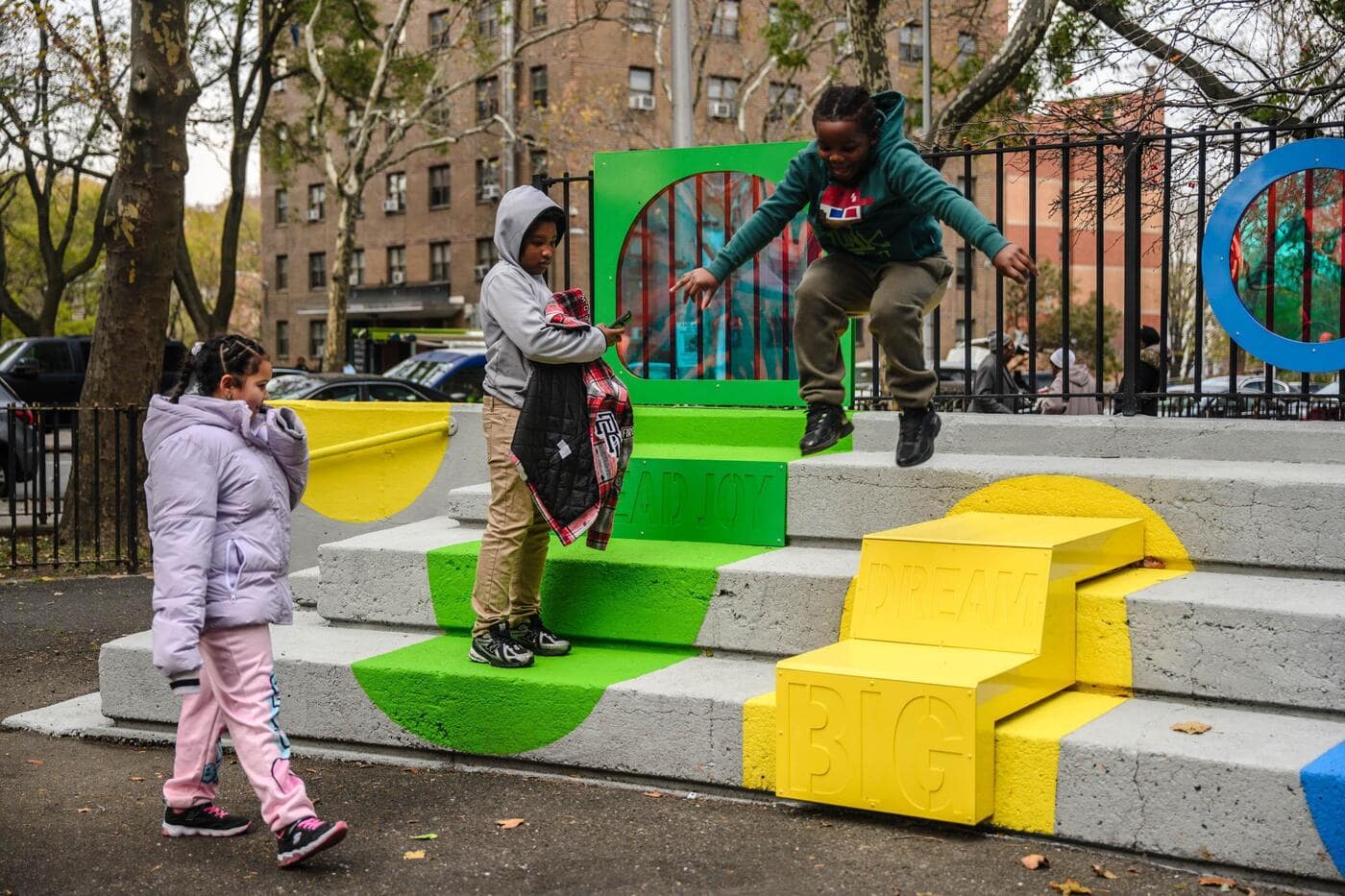
The mural guides movement across the steps, encouraging varied paths and ways of experiencing the space.
Photo credit: Brook Banister
Through an initial survey, Morris Houses residents identified an underutilized concrete bleacher as a top priority for redesign. Once a vibrant gathering spot, the area had deteriorated over time and become largely abandoned. The goal was to reimagine this space as a multigenerational, open-ended environment for play and connection, sparking new activity within the community.

Common Corner encourages communal connection and social activity through open-ended play design.
Photo credit: Brook Banister

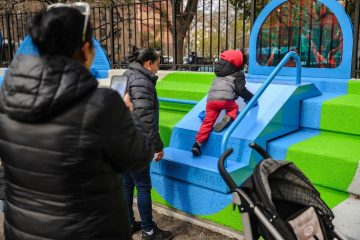
The installation created more accessible seating by lifting it and adding grab rails at different heights.
Photo credit: Brook Banister
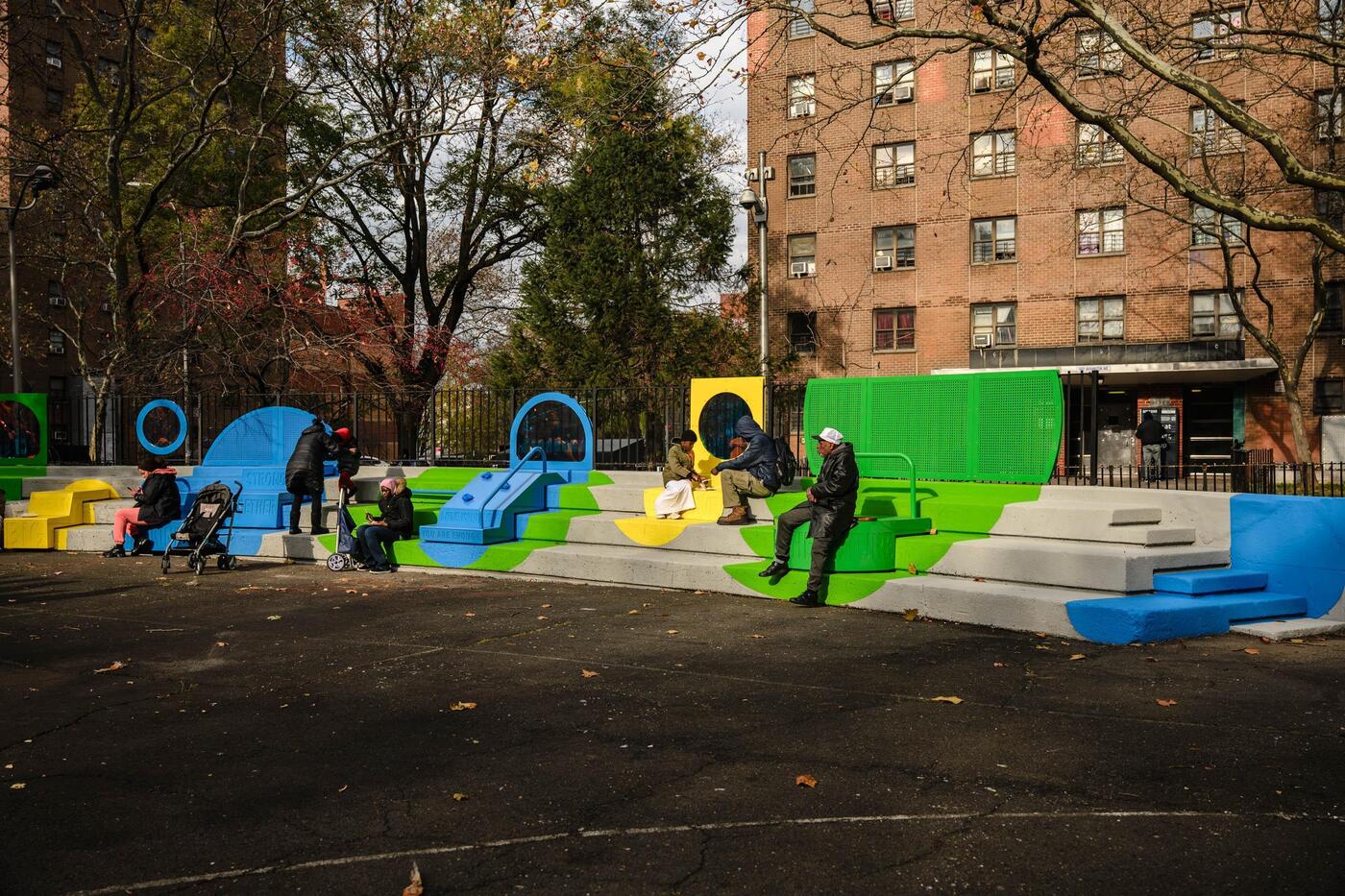
The project activates these once-underutilized steps, transforming them into an active, multigenerational space that supports a wide range of activities.
Photo credit: Brook Banister
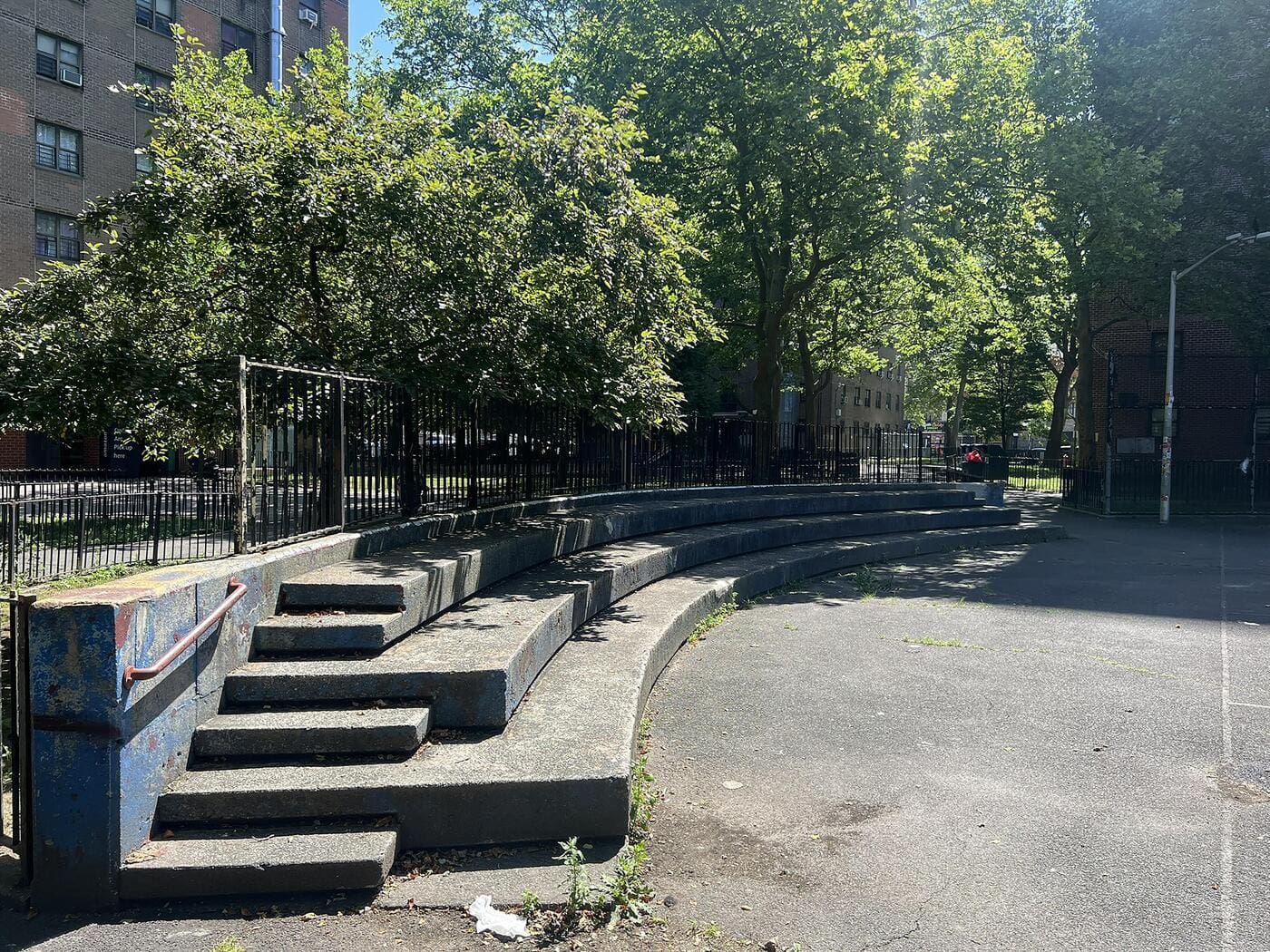
The before photo of the concrete steps that had fallen to disrepair.
Photo credit: The Urban Conga
The Urban Conga led a series of participatory design workshops using playful methods to create a safe and open forum for residents to share their stories, hopes, and ideas. These sessions included both passive, gamified setups at local events and more imaginative or constructive workshops with smaller resident groups. From the earliest stages of conceptual planning to the final design details, community input shaped every part of Common Corner. The new Common Corner now functions as a flexible space where people of all ages can meet, rest, play, exercise, or perform. The design is divided into three interconnected zones inspired by various modes of play—social play, active play, and fantasy play. In the social play zone, seating has been redesigned with accessibility in mind, including handrails and adjusted heights to accommodate different users. The active play zone offers climbing, jumping, balancing, and exercise opportunities that encourage physical engagement. The fantasy play zone introduces a raised platform that acts as a small stage, a space for storytelling or quiet reflection, and even a surface for food distribution during events.
-


- An open-ended design allows the space to adapt to a range of activities. Photo credit: Brook Banister

-

- A climbing wall meant to encourage active play and exploration within the space. Photo credit: Brook Banister

-

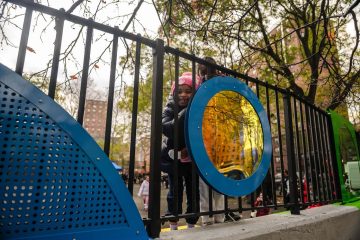
- Reflective, color-changing panels line the back fence, mirroring movement and refracting light throughout the surrounding environment. Photo credit: Brook Banister

-

- Phrases of affirmation chosen by the community line the edges of the installation. Photo credit: Brook Banister

-

- Photo credit: Brook Banister

-
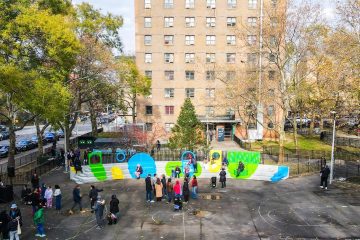
- The installation is organized into zones that encourage social, active, and imaginative play. Photo credit: Tameek Williams

-

- The installation drapes over the steps, drawing people in and activating the space. Photo credit: Brook Banister

-

- Perforated panels wrap the existing fence, creating a framework for future communal paracord artworks. Photo credit: Brook Banister

-
- Photo credit: Brook Banister

-

- Photo credit: Brook Banister

A forced-perspective mural ties all three areas together, flowing across the surfaces and extending to the back wall, symbolizing the evolving vision of the community. Above the site, mirrored panels with reflective and color-shifting properties, along with perforated walls for community-created paracord art, add a dynamic and ever-changing visual layer. Inspirational phrases chosen by residents—such as “We Are The Future”, “Dream Big”, and “Stronger Together”—are inscribed along the stair risers, instilling a sense of pride and identity.
-

- The dichroic mirrors allow people to see themselves in the work and the surrounding space. Photo credit: Brook Banister

-
- Photo credit: Brook Banister

-

- Photo credit: Brook Banister

-
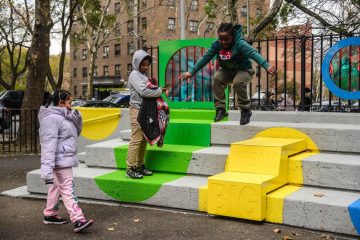
- The design is meant to encourage active play on and around the space. Photo credit: Brook Banister
-

- The project is intended to spotlight the space and catalyze further investment in the surrounding open space. Photo credit: Tameek Williams

-

- A co-design tabling activity at a block party in the Morris Houses neighborhood. Photo credit: Pramity Shah

-

- A co-design session where community members shared their wishes and wonders around the future space. Photo credit: Pramity Shah

-

- A co-design session that encouraged multi-generational conversation in creating the space. Photo credit: Pramity Shah

“Common Corner represents what we can achieve when residents’ voices are truly heard,” said Regina Carter, President of the Morris Houses Residents Association. “For years, these bleachers sat empty, but through this project, they’ve been transformed into something beautiful and meaningful for everyone; a place where young people, older adults, and families alike can meet and play. For us, this is more than a space to sit; it’s a space to come together, to play, and to celebrate our community.” The project is part of NYCHA’s Connected Communities program, which aims to modernize and improve public spaces through participatory planning and public-private partnerships. As a resident-led initiative, Common Corner is a tangible example of inclusive design shaped by the needs and ideas of the community itself. “This transformation is a perfect example of NYCHA’s Connected Communities program and the power of resident-led design,” said Lisa Bova-Hiatt, NYCHA Chief Executive Officer.

Photo credit: Tameek Williams

Photo credit: Brook Banister
About The Urban Conga
The Urban Conga is a Brooklyn-based multidisciplinary design studio led by Ryan Swanson and Maeghann Coleman (AIA, NOMA). Their mission is to spark social interaction and community engagement through open-ended play beyond traditional playgrounds. Using play as a critical design methodology, they create inclusive, multiscale spatial opportunities that transform overlooked or underutilized spaces into creative platforms. The studio has collaborated with municipalities, institutions, NGOs, businesses, and communities worldwide, delivering a wide range of work from spatial interventions and temporary installations to public policies and development strategies—all rooted in the power of play to foster empathy, curiosity, and connection.

