

 English
 日本語
日本語

House of Kunio Maekawa in Tokyo
In the northwest of Tokyo, Koganei-shi of Japan, there is an Edo-Tokyo Open Air Architectural Museum. Whilst the museum hosts a large number of reconstructed houses depicting the lifestyle during the Edo period, there is one particular house that I wanted to highlight - Kunio Maekawa’s house. This is because it was in this very house that a number of Maekawa’s design philosophies can be experienced cumulatively. After Maekawa passed away in 1986, the Kunio Maekawa house was restored as it was in 1997 in this museum.

House of Kunio Maekawa in Tokyo, Japan. Image by Von Chua.
After graduating from architecture at the University of Tokyo, through his connections - an uncle who was a diplomat, Maekawa travelled to France to work under Le Corbusier’s team. Historically, he was recorded as the first Japanese architect to do so, obtaining first-hand practical training from one of the fathers of modern architecture in the world, before returning to Japan with this newfound knowledge. Maekawa was said to have worked mostly under Le Corbusier’s cousin Pierre Jeanneret, who worked closely with Le Corbusier for twenty years.
Returning to Japan, within a society of traditionalists, Maekawa was an advocate for modern architecture. He continued to embrace modernism, a Western concept, through his exposure to foreign architects within Japan; Maekawa worked for Antonin Raymond who was based in Japan to assist Frank Lloyd Wright with the Tokyo Imperial Hotel project. It was only after that, Maekawa set up his own studio Mayekawa Kunio Associates. During this period, Maekawa influenced some of the leading Japanese modern architects, including Pritzker Prize winner in 1987 Kenzo Tange, who was a disciple of Maekawa for four years.
The Kunio Maekawa house is described as “values borrowed from his European mentors with the vernacular building traditions of Japan”. Before entering the Kunio Maekawa house, the use of the Oya stone warmly greets you. The Oya stone was heavily used as a material by Frank Lloyd Wright at the Tokyo Imperial Hotel, suggesting Maekawa’s influence from his time working for Antonin Raymond. During Maekawa’s career as an architect, Maekawa’s architecture focused on applying his learnt modernism exposure within a Japanese context. After seeing and experiencing the Kunio Maekawa house this spring, his house was perhaps more rooted in traditional Japanese architecture compared to his public works.
On the exterior, the Kunio Maekawa house features the characteristics of the Japanese gable roof accompanied by traditional grid patterns in the facade. The 111.55 square meter house is constructed in wood, with a simple floor plan featuring a double height living room. A personal favourite detail of this house is the oversized pivot door on the first floor between the house’s entrance and the living space. It was oversized in relation to the footprint of the house itself, but there is a very deliberate air and intention of it when you are standing in the space. It was propped open with a simple metal hook during my visit, and I wondered if it was an original detail.

Floor plans of the House of Kunio Maekawa. Image by Von Chua.
One of the impressive features of the Kunio Maekawa house is the various lighting methods deployed. On a spring day visit, the use of shoji screens and glazed areas is a wonderful demonstration of Maekawa’s grasp of how natural light can be sensitively controlled. Within the house, the use of artificial lights also appears to be carefully selected with a mix of Japanese and Western influences yet again. Hanging within the double-height atrium space, two unidentical paper lanterns hang from the ceiling; this pair of lighting dominates the asymmetry of the space in a powerful way. The dining table located directly under the second floor is illuminated by an intricately designed brass light. Hanging from the exposed eaves that retained a strong proportion of Japanese architecture, this low-hanging light is another reminder of Maekawa’s short time in France, but an influential period of his architectural career.
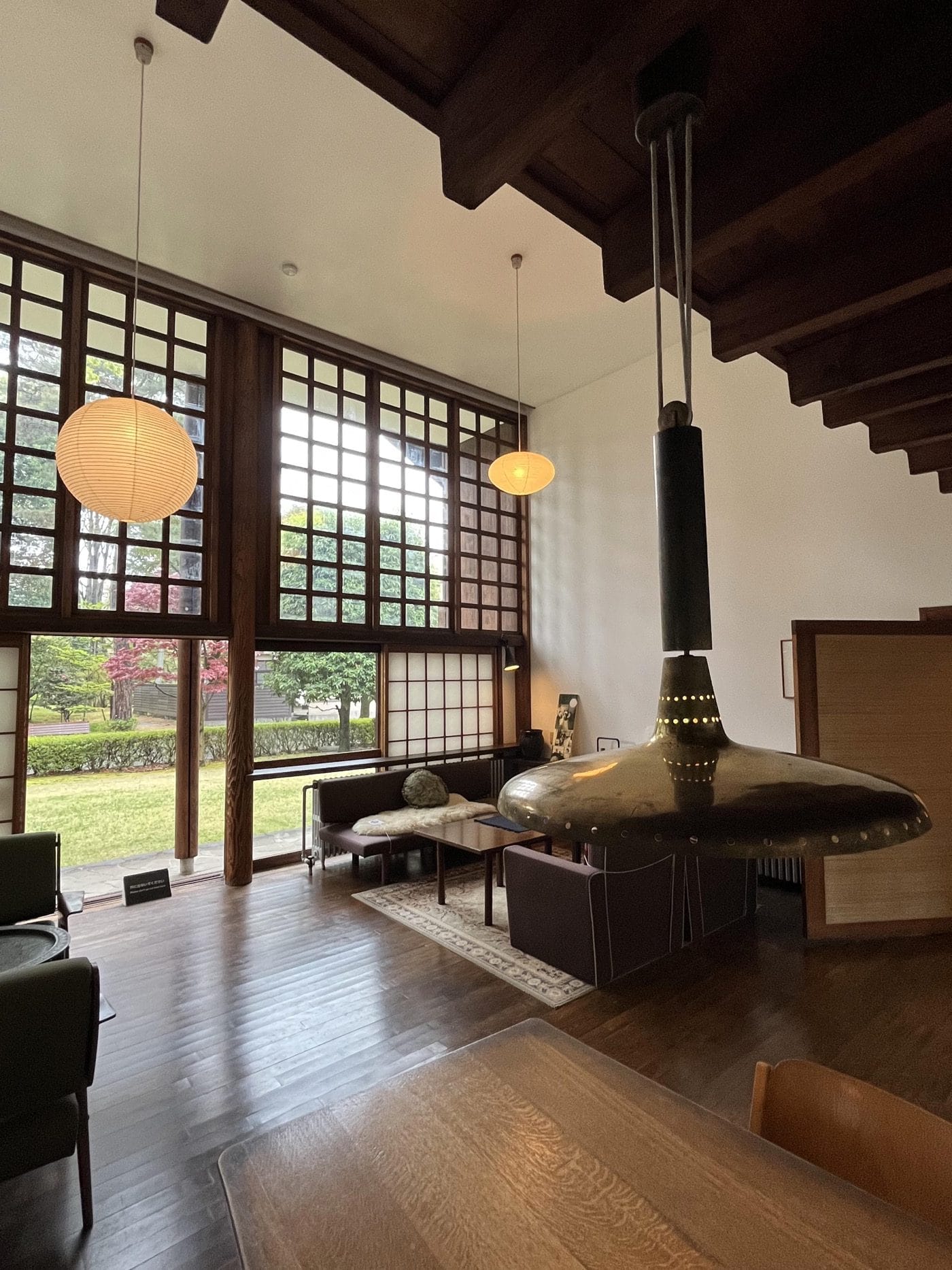
Various lighting in the House of Kunio Maekawa. Image by Von Chua.
It is worth mentioning that the Kunio Maekawa house was designed by his studio’s chief of staff Kosaburo Sakitani. While Maekawa focused his attention on the public buildings he was appointed for, he entrusted Sakitani to design his house. This house was said to be beloved by Maekawa so much so that when he and his family moved out in 1974, he saved all the original materials with the intention of using them in his second house. Unfortunately, he passed away in 1986 before he could realise it.
After visiting the Kunio Maekawa house, I also searched for his publicly accessible architectural works in Japan and found the below museums:
- Hayashibara Museum of Art, Okayama (1966)
- Tokyo Metropolitan Art Museum, Tokyo (1975)
- Kumamoto Prefectural Art Museum, Kumamoto (1977)
- Yamanashi Prefectural Museum of Art, Yamanashi (1978)
- Fukuoka Art Museum, Fukuoka (1979)
- National Museum of Western Art (New Wing), Tokyo (1979)
- Miyagi Museum of Art, Miyagi (1981)
If the works of Le Corbusier, and Japanese architects such as Kenzo Tange and Arata Isozaki interest you, Kunio Maekawa’s works may interest you. To visit this tangible cultural property designated by the Tokyo Metropolitan Government, it is just over an hour on public transport from central Tokyo to arrive at Koganei Park. If the timing is right, the walk from Koganei Park’s entrance to the museum’s entrance is also beautifully lined with sakura trees. Address: Kunio Maekawa Residence at the Edo-Tokyo Open Air Architectural Museum, 3-7-1 Sakuracho, Koganei City, Tokyo 184-0005.

