

 English
 日本語
日本語

“When a brand opens a highly immersive, successful flagship in a city, their e-commerce sales in that specific surrounding region spike significantly.”
“When a brand opens a highly immersive, successful flagship in a city, their e-commerce sales in that specific surrounding region spike significantly” is a quote that came from a multi-year research project conducted by the International Council of Shopping Centers (ICSC) titled The Halo Effect. Reading the quote sparked my interest in better understanding the research, data and findings behind it. The latest report, released in 2023, collected and analysed customer spending data across 69 retailers and 2,100 physical retail stores, showcasing a large pool of evidence.
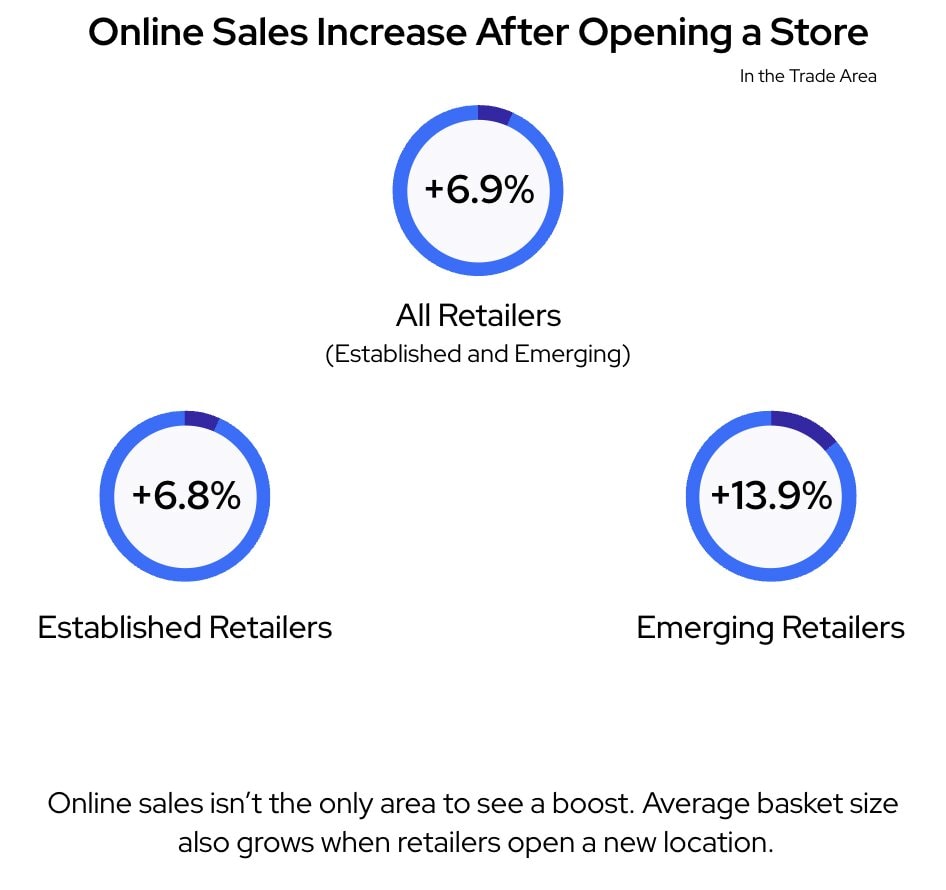
Diagram from The Halo Effect III report.
The Halo Effect - Research Project
The Halo Effect research project provided measurable data on the impact that a brand’s physical retail stores have on the brand’s own online sales within that specific geographical region. The Halo Effect’s initial report - The Halo Effect I: How Bricks Impact Clicks focused on digital awareness and website traffic rather than sales volume. The report’s findings include evidence that opening a new physical retail store leads to a 37% average increase in overall web traffic from consumers located in that geographical location. Some key reasons identified include brand exposure, customers who have tested sizing, fit and quality of products at a physical retail store, as well as trust gained from customers knowing that a physical retail store is near to access customer service.
More recently in The Halo Effect III: Where the Halo Shines, the data gathered showed that opening a physical retail store boosts online sales by an average of 6.9% in the area. For emerging brands, this boost is even more significant, increasing online sales by 13.9%. For clients and designers who handle the realisation of physical retail stores, these findings signal a shift in the purpose of a new physical retail store. When a brand’s new physical opening needs to carry not just the weight of generating sales in-store, but also its brand identity and brand representation that will also affect online sales, real estate becomes the blank canvas for customers to experience a brand’s values. Providing a space for the sale of goods or services no longer suffices. Or worse, a badly executed place for a brand causes customers to lose interest and trust, potentially devaluing a brand. In these scenarios, it is not merely a monetary loss for the business, but also a reputational risk to the brand.
Opening a physical retail store requires a large investment sum, particularly in key locations where flagship stores are present. From leasing the real estate to spatial design and constructing the space, each step of realising the brand within a space requires careful allocation of funds. Today, the lease for a physical store sits not just under a real estate expense, but includes other budgets from marketing, customer acquisition etc. If a brand under-invests and fails to curate its place for the brand, it risks devaluing its reputation and losing customers. Another piece of interesting data from the report is that the presence of a physical retail store also increases the average online basket size within that postcode. This information points toward the importance of having a well-represented physical retail store, and questions the capital expenditure brands allocate per store, as well as the revenue generated by a particular geographical area before and after a physical retail store is operational.
The above reasons may be why we can see a shift in brands allocating budgets to fewer but better immersive retail stores. The combination of new data and inflating capital expenditures has steered brands to reorganise their budget spends, focusing the budgets into a few but highly impactful flagship locations in the world’s leading centers for fashion, culture, finance and technology, such as New York, Paris, London, Tokyo and Seoul. On the other end of the spectrum in retail design, short-term retail pop-ups designed to launch single products or test new markets are proving to be a useful and lower-risk strategy for brands, but that is a discussion for another day.
Living up to the Unspoken Standards
Based on The Halo Effect research project, it is now also essential for design teams to deliver places for brands in a way that silently communicates a brand’s core identity. Using spatial design as a tool, initial zoning plans act as key discussion starters with brand owners or representatives to develop into a detailed floor plan. During this design development stage, unspoken standards such as the widths of the circulation paths, which silently signal premium particularly in high-rent cities, the adjacencies of one zone to another, will contribute to the customer experience and drive sales in a subtle manner. With a well-considered floor plan, customer journeys and their viewpoints upon entering a physical retail environment designed for the brand are under its full control. Every touchpoint is intentional and seamless; each space is designed with intention, contributing to a controlled narrative. Designers need to thoughtfully design cues that signal a brand’s story to passersby within seconds, inviting them to step inside a brand’s universe, whether one intended to visit the physical store or not. Occasionally, these unspoken standards also appear in the form of other senses, such as smell and sound, to transform the brand experience.
Consumers today are informed and have quick access to information. If a brand claims to have and support craftsmanship in their products, the designers of the place for the brand will need to subtly incorporate it. The physical retail store is the place to represent the brand - the proof is in the pudding. Whatever a brand speaks out for, in its physical retail store is an unspoken standard that consumers will be looking out for, consciously or subconsciously. Brands like Aesop personal care to Kith lifestyle and private-label fashion houses, in my opinion, successfully deliver place as a brand time and time again. When you see an ‘Aesop space’, the DNA of Aesop is maintained and confirmed by its black and white product design labels. When you experience a ‘Kith space’, the opulence of materials specified and lighting design contributes to the Instagrammable factor - it unmistakably screams it is a ‘Kith space’ without seeing the Kith logo. Each physical retail store embodies the brand through and through.
About unspoken standards, Aesop, in particular, struck the balance of maintaining a strict visual language, without being repetitive or appearing corporate. While Aesop does not publicly disclose their online sales revenue, it is estimated to be in the region of 15% to 25% of the brand’s total revenue. Each Aesop store opening conveys that it is an international brand who respects the local tradition and community. Often, the brand achieves this by working with local designers and materials, eg. using local stone. One would hardly know that Aesop is owned by the L’Oreal conglomerate. And that is exactly what they set out to do.
