English
 日本語
日本語

New riverfront installation invites visitors to remix lyrics from local artists and contribute to the city’s evolving cultural story
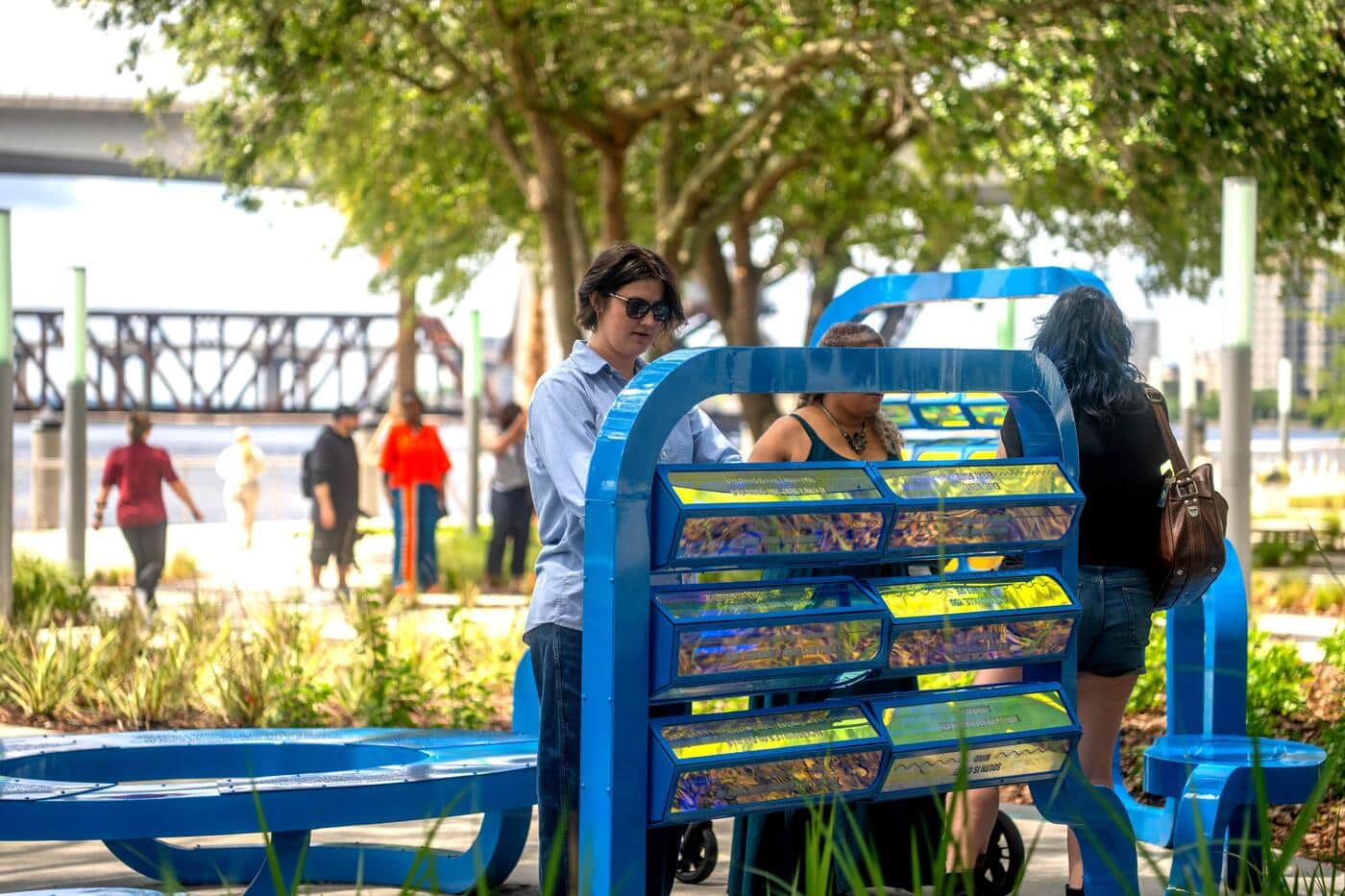
A new public artwork on Jacksonville’s riverfront is transforming the city’s rich musical legacy into an interactive experience that encourages creativity, participation, and community engagement. Created by The Urban Conga, A Cappella has been installed within the newly developed Jacksonville Riverfront Music Garden along the St. Johns River, adjacent to the Jacksonville Symphony.

Photo credit: Photo by Christopher Brickman

A series of seats serves as places of pause and reflection within the work.
Photo credit: Photo by Christopher Brickman

The flowing form of the artwork represents the four movements that comprise a traditional symphonic structure.
Photo credit: Photo by Christopher Brickman
Designed as both a tribute to Jacksonville’s musical history and a platform for future expression, the installation celebrates the diverse voices that have emerged from the city across generations. The artwork draws inspiration from the structure of a symphony, with its flowing form arranged into four distinct sections corresponding to the four movements of a musical composition. Each section explores a different theme—motivation, home, love, and freedom—creating a sequence of experiences that reflects Jacksonville’s cultural identity through multiple perspectives and eras.

A visitor reads about the artwork and its relationship to symphonic structure and composition.
Photo credit: Photo by Christopher Brickman

Birdseye view of people interacting with 'A Cappella.'
Photo credit: Photo by Ryan Swanson

Photo credit: Photo by Christopher Brickman
At the heart of the project is the city’s extensive musical heritage. Developed through a broad community engagement process, A Cappella incorporates lyrics drawn from 84 songs by more than 60 Jacksonville artists spanning a century of music, from the 1920s to the 2020s. Local residents helped identify songs and lyrics that best represent the city’s character, resulting in a collection that highlights both the diversity of Jacksonville’s music scene and the shared themes that connect generations of artists.

Light reflects and refracts off the work onto the surrounding environment.
Photo credit: Photo by Christopher Brickman

At night, the installation illuminates, creating new interactions with light throughout the space.
Photo credit: Photo by Robin Bossinger
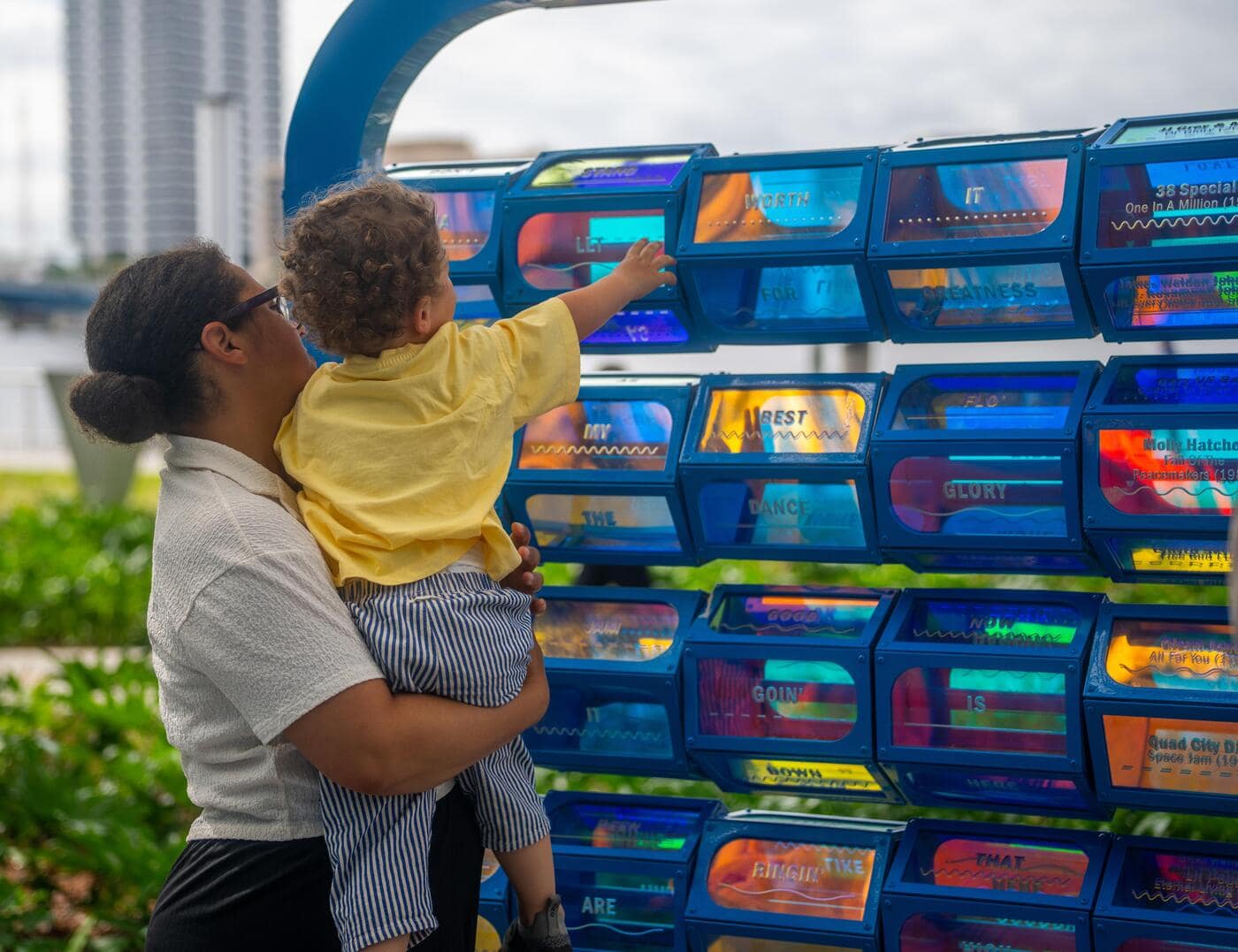
Mom and son play with the lyrics of a song from the Jacksonville band 38 Special.
Photo credit: Photo by Christopher Brickman
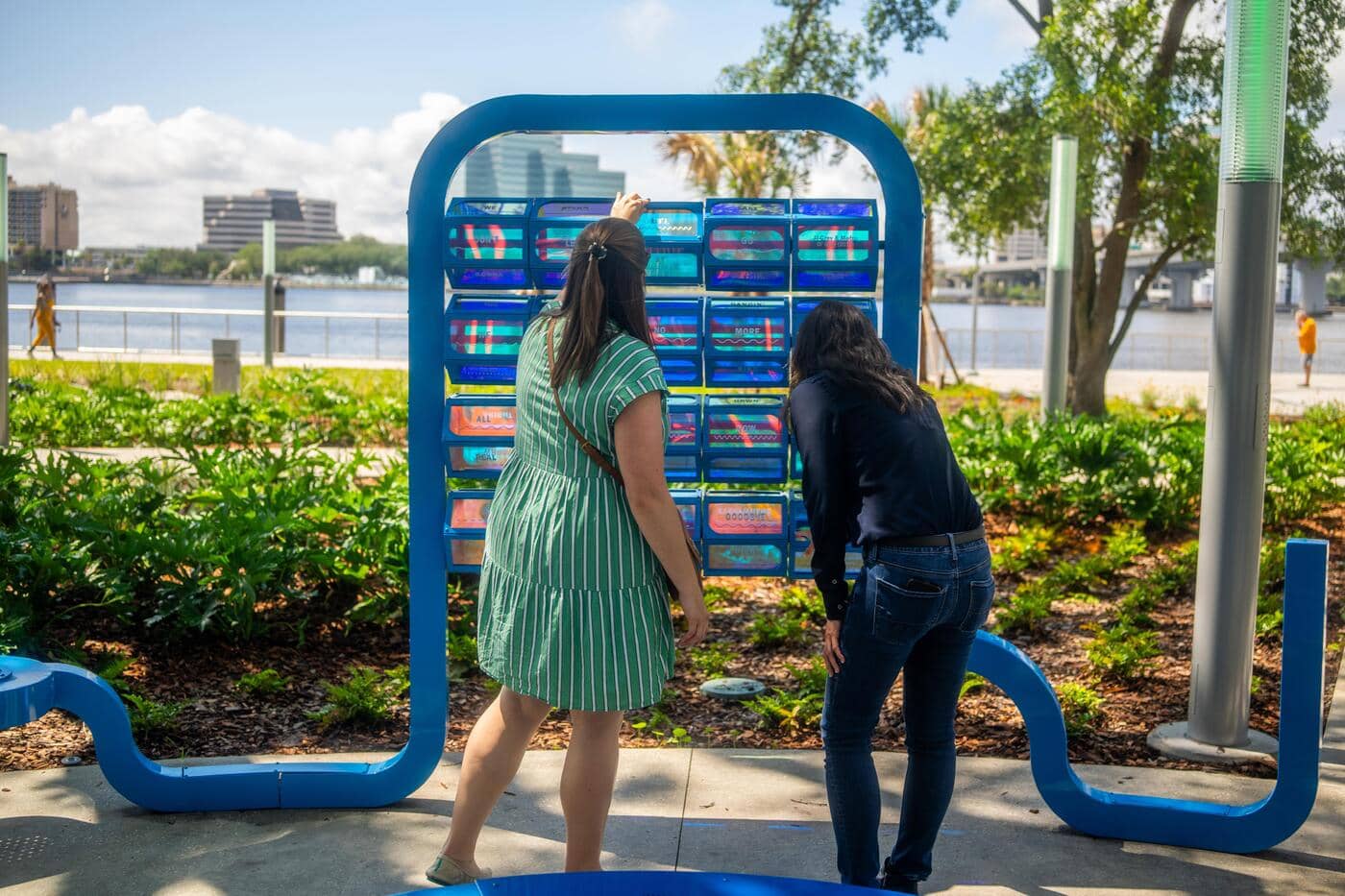
Rather than presenting the lyrics in their original form, the project breaks them down into individual words and short phrases that visitors can rearrange and recombine. This interactive approach allows participants to create their own verses, encouraging them to engage directly with the city’s musical legacy. By mixing words from different artists, genres, and decades, visitors can uncover unexpected connections while producing new lyrical compositions of their own.

A visitor lines up words to create their own lyric.
Photo credit: Photo by Christopher Brickman
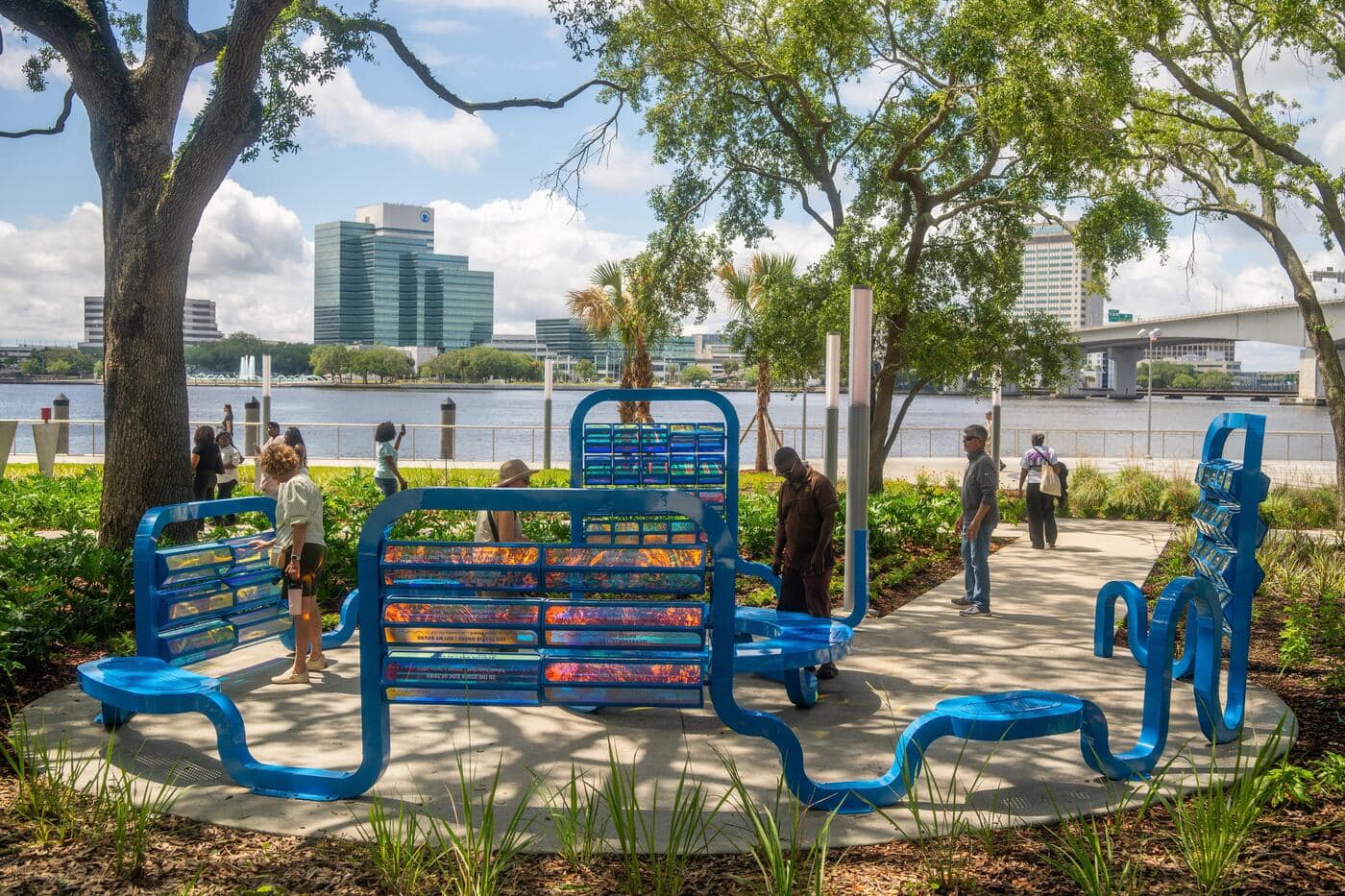
The installation sits on a music note created as a part of the park's overall plan.
Photo credit: Photo by Christopher Brickman

Photo credit: Photo by Christopher Brickman
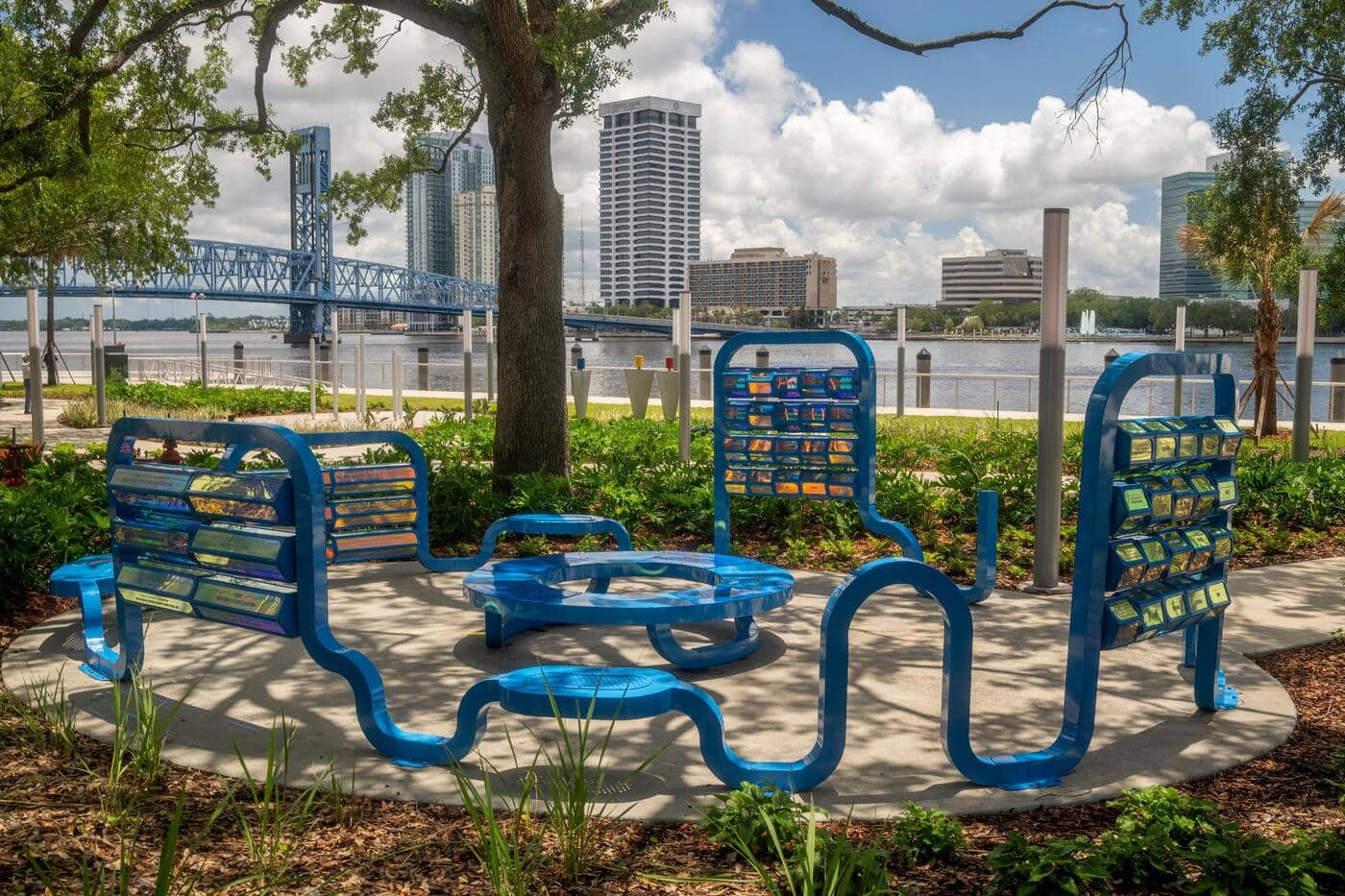
The installation’s visual design reinforces its emphasis on exploration and discovery. Dichroic and reflective panels respond to changing daylight conditions, producing shifting effects of color, light, shadow, and reflection throughout the day. Integrated seating areas encourage visitors to gather, converse, and observe, while a central circular bench serves as a focal point that explains the relationship between the artwork’s four sections and the four movements of a symphony.

A visitor reads the longer verses of artists in the
Photo credit: Photo by Christopher Brickman

The dichroic panels shift and change color depending on how the light hits the work.
Photo credit: Photo by Christopher Brickman

The frame and line associated with each unit provide a visual cue showing when the original verse has been correctly matched.
Photo credit: Photo by Christopher Brickman
Designed to evolve over time, A Cappella also allows for the inclusion of additional artists in the future, ensuring that the installation remains connected to Jacksonville’s changing cultural landscape. By combining music, storytelling, play, and public participation, the project creates a dynamic civic space where visitors can reflect on the city’s past while actively contributing to its ongoing creative narrative.

The form and interaction of the work encourage moments of open-ended play.
Photo credit: Photo by Christopher Brickman

The work was designed to frame out different views of the surrounding city and landscape.
Photo credit: Photo by Christopher Brickman

The work was designed to appear as if it were rising up out of the landscape.
Photo credit: Photo by Christopher Brickman
More than a monument to local music history, A Cappella functions as a living cultural platform—one that celebrates Jacksonville’s enduring musical identity while fostering new voices and connections for generations to come.

Visitors take a selfie in the work.
Photo credit: Photo by Christopher Brickman
-


- Visitors finding their favorite songs on the work. Photo credit: Photo by Christopher Brickman

-

- The work sits in the Music Garden on the St. Johns River. Photo credit: Photo by Christopher Brickman
-

- The work sits within a musical note of the overall park design. Photo credit: Photo by Christopher Brickman

-

- Photo credit: Photo by Christopher Brickman
-

- Photo credit: Photo by Christopher Brickman
-

- Verses from artists including The Red Jumpsuit Apparatus, Shinedown, and Ray Charles can be discovered, rearranged, and played with throughout the installation. Photo credit: Photo by Christopher Brickman

The Urban Conga
The Urban Conga, an award-winning multidisciplinary design studio led by Ryan Swanson and Maeghann Coleman, AIA, NOMA based in Brooklyn, New York, whose work explores how play can act as a catalyst for community interaction and social activity within the public realm. Working across the intersections of architecture, urban design, public art, and social practice, the studio focuses on creating inclusive, multiscale spatial opportunities that transform overlooked or underutilized spaces into stimulating environments that encourage curiosity, interaction, and free-choice learning.
Central to the studio’s practice is the utilization of play methodologies as a critical tool implemented not just in the work itself, but within the community-driven design process in which the work is created. The studio examines how participatory design and open-ended spatial systems can help cultivate more empathetic, responsive, and socially resilient environments.