

 English
 日本語
日本語

A new model of Cycladic architecture that achieves both energy autonomy and ecological restoration
Located on a sloped site in Syros, Horizon House is a net-zero energy residence designed by ONUS Architecture Studio. Rooted in the climate and landscape of the Cycladic islands, the project focuses on energy autonomy, ecosystem regeneration, and circular resource use. The semi-subterranean design minimizes visual impact while enhancing environmental performance, offering a case study in regenerative architecture for island contexts.

Aerial view of Horizon House nestled into the rocky coastline of Syros.
Photo credit: ONUS Architecture Studio
The house was selected as the global winner of the 2025 Architizer A+ Award for Best Sustainable Residential Project, recognized by an international jury for its off-grid energy system, site-responsive design, and low-impact construction approach tailored to island topography.
A reinforced connection to place
Horizon House sits on a steep slope overlooking the Aegean Sea in Syros, Greece. The 230-square-meter structure is partially embedded in the earth, allowing the terrain to shape the building’s form and performance. Stone excavated from the site is reused for structural walls and cladding, creating a strong material link to the land. The design incorporates reclaimed wood, raw concrete, and native vegetation, resulting in a low-carbon and locally grounded material palette. The house unfolds along a linear axis parallel to the horizon. All living spaces face south, ensuring unobstructed views and maximizing passive solar gain. The north-facing façade is more sheltered, reducing exposure to prevailing winds and improving indoor thermal comfort. An L-shaped pool defines the outdoor area, contributes to passive cooling, and creates visual continuity with the surrounding terrain.

The stone façade mirrors the texture and color of the surrounding terrain.
Photo credit: ONUS Architecture Studio

The linear volume follows the contours of the land, combining raw textures with refined precision.
Photo credit: ONUS Architecture Studio

The living space opens fully to the horizon, blurring the line between architecture and landscape.
Photo credit: ONUS Architecture Studio

At sunset, the geometry of the house reflects across the water, reinforcing its connection to the topography.
Photo credit: ONUS Architecture Studio

The cantilevered structure hovers above the landscape, framing uninterrupted sea views.
Photo credit: ONUS Architecture Studio
Bioclimatic design at the core
Deep-set openings, operable windows, and three skylights promote natural ventilation and daylighting, minimizing reliance on mechanical systems. In summer, thermal mass and air circulation help stabilize indoor temperatures and ensure comfortable living conditions.

A thick stone wall frames a quiet view of the Aegean, recalling the Cycladic vernacular.
Photo credit: ONUS Architecture Studio
Achieving full energ
On site, micro wind turbines harness the island’s steady winds, while a geothermal system supplies both heating and cooling. A 300-square-meter green roof collects rainwater, filtered and stored via a blue roof system. Greywater is also treated and reused, enabling complete off-grid functionality.

Built into the hillside, Horizon House blends with the native terrain through form, material, and vegetation.
Photo credit: ONUS Architecture
Landscape design that supports ecosystems
The planting strategy features native species adapted to the Cycladic ecosystem, enhancing biodiversity, attracting pollinators, and stabilizing soil. Strategically placed trees and shrubs provide wind protection and shade, improving the microclimate around the building. These interventions support long-term soil health and water retention, contributing to a resilient ecological balance.

Above the living spaces, a planted green roof integrates a blue roof system that captures, filters, and reuses rainwater, enhancing resilience and supporting local regeneration.
Photo credit: ONUS Architecture Studio
A spatial layout focused on simplicity and continuity
The interior design emphasizes simplicity and continuity. Living and sleeping areas are oriented toward natural light and views, while minimal finishes highlight the tactile quality of each material. Transitions between indoor and outdoor spaces are fluid, with courtyards, terraces, and shaded verandas extending the living experience outward. Horizon House reflects a design philosophy that prioritizes regeneration over consumption. Conceived not merely as a shelter, the house functions as a system that supports both environmental and human well-being. It shows how architecture can serve as ecological infrastructure—integrated with natural processes while offering a refined and resilient space for living. By integrating renewable energy, water reuse, local materials, and ecosystem-based strategies, the project presents a sustainable lifestyle adapted to place and climate. It's quiet presence in the landscape reflects a sincere architectural approach to living in harmony with the land.
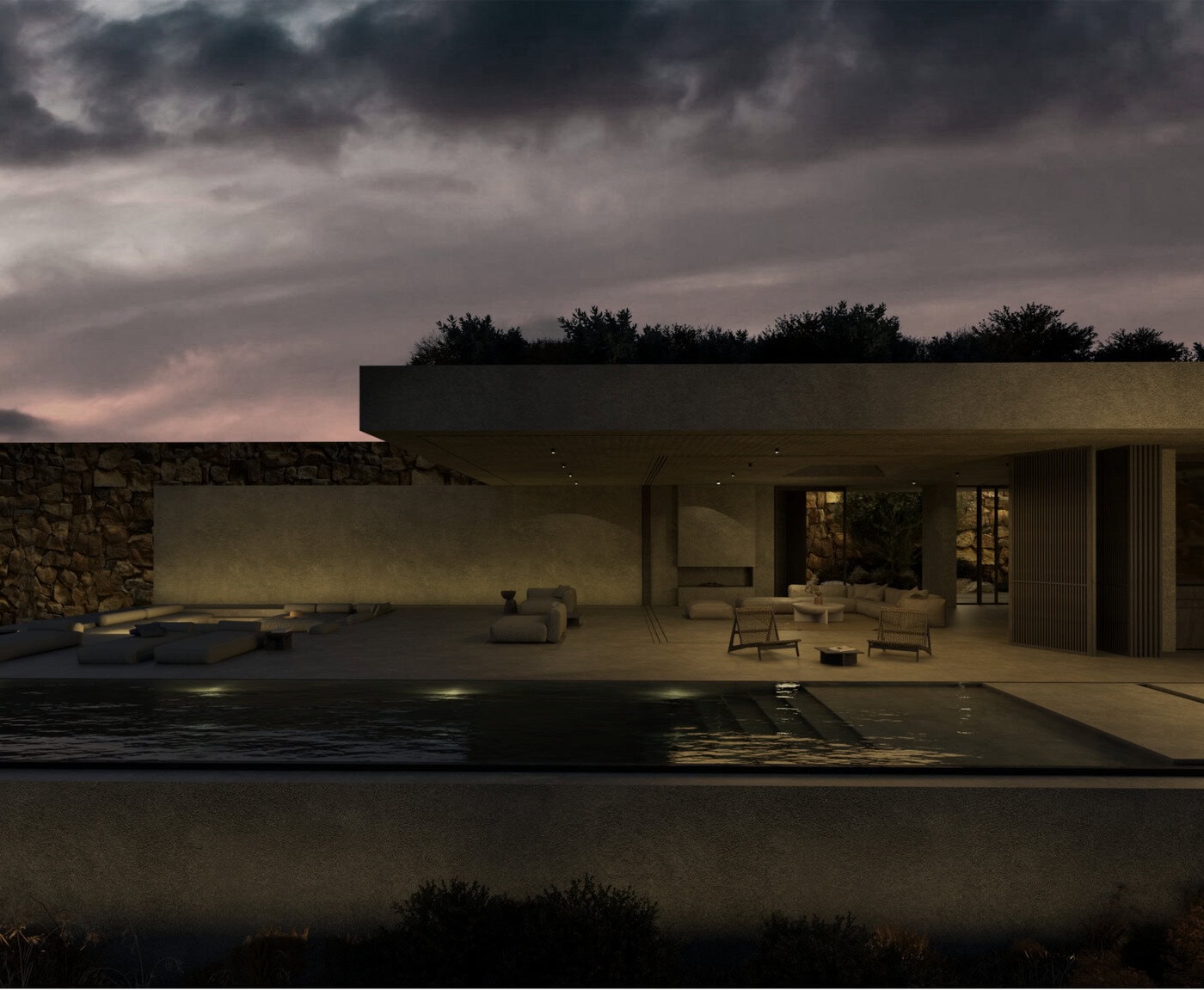
At night, the softly lit interiors create a quiet dialogue between built and natural environments.
Photo credit: ONUS Architecture Studio

Horizon House under a starlit sky energy-autonomous, silent, and fully immersed in its environment.
Photo credit: ONUS Architecture Studio
About ONUS Architecture Studio
ONUS Architecture Studio is an Athens-based architectural firm dedicated to sustainable and regenerative design. The studio continues to grow steadily and has received multiple international awards, including the 2025 Architizer A+ Award. ONUS specializes in circular construction, passive house principles, and ecosystem-based planning. Their projects demonstrate a careful balance between environmental performance, material clarity, and spatial intention—exploring how architecture can actively contribute to both ecological and social systems.

