English
 日本語
日本語

Fingerpainting the Atmosphere: Ayako Rokkaku in Berlin
Inside the brutalist stillness of St. Agnes in Berlin, color explodes.
The former church - now the monumental home of KÖNIG GALERIE - hosts “Scenery in the Process of Being Formed,” the latest solo exhibition by Japanese artist Ayako Rokkaku, on view until 5 April 2026. The show unfolds across the cavernous nave like a sensory weather system: spontaneous, luminous, and slightly unruly.

Ayako Rokkaku, SCENERY IN THE PROCESS OF BEING FORMED, 2026, Berlin,
Nave, Photo by Roman März, Courtesy of the artist & KÖNIG GALERIE
Rokkaku’s practice has always thrived on immediacy. Known for applying acrylic paint directly with her fingers rather than brushes, she builds compositions through physical engagement by pressing, smearing, and layering pigment onto the surface until animated figures and dreamlike environments emerge. As the artist explains, “I paint with my fingers because I want to feel the paint directly.” The gesture is not merely technical; it is a way of collapsing the distance between body and image.
In Berlin, however, the artist pushes her vocabulary further. Painting remains central, but the exhibition expands into a spatial landscape of sculptures in ceramic and glass, allowing the artist’s instinctive gestures to migrate into three dimensions. The result is not a conventional
exhibition but an evolving environment, one that mirrors the show’s title.
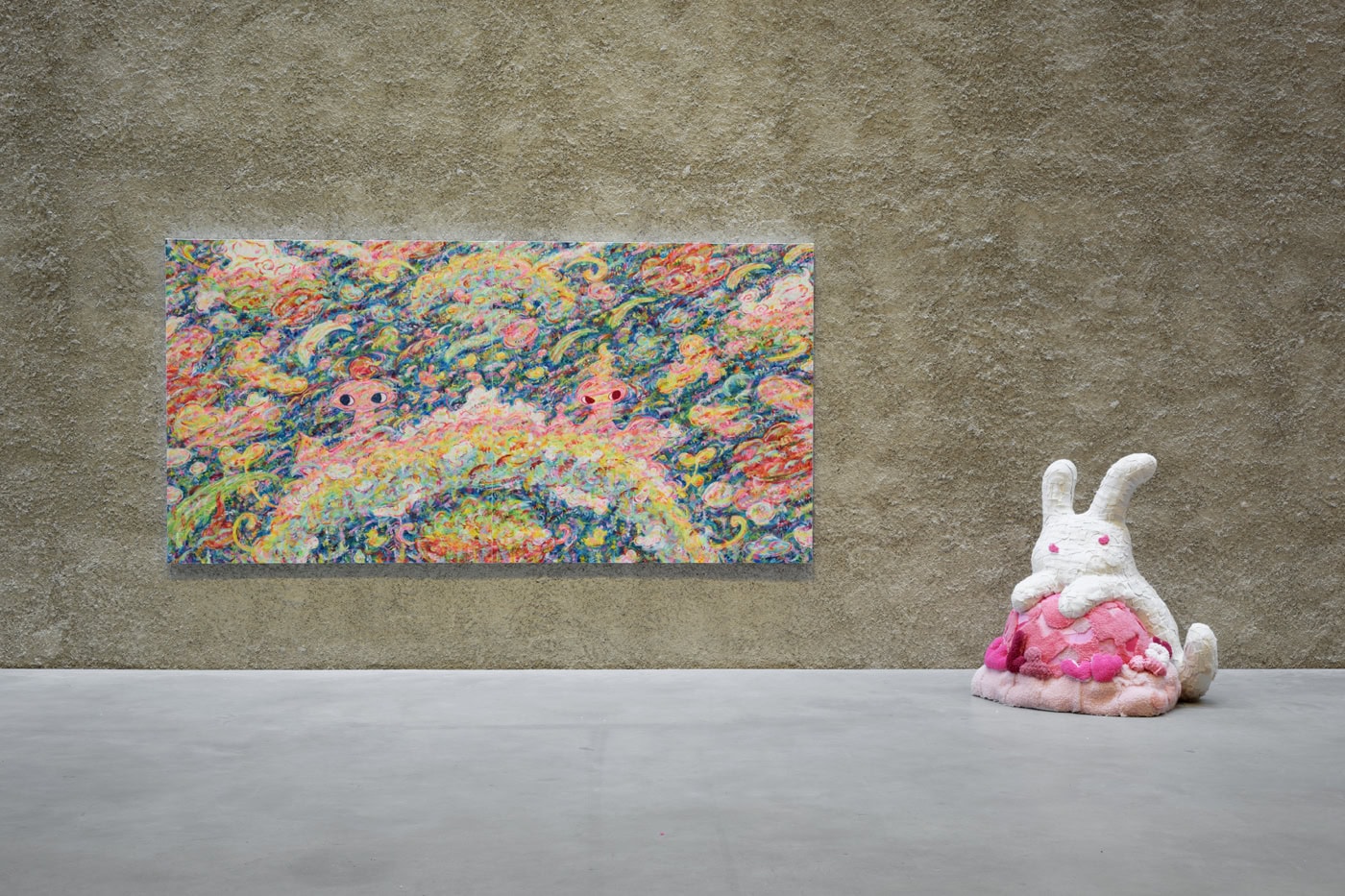
Ayako Rokkaku, SCENERY IN THE PROCESS OF BEING FORMED, 2026, Berlin,
Nave, Photo by Roman März, Courtesy of the artist & KÖNIG GALERIE

Ayako Rokkaku, SCENERY IN THE PROCESS OF BEING FORMED, 2026, Berlin,
Nave, Photo by Roman März, Courtesy of the artist & KÖNIG GALERIE
“Scenery in the Process of Being Formed” suggests an open-ended state, where images are not fixed but continuously becoming. Rokkaku’s works feel less like finished objects and more like moments caught mid-transformation, as if the paintings were still moving. That sense of openness reflects the way the artist approaches her process.
Rather than beginning with a predetermined composition, she works intuitively, allowing forms to emerge through movement and rhythm. As she notes, “I don’t start with a clear image. I follow my feelings and see what appears.”
At the core of Rokkaku’s visual language are the wide-eyed, childlike characters that populate her canvases, floating figures that oscillate between innocence and uncanny intensity.
Their faces, often rendered with minimal lines, drift through fields of vibrant color: pastel pinks, electric blues, and citrus yellows colliding in soft, tactile layers. The technique is deceptively simple. Without preparatory sketches, Rokkaku paints directly on raw surfaces, responding intuitively to the rhythm of the material. The process is closer to improvisation than to traditional
composition.

Ayako Rokkaku, SCENERY IN THE PROCESS OF BEING FORMED, 2026, Berlin, Nave, Photo by
Roman März, Courtesy of the artist & KÖNIG GALERIE
Yet the apparent spontaneity masks a deeper sensibility. Rokkaku’s imagery is shaped by accumulated impressions, fleeting encounters with landscapes, cities, and everyday
atmospheres.
Light hitting a harbor, the textures of a street market, the pulse of a coastline: these fragments quietly enter her memory before resurfacing as abstracted emotional terrains on canvas.

DidascaliaAyako Rokkaku, SCENERY IN THE PROCESS OF BEING FORMED, 2026,
Berlin, Nave, Photo by Roman März, Courtesy of the artist & KÖNIG GALERIE

DidascaliaAyako Rokkaku, SCENERY IN THE PROCESS OF BEING FORMED, 2026,
Berlin, Nave, Photo by Roman März, Courtesy of the artist & KÖNIG GALERIE
In Berlin, this method extends beyond painting. Ceramic works produced in Mallorca, glass sculptures developed in Murano with artisans from Berengo Studio, and canvases created in Porto converge within the nave, forming what could be described as a dispersed diary of movement.
Each material carries the trace of a place and a moment. Together they create a constellation of experiences translated into form.
The glass pieces, in particular, introduce a striking shift in the artist’s language.
While her paintings celebrate immediacy and touch, glass imposes resistance, requiring collaboration, patience, and technical precision. The translucent sculptures glow under the gallery’s subdued light, capturing color within their surfaces as if freezing liquid pigment mid-motion. Their presence punctuates the exhibition like crystalline interruptions, offering a quieter counterpoint to the exuberant canvases.
Equally compelling is the dialogue between Rokkaku’s works and the architecture of St. Agnes itself. Designed as a postwar brutalist church, the building’s austere concrete geometry might appear incompatible with the artist’s playful imagery. Instead, the contrast amplifies both. The
nave’s towering walls act as a neutral stage where color can vibrate with amplified intensity. Rokkaku’s paintings, bursting with life, seem to soften the building’s monumental severity, transforming the sacred space into something more fluid and atmospheric.
At the center of Rokkaku’s imagery are the wide-eyed figures that populate her canvases and sculptures. Their gaze, however, rarely meets that of the viewer. Instead, the eyes are almost always turned slightly to the side, drifting away from direct confrontation.

DidascaliaAyako Rokkaku, SCENERY IN THE PROCESS OF BEING FORMED,
2026, Berlin, Nave, Photo by Roman März, Courtesy of the artist & KÖNIG GALERIE

DidascaliaAyako Rokkaku, SCENERY IN THE PROCESS OF BEING FORMED,
2026, Berlin, Nave, Photo by Roman März, Courtesy of the artist & KÖNIG GALERIE
The effect is subtle but deliberate. Rather than establishing a frontal dialogue, the figures appear to observe the world around them, quietly attentive to their surroundings.
By avoiding direct eye contact, Rokkaku’s characters remain slightly elusive, suspended between presence and distance. They are not looking at us so much as looking with us, absorbing the atmosphere of the space they inhabit. In the vast nave of St. Agnes, this quality becomes
particularly palpable: the figures seem less like portraits and more like quiet witnesses, attentive to the shifting scenery around them.
“Beauty is made of layers,” she notes, referring not only to the stratified surfaces of her paintings but also to the soft, stuffed sculptures that extend her visual language into space. Much like her canvases, these tactile forms are built through successive gestures—layers of color,
material, and emotion gradually shaping the final object.
This layered approach also explains the curious detachment of the figures’ gaze.
This ambiguity is central to the artist’s appeal. Rokkaku’s work resists easy categorization, moving
freely between pop aesthetics, neo-expressionist gesture, and the imaginative openness of children’s drawings. Critics often highlight the playful dimension of her paintings, but beneath the surface lies a deeper psychological charge, an exploration of vulnerability, curiosity, and transformation.
Seen together, the works in “Scenery in the Process of Being Formed” operate like fragments of an unfinished world. Nothing here feels static. Paintings seem to pulse with motion, sculptures appear to crystallize mid-growth, and the exhibition itself reads as a living ecosystem of color, texture, and emotion.
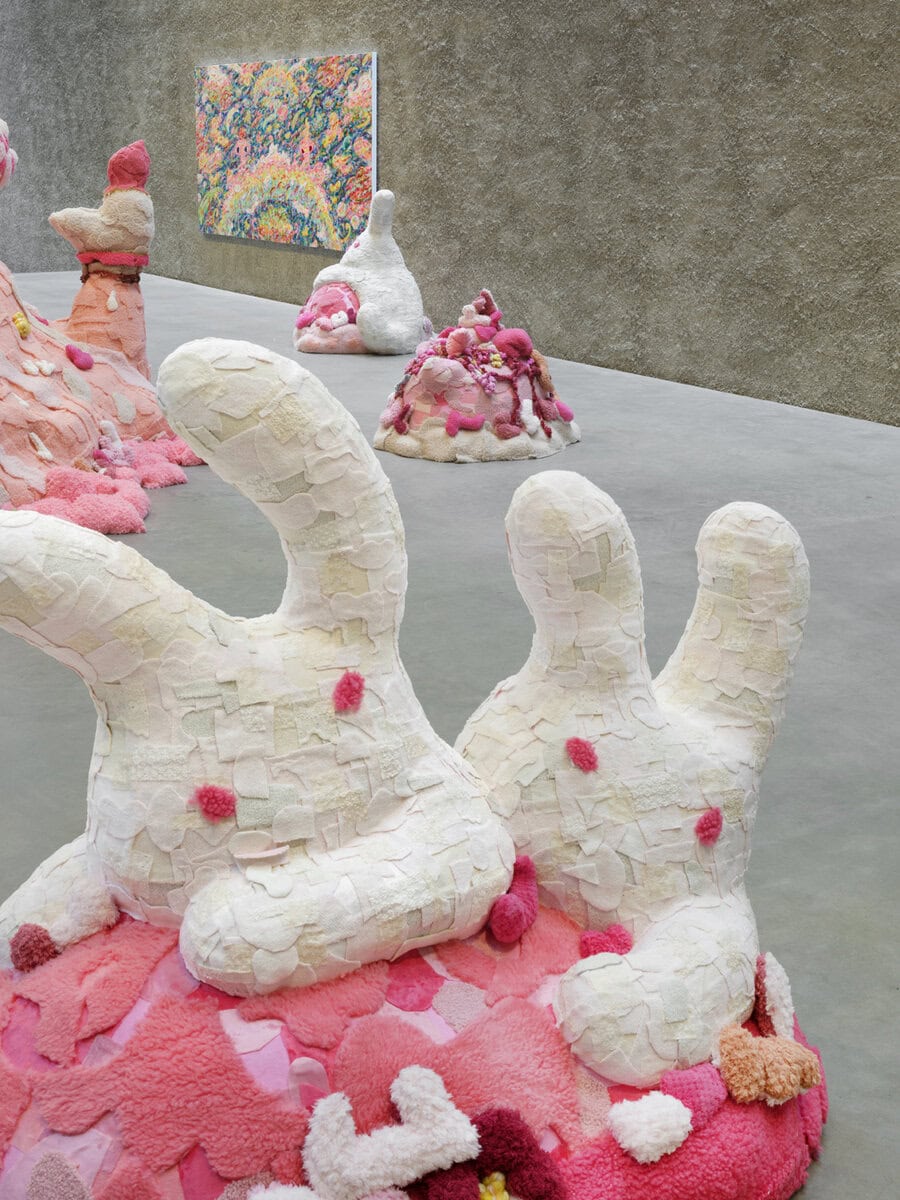
DidascaliaAyako Rokkaku, SCENERY IN THE PROCESS OF BEING FORMED, 2026,
Berlin, Nave, Photo by Roman März, Courtesy of the artist & KÖNIG GALERIE
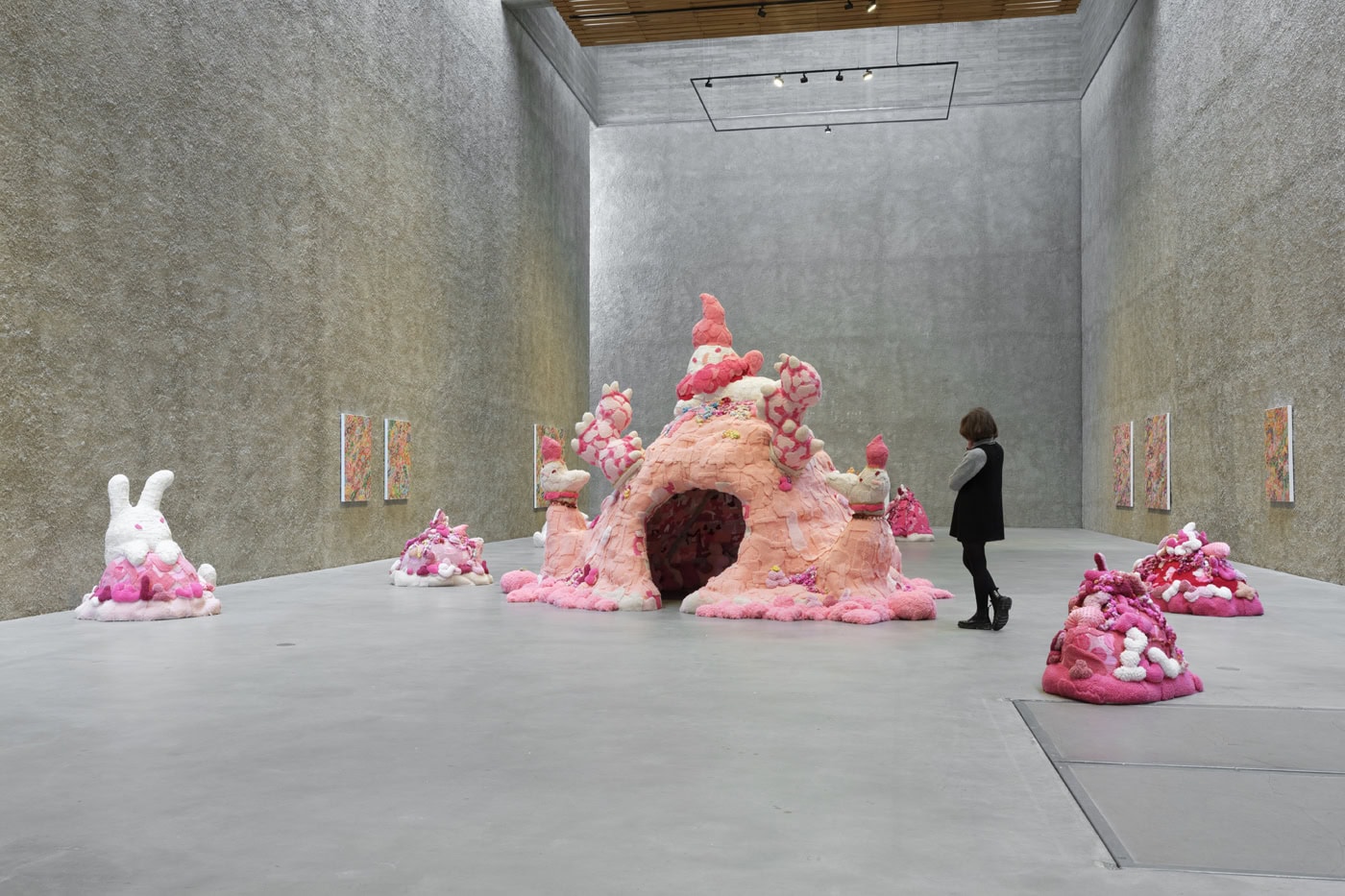
DidascaliaAyako Rokkaku, SCENERY IN THE PROCESS OF BEING FORMED, 2026,
Berlin, Nave, Photo by Roman März, Courtesy of the artist & KÖNIG GALERIE
In an era increasingly dominated by conceptual distance and digital mediation, Rokkaku’s approach feels refreshingly physical.
Rather than presenting a polished conclusion, Rokkaku invites viewers into a state of becoming, an open terrain where images, materials, and sensations continue to evolve.
For those passing through Berlin before early April, stepping into St. Agnes offers the rare chance to witness this process firsthand. Immersed in color, gesture, and atmosphere, “Scenery in the Process of Being Formed” is less an exhibition to observe than an environment to experience, one that rewards the simple act of showing up and letting the scenery unfold.

DidascaliaAyako Rokkaku, SCENERY IN THE PROCESS OF BEING FORMED, 2026, Berlin, Nave,
Photo by Roman März, Courtesy of the artist & KÖNIG GALERIE
Exhibition Info
Artist: Ayako Rokkaku
Title: Scenery in the Process of Being Formed
Venue: KÖNIG GALERIE, St. Agnes (Nave), Berlin
Dates: On view until 5 April 2026
Image: Scenery in the Process of Being Formed, 2026
Berlin, Nave
Photo by Roman März
Courtesy of the artist & KÖNIG GALERIE