English
 日本語
日本語

A family apartment in Chelsea is transformed through craftsmanship, art, and thoughtful adaptation rather than wholesale reconstruction
Located in Manhattan’s Chelsea neighborhood, this full-floor loft apartment underwent a comprehensive renovation by BarlisWedlick Architects and interior designer MK Workshop. Home to a family of five, the 409-square-meter residence already offered generous proportions, four bedrooms, multiple bathrooms, and three terraces. Yet despite its size and desirable location, the recently purchased apartment lacked character. Defined by stark white walls and uniform grey millwork, it felt disconnected from the family who would inhabit it.
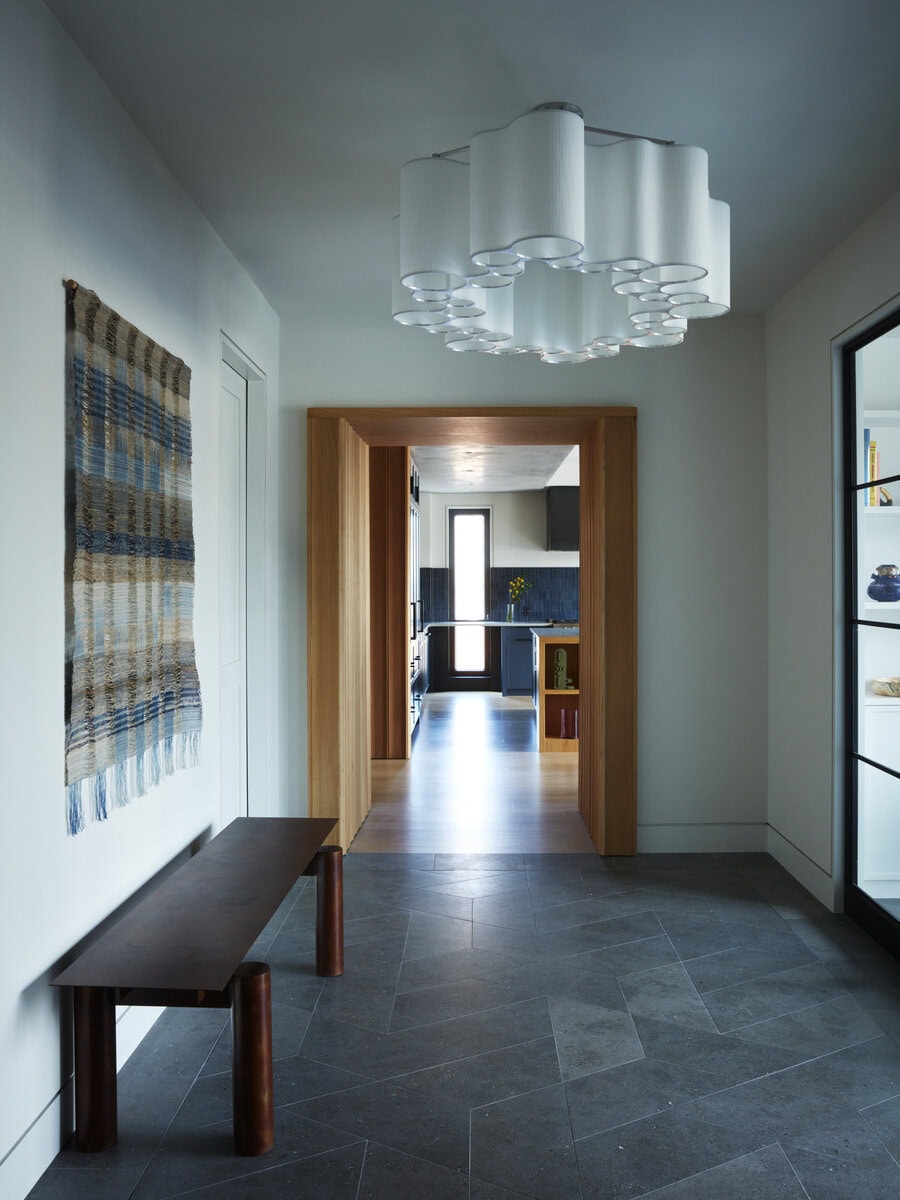
The Foyer features BarlisWedlick Architects’ custom-designed La Palma limestone flooring by Ann Sacks in a trapezoid pattern, a Ralph Pucci Oval Cumulus Chandelier, and a woven tapestry by Rachel Snack of the Weaver House. ph: Tim Lenz
The brief was remarkably straightforward: “Add soul to the place” and “Make it feel like us.”
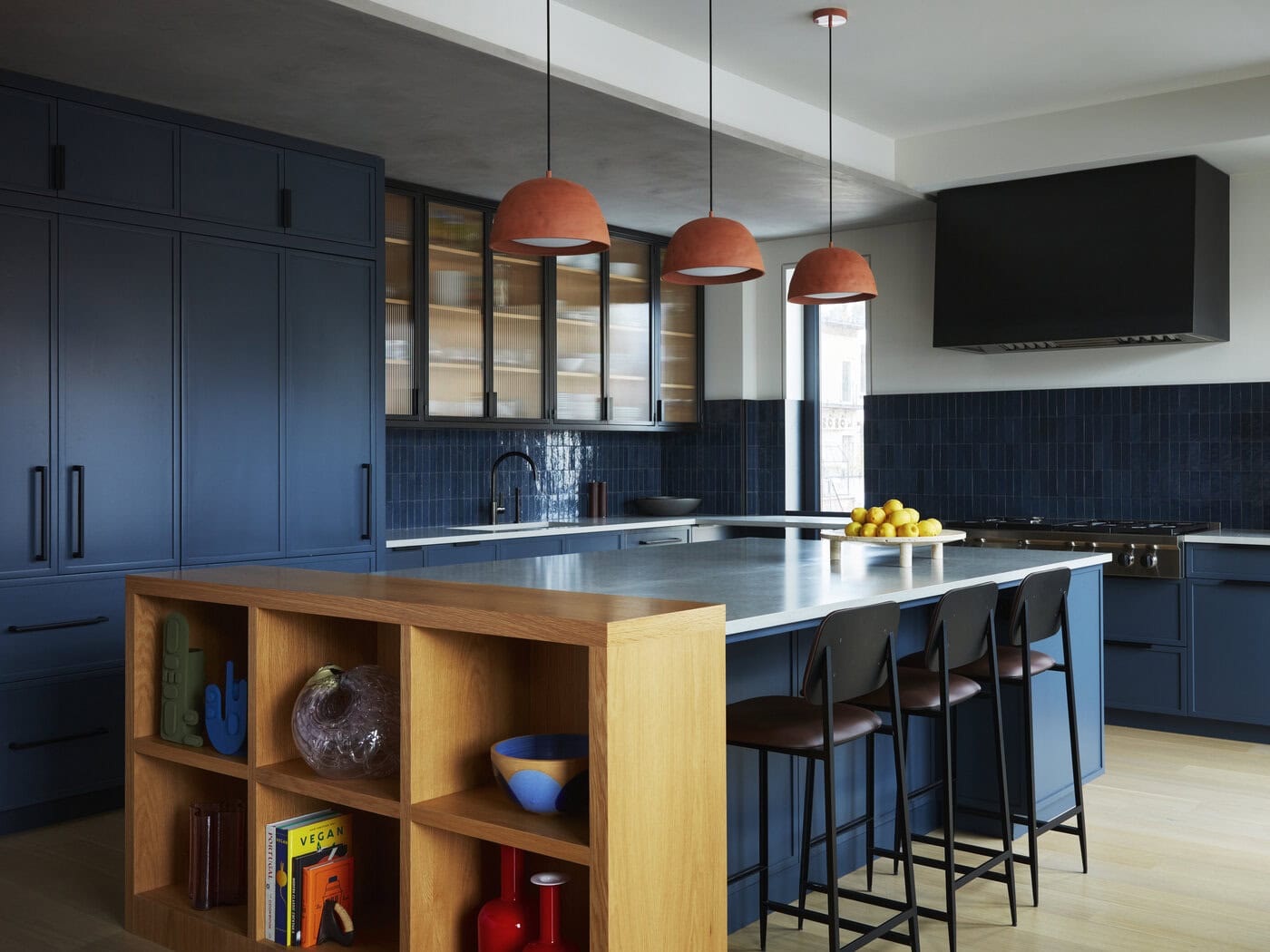
The White Oak and blackened steel elements found throughout are brought into the kitchen for a harmonious design. Island pendant lights illuminate the honed Pental Quartz Concerto countertop. The cabinets, painted in Blue Note from Benjamin Moore, are a visual statement. ph: Tim Lenz
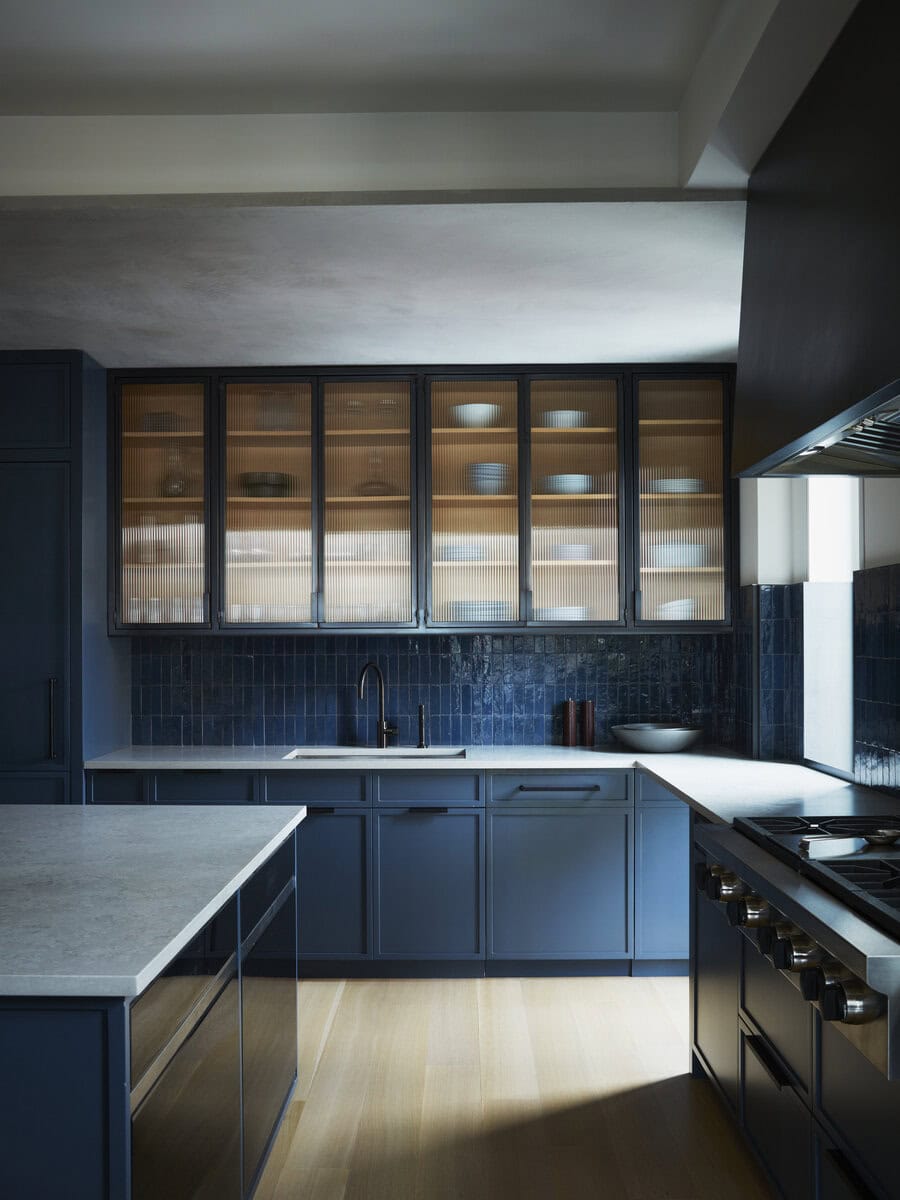
A study in contrast and sophistication, this navy-hued kitchen pairs blackened steel and glass cabinets and handmade indigo Zellige tiles with crisp Pental Quartz Concerto countertops, creating a modern space that feels both bold and timeless. ph: Tim Lenz
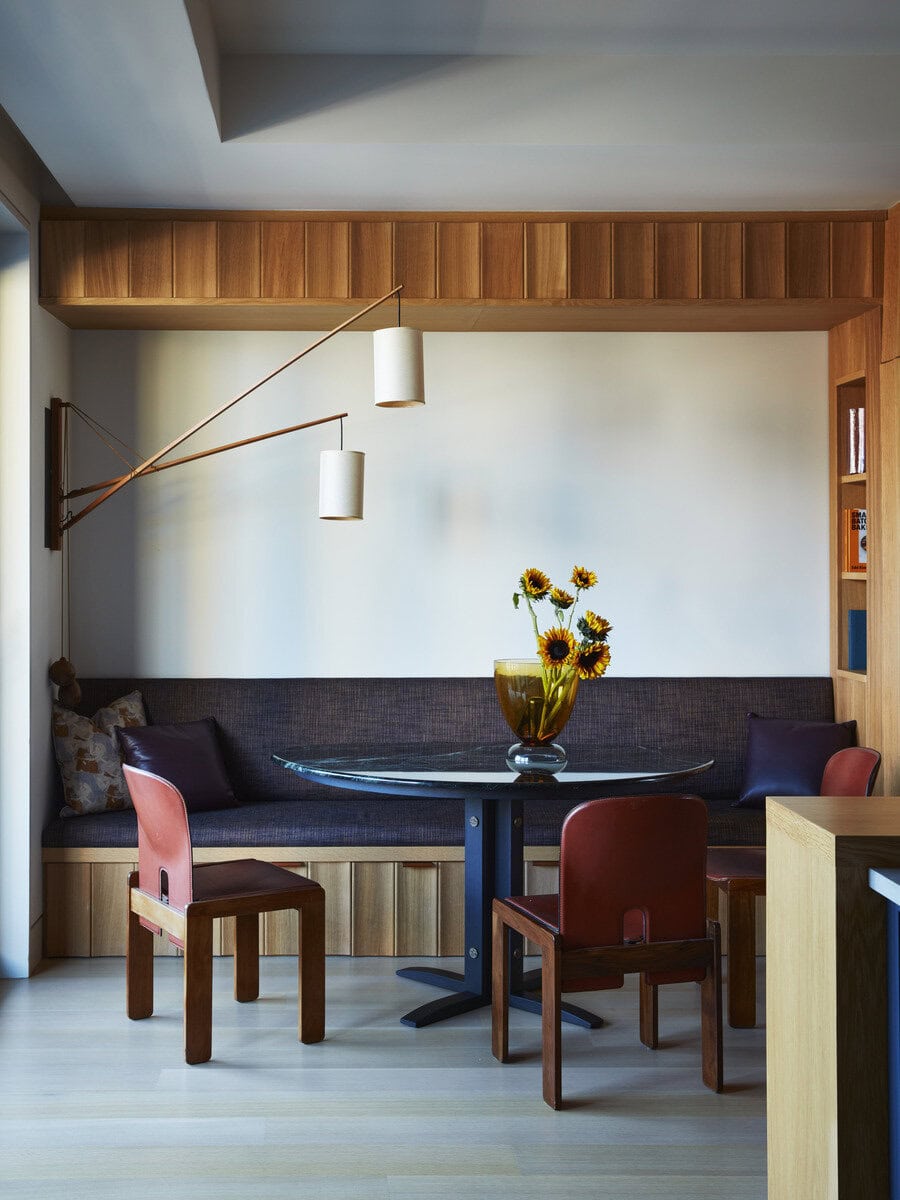
A breakfast area with a custom Verdi Alpi marble top table by MK Workshop was designed especially for banquette seating. ph: Tim Lenz
That ambition became the guiding principle behind a renovation that prioritized identity over spectacle. Rather than undertaking extensive demolition, the design team sought to work intelligently with the existing framework, introducing warmth, functionality, and a stronger sense of belonging. Central to the project was the family’s extensive collection of original artwork, which informed both the architectural interventions and the interior atmosphere.
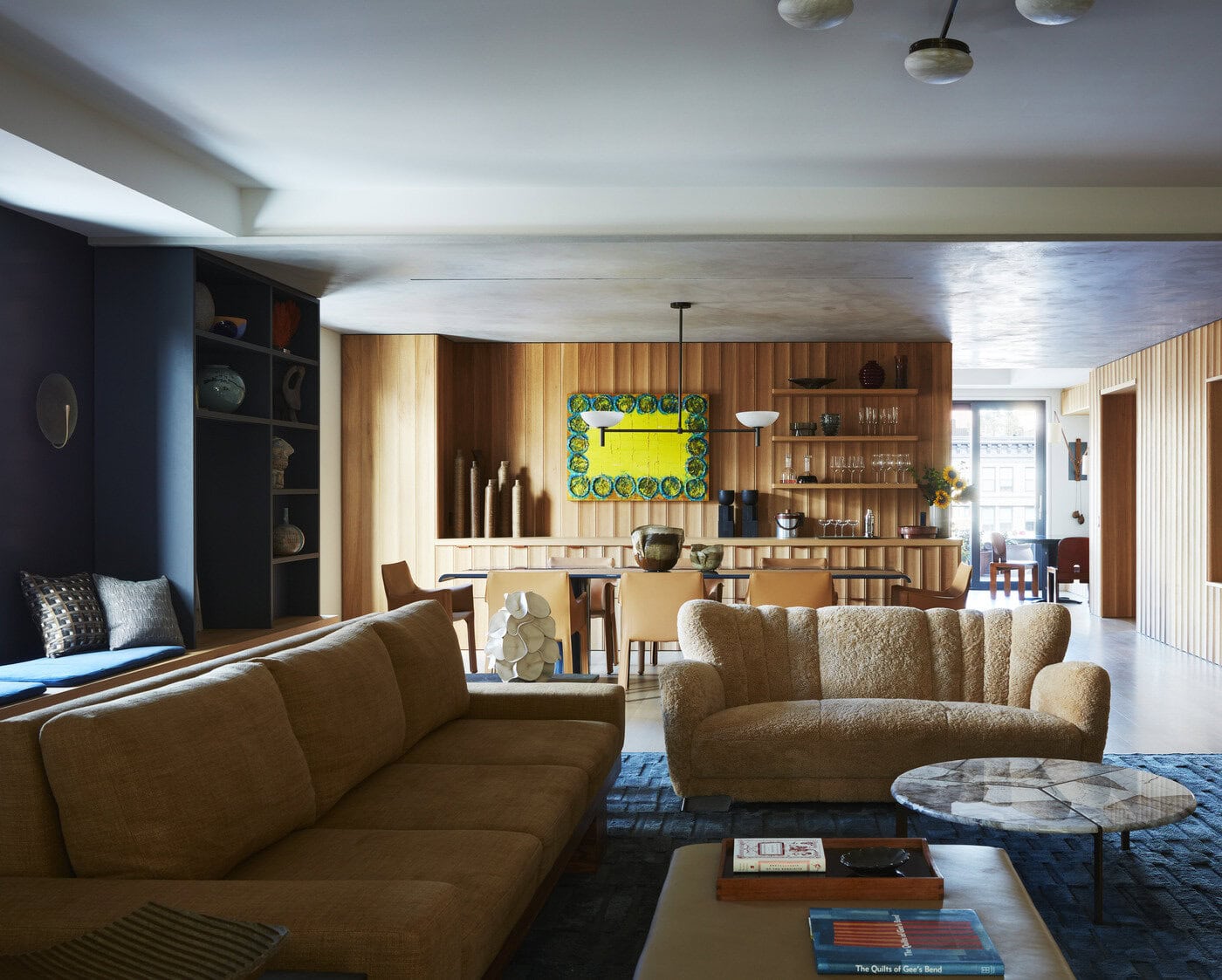
An open plan living and dining area blends tactile warmth with refined craftsmanship, featuring custom seating, natural materials, and a curated mix of art and objects. ph: Tim Lenz
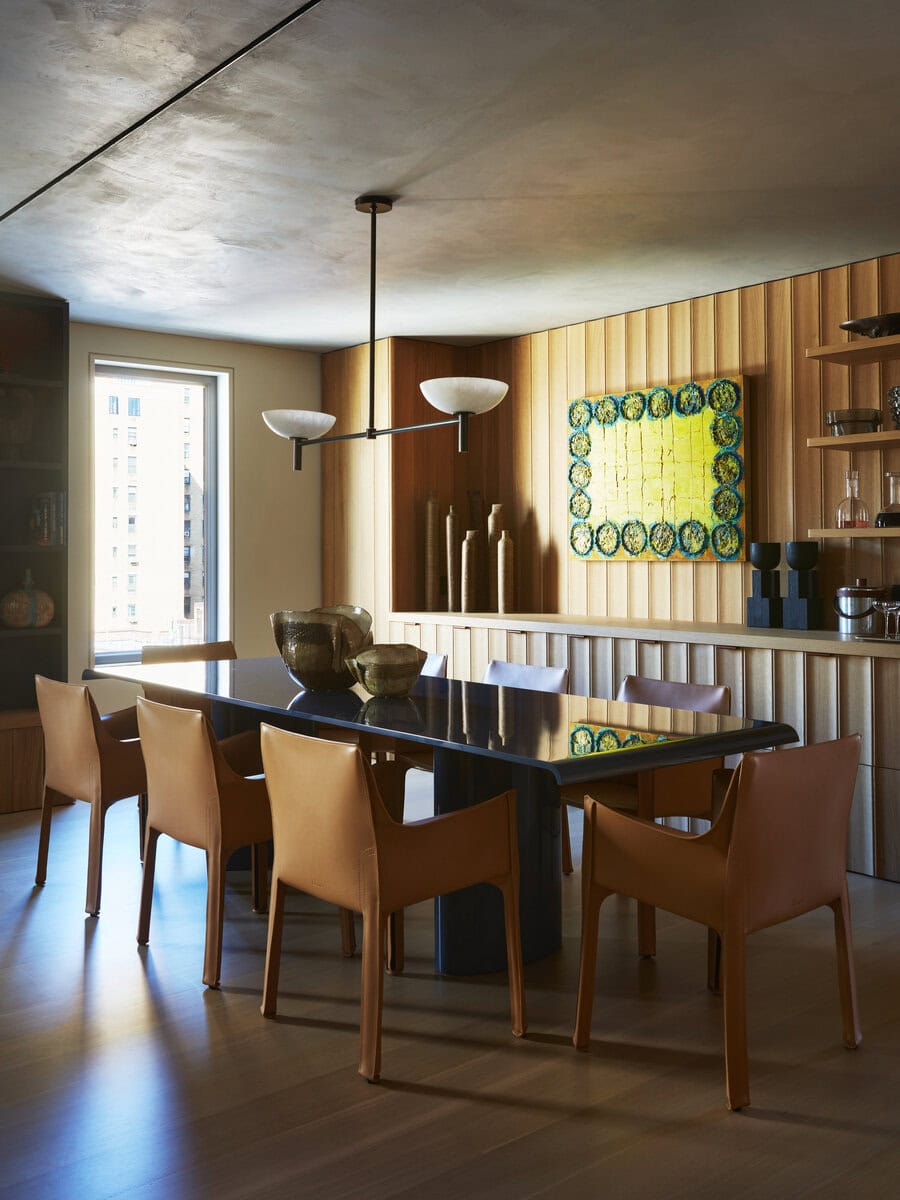
In the dining room, the Prato Pendant by Orphan Work hangs above a custom lacquered table by MK Workshop, surrounded by Mario Bellini’s Cab cowhide chairs for Cassina. ph: Tim Lenz
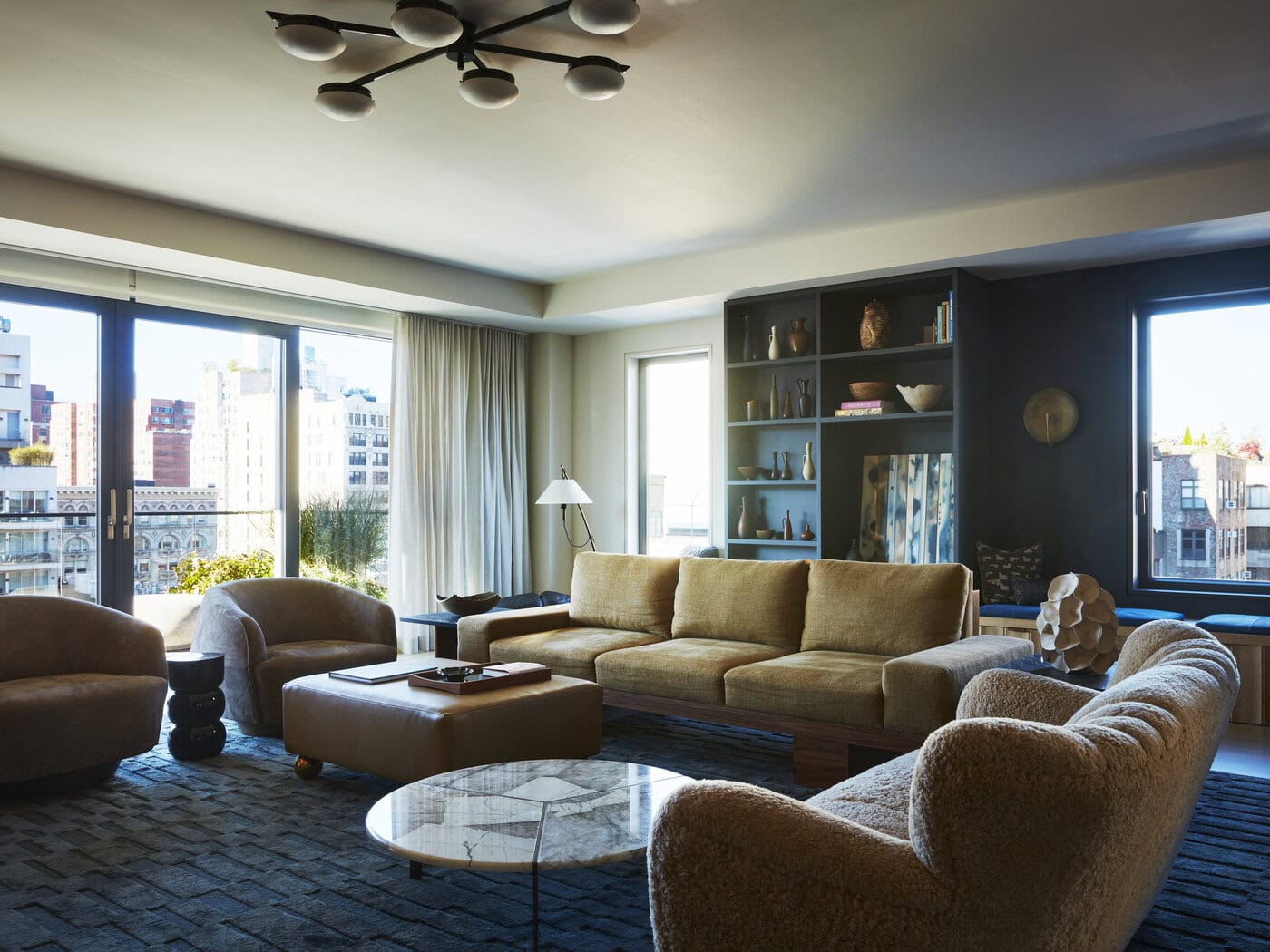
The living room features a custom rosewood sofa in Belgian linen, a leather ottoman with brass globe legs, and a silk Nepalese knot rug—all by MK Workshop. ph: Tim Lenz
A custom white oak language was developed throughout the apartment, becoming the primary tool for redefining the space. More than 230 individually selected and subtly curved oak planks were integrated into walls, storage systems, doorways, shelving, and concealed elements. These interventions serve multiple purposes simultaneously: organizing the apartment, concealing practical functions, and creating a cohesive visual rhythm. The result is a home where utility and aesthetics are inseparable, allowing the architecture to feel calm and highly resolved despite its complexity.
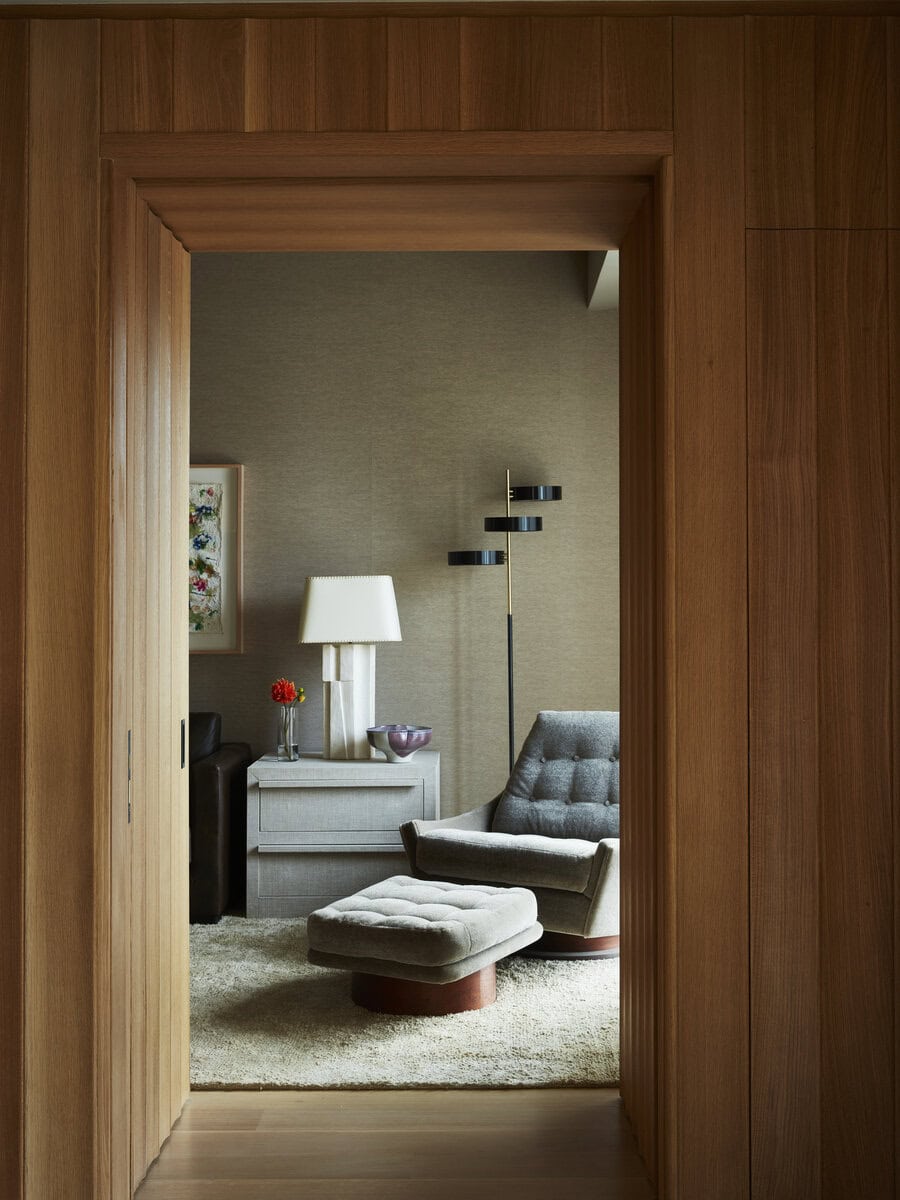
The entire home was designed for comfort, with soft textures and warm tones. ph: Tim Lenz
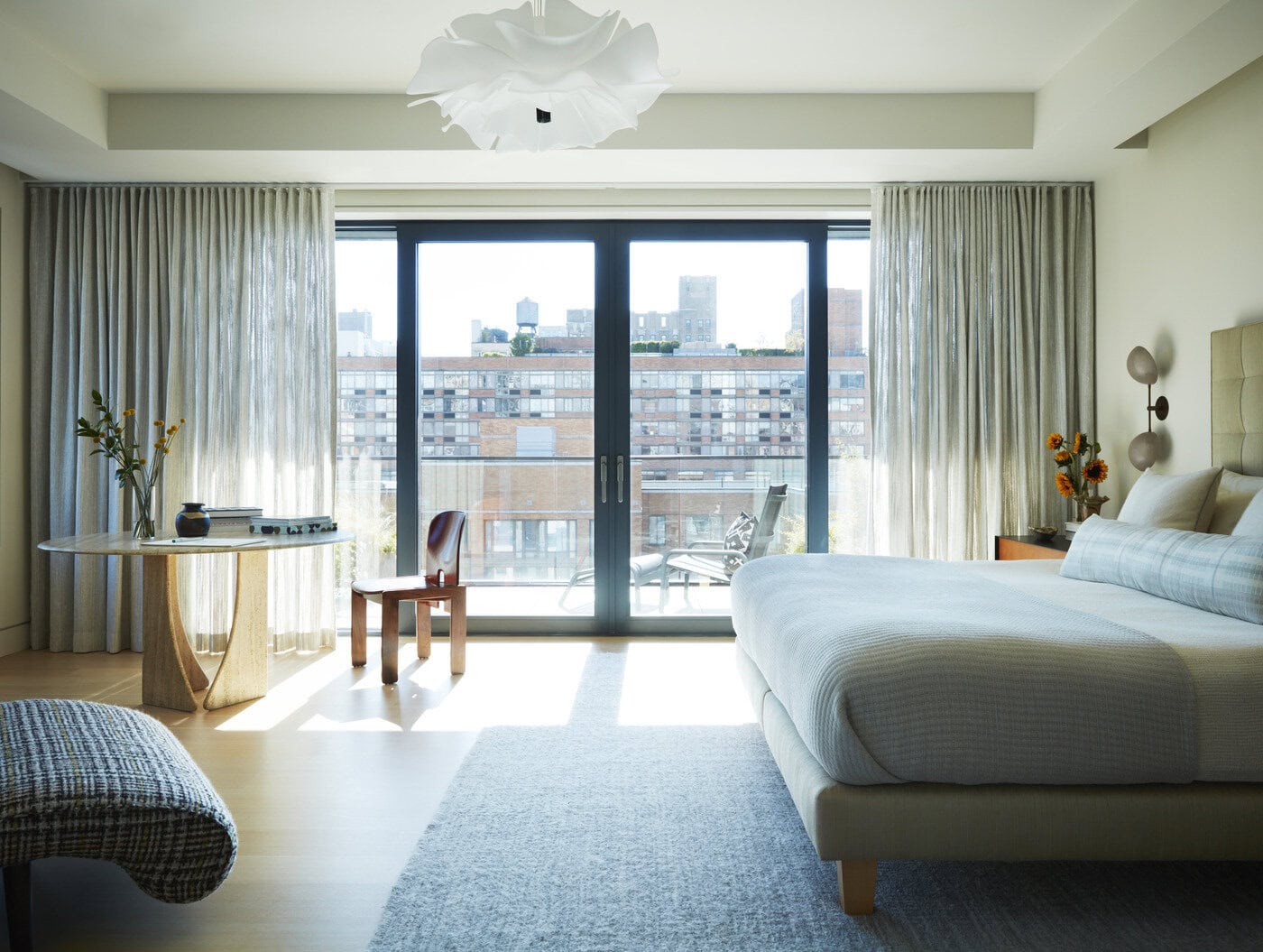
The Main Bedroom features a MK Workshop custom designed area rug in South African Mohair, a Chandelier from Juniper, vintage Travertine Table and Wave Chaise Lounge. ph: Tim Lenz
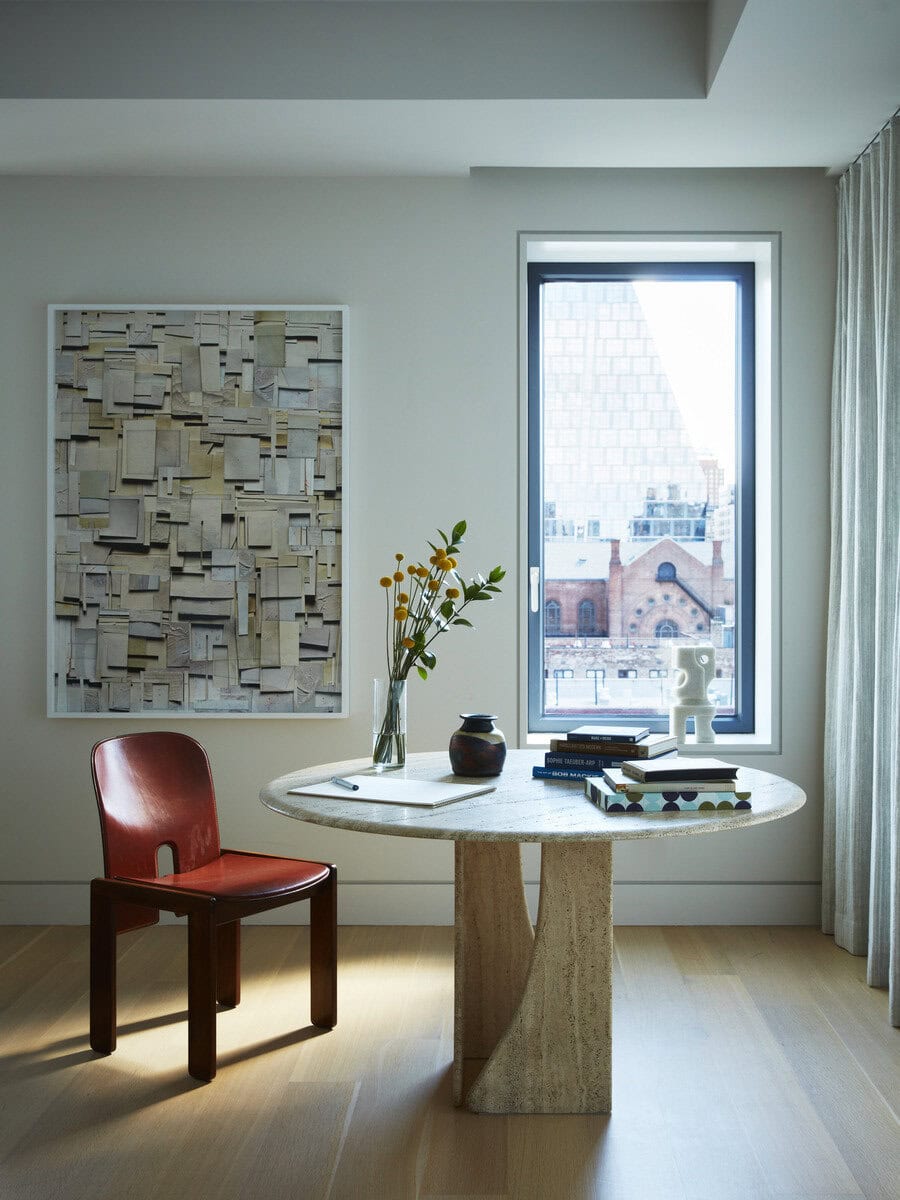
In the Main Bedroom, natural light and thoughtful details create a calm, balanced workspace. Vintage Travertine Table, circa 1970. ph: Tim Lenz
The open-plan living area became the heart of the residence. Designed around the family’s passion for music, the space incorporates concealed storage for an extensive vinyl collection alongside integrated audio equipment. Architectural elements were used to subtly distinguish zones within the large floor plate. In the dining area, a lowered plaster ceiling introduces a sense of intimacy while contrasting with the expansive glazing that surrounds the space. Carefully integrated lighting further reinforces the transition between gathering spaces without relying on physical partitions.
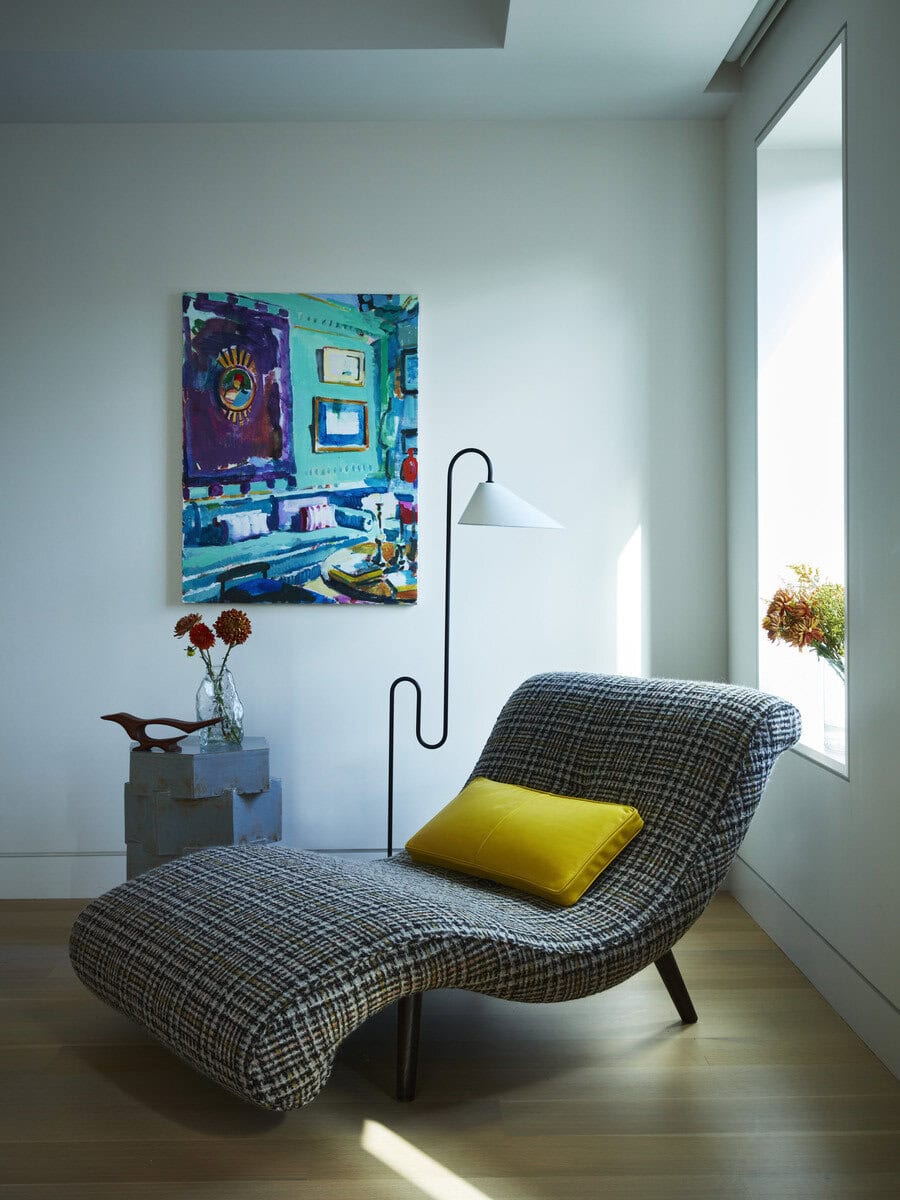
In the Main Bedroom, a Wave Chaise Lounge, circa 1990, reupholstered in Passel ph: Tim Lenz
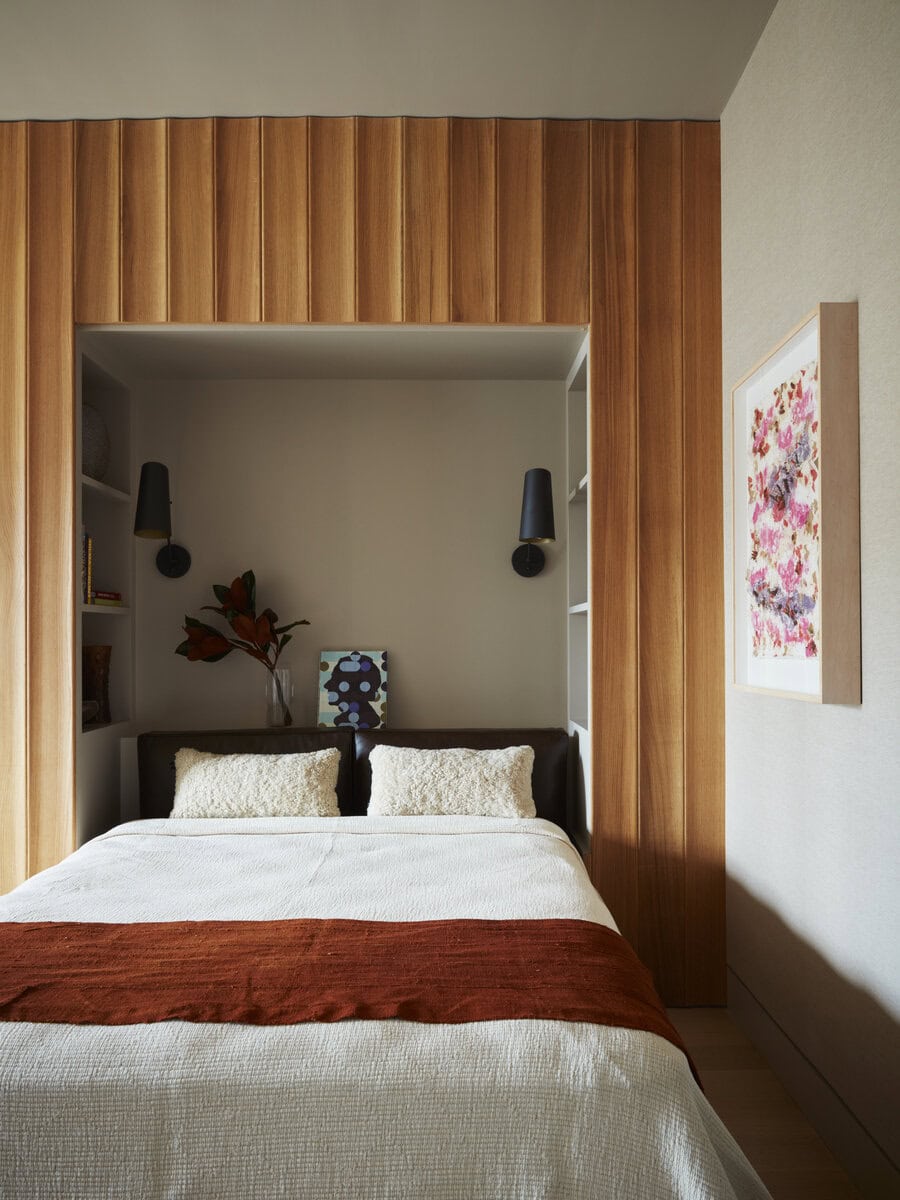
In the Guest Bedroom, the hideaway bed is ready for guests, the wall section having been lowered like a drawbridge, with hinges at the bottom of the wall, to reveal the mattress affixed to the other side of the wall. Greige ceiling by Sherwin-Williams, rift-sawn White Oak paneling, grasscloth wallpaper in Latte by Holly Hunt. ph: Tim Lenz
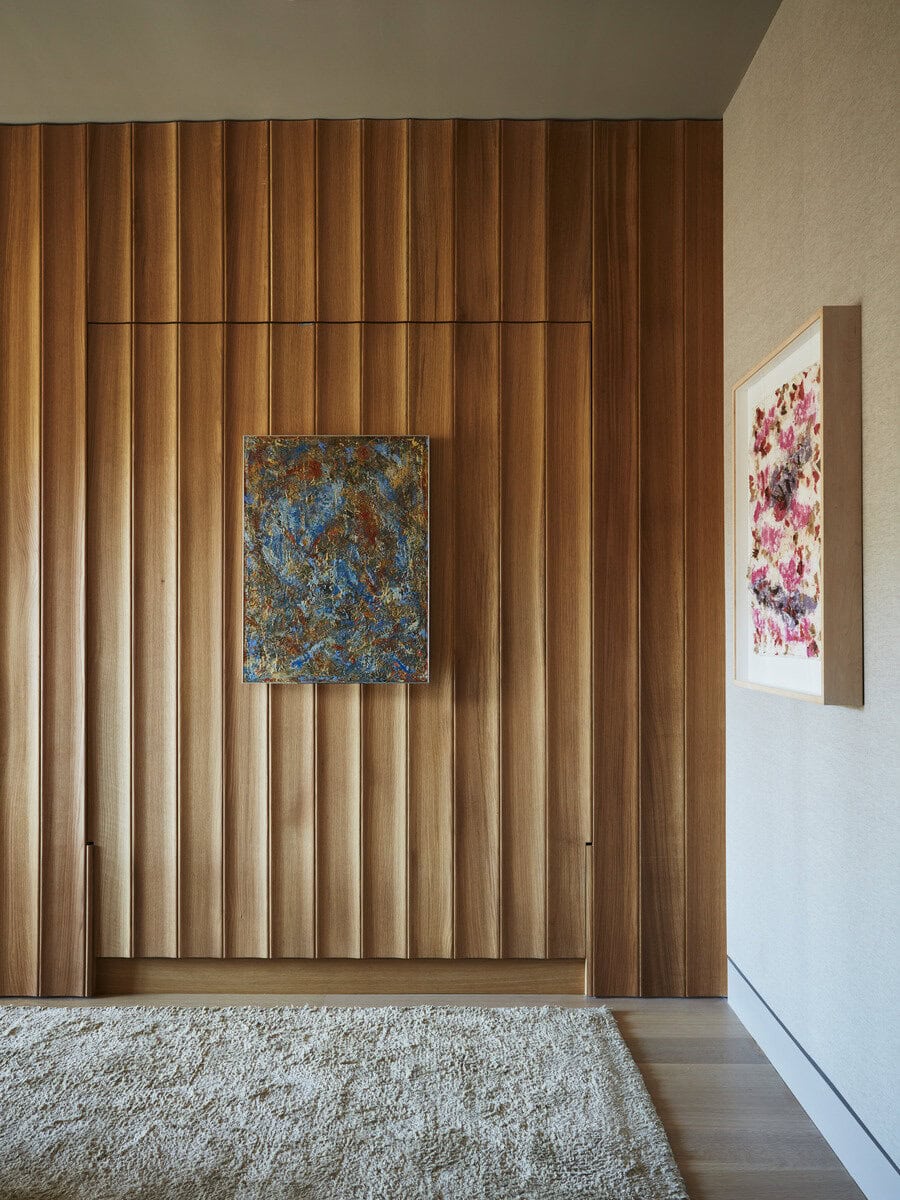
In the Guest Bedroom, the hideaway bed is tucked behind the wall of rift-sewn White Oak paneling, which hinges at the bottom. Frederic Choisel’s “Inextricable 12” painting is custom framed with discreet handle slots hidden on the left and right sides. The picture frame is attached to the wall so it becomes the handle to the wall, allowing the hideaway bed to be lowered. Grasscloth wallpaper in Latte by Holly Hunt and a rug custom-designed by MK Workshop. ph: Tim Lenz
Elsewhere, the renovation focused on improving everyday functionality while maintaining visual clarity. The kitchen was reconfigured through a series of strategic adjustments that enhance circulation and usability while keeping work areas discreetly hidden from the main living spaces. A more casual dining nook complements the formal dining room, providing flexibility for family life.
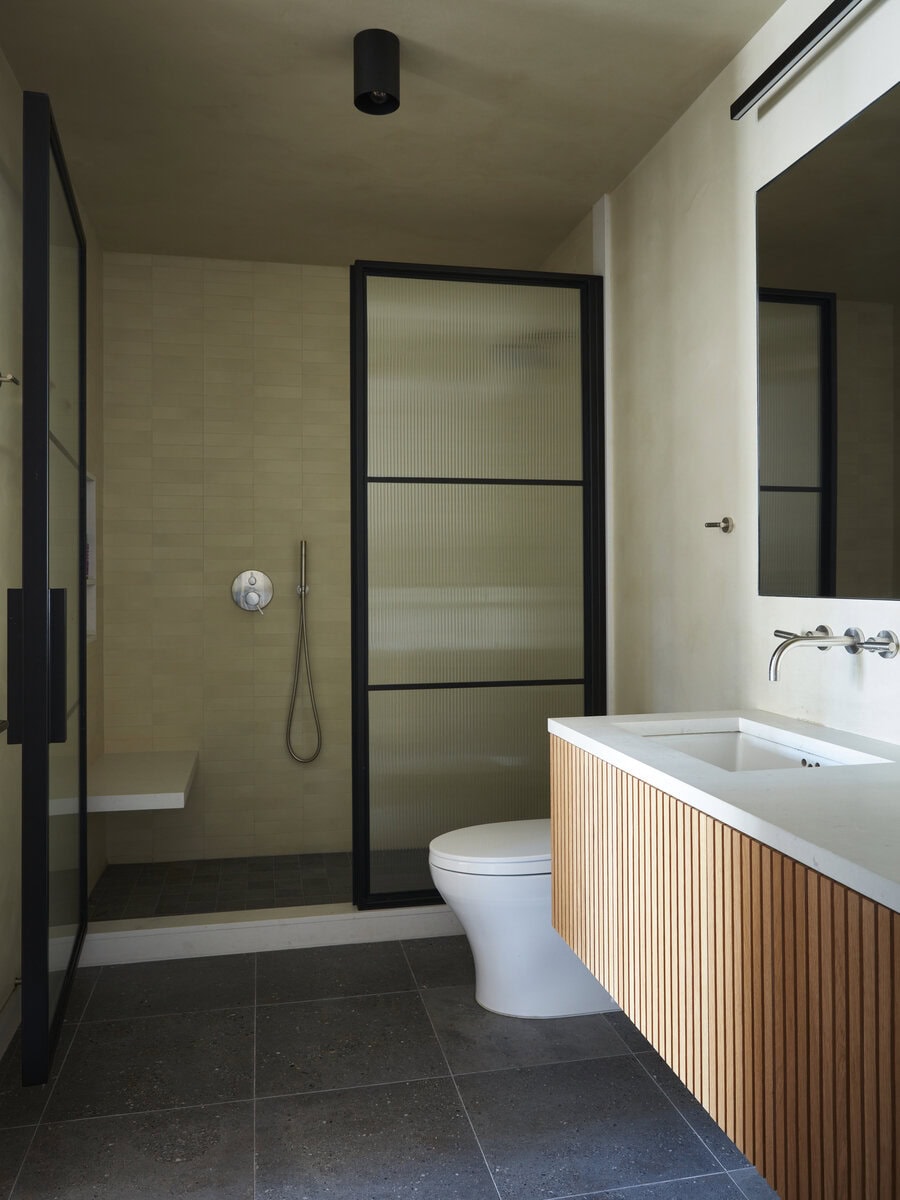
A new Guest Bathroom with blackened steel shower doors with ribbed glass and Venetian plaster ceiling and walls in custom color. ph: Tim Lenz
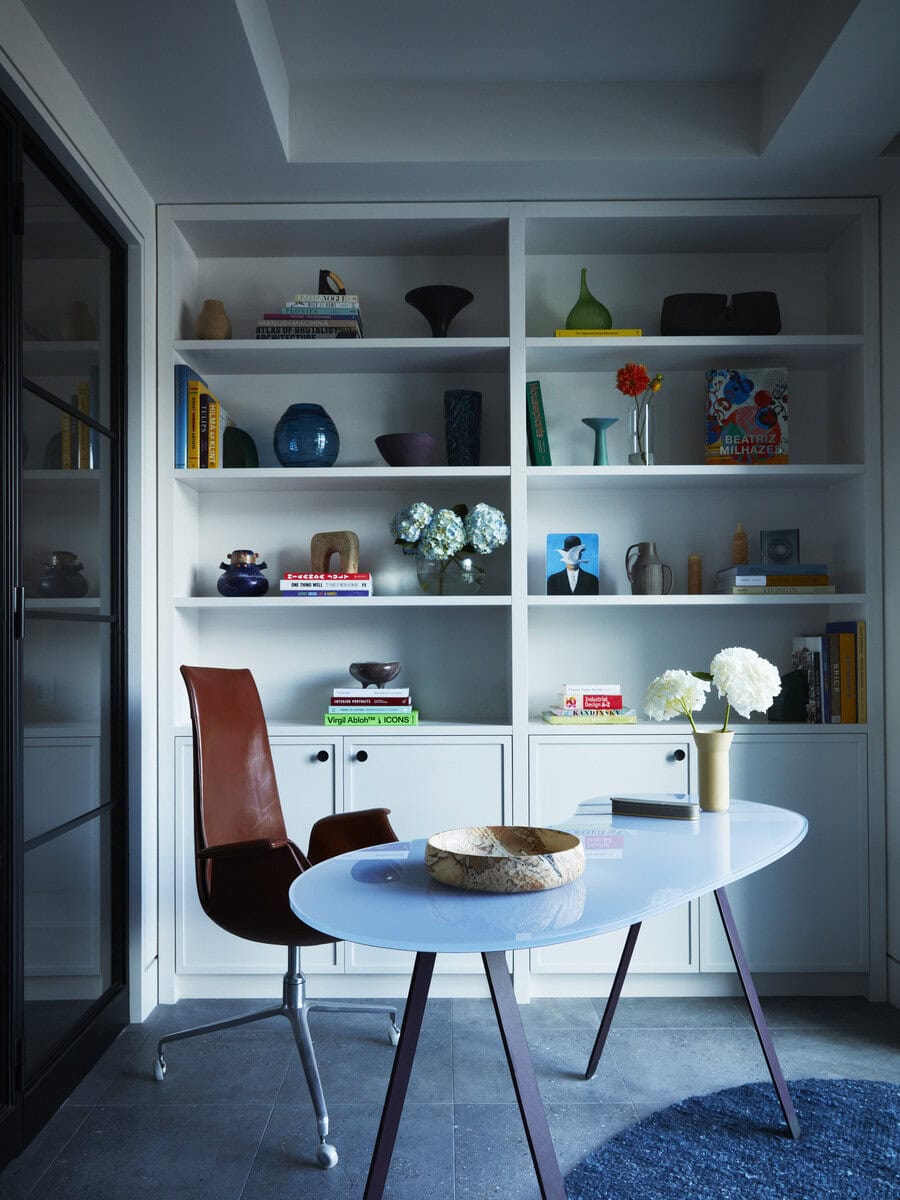
The home office features walls and ceiling in Silver Satin by Benjamin Moore. A vintage Tulip Chair by Preben Fabricius & Jørgen Kastholm pairs with a custom glass-top desk designed by MK Workshop Interior Design and crafted by Karol Popek of Model Smith. ph: Tim Lenz
The arrival sequence was also completely reconsidered. What had previously been a transitional space was transformed into a formal foyer that establishes a clear sense of entry and arrival. Supporting spaces such as the mudroom and home office were relocated and reorganized, allowing practical functions to remain hidden while preserving a seamless progression from the elevator into the home.
Flexibility became another defining theme of the project. The den was designed as a multi-purpose room capable of functioning as a television lounge, home office, or guest bedroom. Through carefully integrated architectural elements, the space can either connect openly to the living area or operate independently when privacy is required. Adjacent bathrooms were similarly reconfigured to improve functionality while accommodating both family life and visiting guests.
While the project is characterized by craftsmanship and bespoke detailing, sustainability played a significant role in shaping the renovation strategy. Rather than discarding serviceable materials, the design team donated all removed millwork, kitchen cabinetry, and appliances to a local charity. This decision reduced waste while extending the lifespan of materials that remained in excellent condition.
The project also sought to reduce its environmental footprint through collaboration with local artisans and furniture makers based in nearby New Jersey and Brooklyn. By relying on regional craftsmanship for many of the custom-designed elements, the renovation demonstrates how sustainability can be embedded within a project not only through material choices, but also through responsible sourcing and community-based production.
The completed apartment is less a dramatic reinvention than a carefully calibrated transformation. Through precise interventions, integrated craftsmanship, and a deep understanding of how a family lives, the project succeeds in turning an anonymous loft into a home with a distinct identity—one shaped as much by the people who inhabit it as by the architecture itself.