

 English
 日本語
日本語

At the 19th Venice Architecture Biennale, architecture becomes language as Taiwan’s pavilion explores identity, adaptability, and the quiet strength of not conforming
Every two years, the world gathers in Venice for one of the most significant events on the global cultural agenda: La Biennale di Venezia. The 19th International Architecture Exhibition, curated by architect and engineer Carlo Ratti, unfolds under the theme ‘Intelligens. Natural. Artificial. Collective’. Open to the public from May 10 to November 23, 2025, the Biennale invites over 750 participants across different disciplines—architects, scientists, artists, coders, farmers, and designers—to rethink the built environment amid accelerating climate challenges.
This year’s Biennale isn’t just about imagining better buildings – it’s about rethinking the role of architecture entirely. Ratti challenges us to move beyond trying to fix climate problems from the outside. Instead, he proposes we embrace new forms of intelligence—human, non-human, machine-based, and collective—to adapt to the unpredictable. In a time marked by wildfires, floods, and social unrest, design can no longer be a top-down exercise in control. It becomes a process of learning from nature, from technology, and each other.
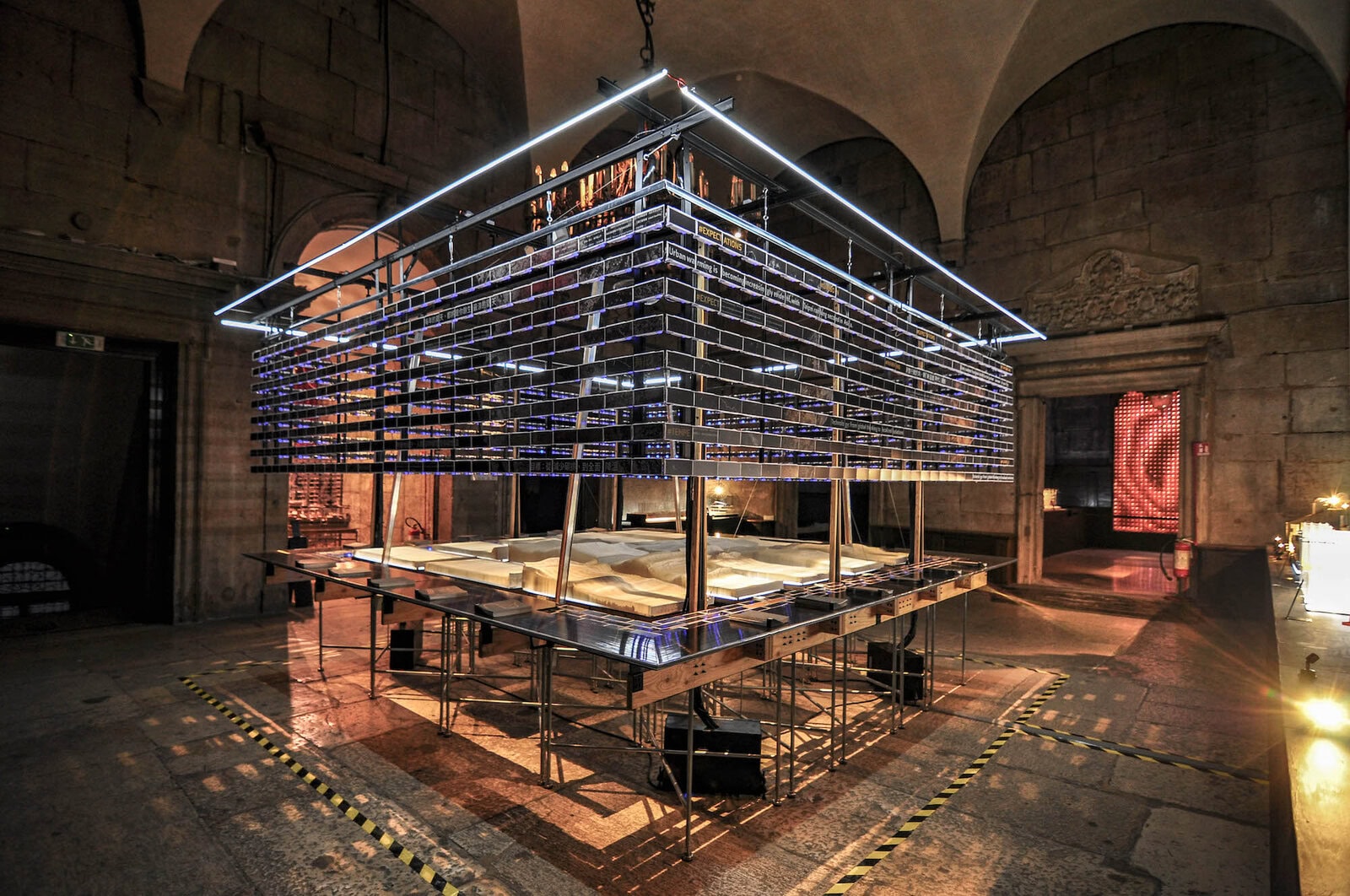
H2O Studio, NON-Belief in TECHisland (Exhibition space), 2024, E-paper, Honeycomb Paper, Steel Structure, Digital rendering and laser cutting. Courtesy of National Taiwan Museum of Fine Art.
In keeping with this spirit of renewal and reinvention, the Biennale itself is taking meaningful steps toward sustainability. The 2025 edition aims for full carbon neutrality under the ISO 14068 standard—an ambitious goal for a global event of this scale. From reusing materials to carbon offsetting, the Biennale frames architecture as both medium and message in the push toward circular, regenerative futures. This focus on circularity and collective adaptation sets the stage for a range of responses that rethink architecture’s role in a precarious world—responses that extend beyond national narratives and into more fluid, experimental terrain.
Among the standout Collateral Events of the Biennale is Taiwan’s contribution: ‘NON-Belief: Taiwan Intelligens of Precarity’. Organized by the National Taiwan Museum of Fine Arts and curated by a team from National Cheng Kung University (NCKU), the pavilion offers a striking meditation on instability, identity, and innovation. The curatorial team—led by Professor Cheng-Luen Hsueh and joined by Ping-Sheng Wu, Sung-Chang Leo Chiang, and Meng-Tsun Su—chose not only to confront Taiwan’s geopolitical and ecological precarity but to embrace it as a catalyst for architectural creativity.
Set within the evocative halls of the Palazzo delle Prigioni, just across the canal from Piazza San Marco, the Taiwan Pavilion features 17 research projects and 12 working models that together form a network of ideas rather than a single narrative. Immersing visitors in Taiwan’s complex relationship with technology, geography, and resilience, these projects explore a range of tensions—between high-speed and slow living, rural traditions and high-tech development, ecological care and industrial ambition.
Prior to the Biennale’s official opening, we had the opportunity to speak with Professor Cheng-Luen Hsueh over Zoom—just one day before he and his team flew to Venice.
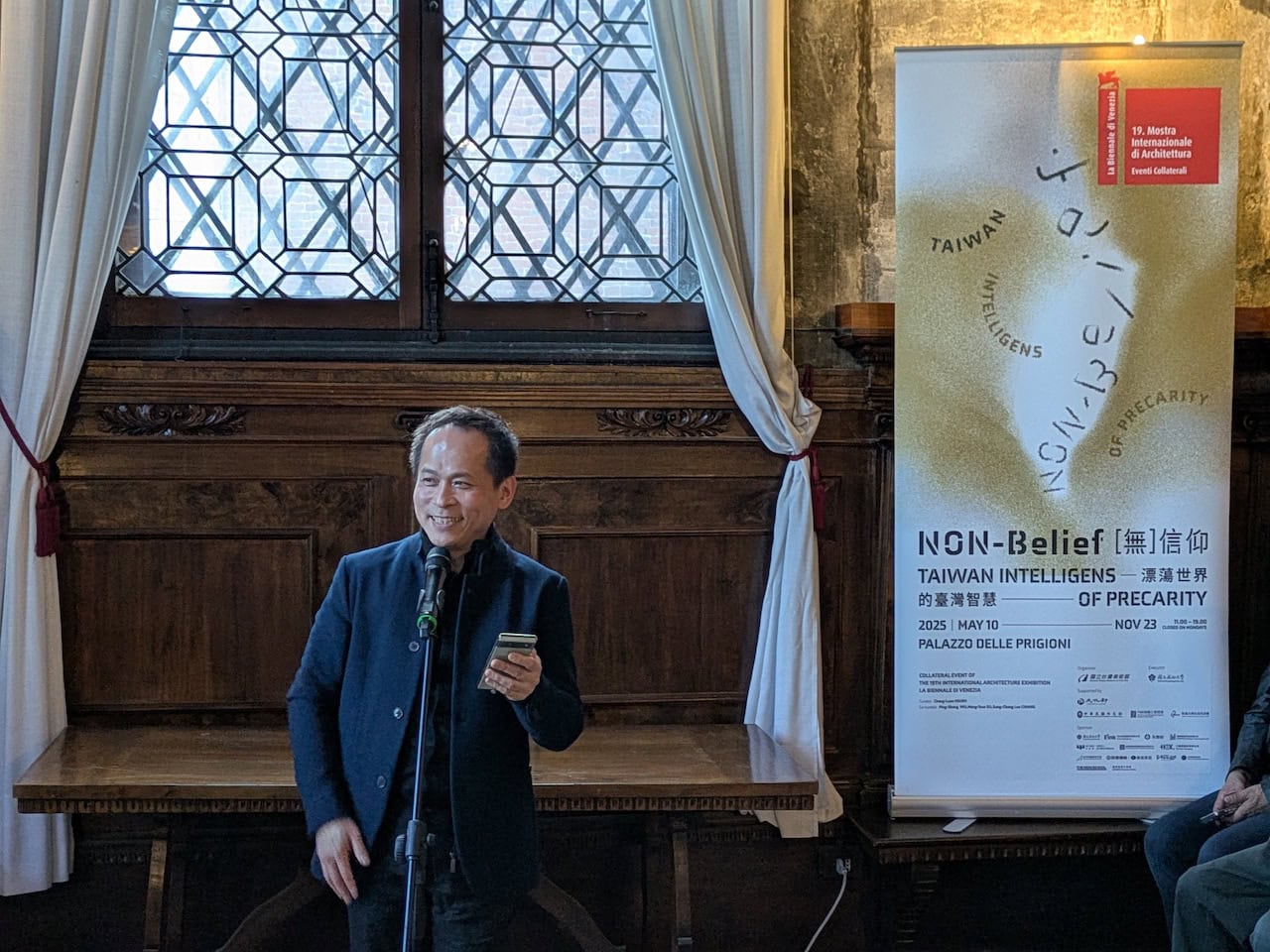
Professor Cheng-Luen Hsueh, Chair of NCKU Architecture and curator of the exhibition, delivers the opening remarks at the exhibition’s launch.
Can you tell us about the exhibition “NON-Belief: Taiwan Intelligens of Precarity”?
“NON-Belief is something very familiar to Taiwanese people. We have a strong culture of belief—whether in traditions, religion, or progress—but we also have the flexibility to let go, to shift beliefs when needed. That openness is something we've developed through living in an unstable environment—physically, politically, socially. We're always adapting. We see that adaptability as a form of intelligence. It's not about having the right answer all the time, but about staying responsive, staying curious — a special way of surviving and thriving despite instability.
“Through our research, we observed how this mindset is reflected in Taiwan's architecture: it’s resilient, flexible, and able to respond to change. That's what we wanted to bring to the global stage at the Venice Biennale — this unique 'intelligens' born from Taiwan’s precarious position.
“We also chose microchips as a central symbol, because Taiwan — through companies like TSMC [Taiwan Semiconductor Manufacturing Company]— produces a huge percentage of the world’s semiconductors. In a way, microchips have become a national 'belief' — a symbol of survival and temporary sovereignty amid global tensions, especially between China and the U.S. During the COVID pandemic, we even used microchips as leverage to negotiate for vaccines. So, technology, particularly microchips, has become intertwined with Taiwan’s sense of identity and survival.
“Overall, Taiwan’s architecture and urban development reflect this ‘non-belief’ sensibility — growing from a place of constant precarity, constantly adapting. That’s the heart of the exhibition.”
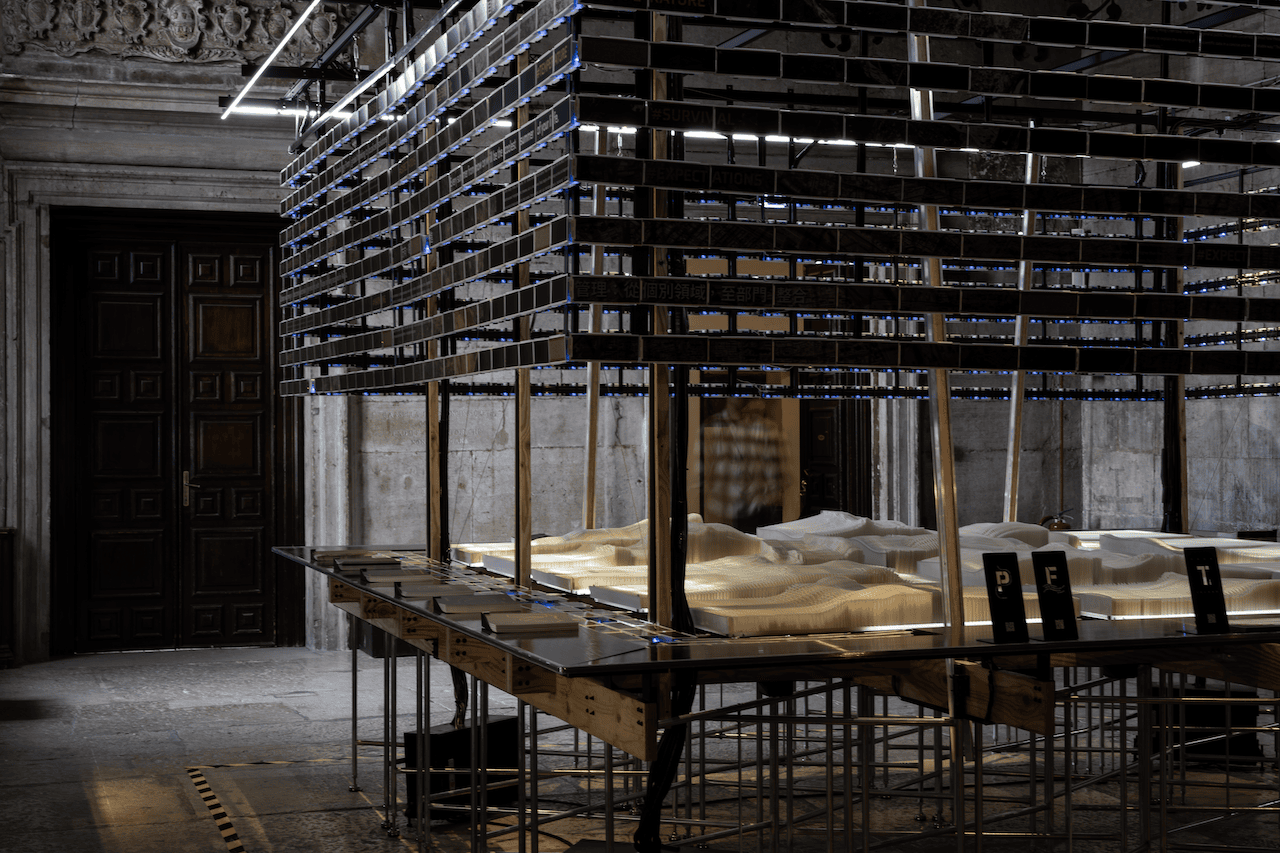
H2O Studio, NON-Belief in TECHisland (Exhibition space), 2024, E-paper, Honeycomb Paper, Steel Structure, Digital rendering and laser cutting. Courtesy of National Taiwan Museum of Fine Art.
What inspired the choice of the word “NON-Belief” for the title of the exhibition?
“The word "NON-Belief" was chosen to describe Taiwan’s constantly shifting belief systems. Taiwanese society often moves between different, even contradictory, beliefs — for example, believing in high-tech manufacturing while also idealizing ecological sustainability, even though technological development harms the environment. This back-and-forth creates a dynamic, flexible mindset, not a rigid commitment to a single ideology.
“The word "NON" is not meant negatively; instead, it highlights this in-between, fluid condition — similar to Robert Smithson’s idea of "non-site", where two contradictory states coexist. Thus, "NON-Belief" expresses Taiwan’s resilience and adaptability — the ability to exist confidently between different beliefs, rather than being locked into one.”
You explore NON-Belief in things like high-speed rail and semiconductor tech – often seen as signs of progress. What made you want to question these narratives?
“The exhibition engages with themes like technology, speed, and control because they deeply shape Taiwan today. High-speed infrastructure, like the high-speed rail network, has made it possible to travel around the entire island within a single day, accelerating urbanization, development, and a widespread belief in "high-speed living."
“At the same time, Taiwan's semiconductor industry — symbolized by the rise of massive high-tech science parks — has driven a rapid transformation of rural landscapes, consuming huge amounts of water and agricultural land. To support the energy demands of this development, large-scale solar farms are replacing green farmland, especially in southwestern Taiwan.
“The exhibition critically questions this faith in technological progress, asking audiences to also consider what is being sacrificed: natural resources, traditional agricultural practices, and rural ecologies. The idea of "non-belief" emerges here, proposing a more fluid, dynamic way of thinking, moving between belief in technological progress and skepticism about its costs.
“Rather than presenting a purely negative view, the exhibition explores adaptive, resilient possibilities: new types of hybrid infrastructures, like integrating solar farms with fish farms, or reimagining abandoned landscapes around science parks as important buffers during extreme weather events.
“In this way, the exhibition suggests that Taiwan’s modernization is not simply a story of success or loss, but an ongoing negotiation between growth, resilience, and ecological stewardship.”
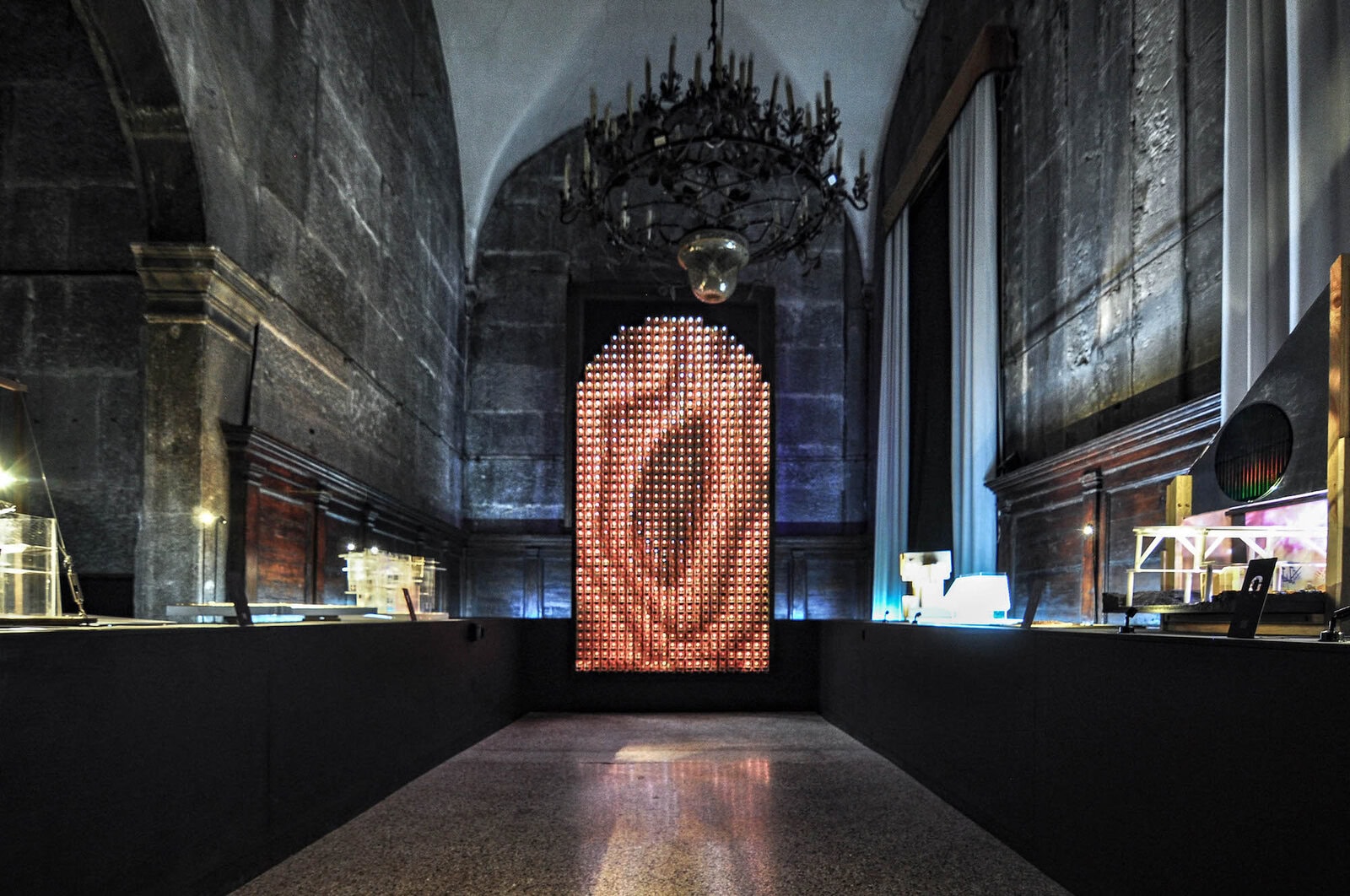
H2O Studio, Votive Lamp Wall (Exhibition space), 2024, Votive Lamp, E-paper. Courtesy of National Taiwan Museum of Fine Art.
How did the unique setting of the Palazzo delle Prigioni—and its layered history—influence the exhibition’s approach?
“Historically, this was where prisoners glimpsed the outside world for the last time, crossing the famous Bridge of Sighs. There’s a window in our exhibition space that mirrors the exact view the prisoners would have had. It’s poetic and painful at the same time – a beautiful farewell, a liminal space between confinement and freedom.
“That emotional in-betweenness echoes Taiwan’s global standing: officially recognized only as a “collateral” participant, it is excluded from the main national pavilions due to its contested political status. This sense of marginality becomes, paradoxically, a strength—fuel for a radically adaptive approach to architecture.”
Can you tell us about one or two pieces or installations in the exhibition that you think visitors should absolutely not miss? Why are they important?
“There are three key highlights.
“Firstly, ‘Tech Island’, a central installation inspired by Taiwanese temple offering tables, built from 20–30 banquet table legs to resemble the piles beneath Venice’s historic buildings. Above it hangs a lantern-like structure made from e-paper, a Taiwanese tech innovation. The contrast between the glowing, high-tech element and the heavy Venetian stone walls symbolizes the tension between tradition and modernity. Its shifting light and imagery, changing every three minutes, make it a dynamic, living piece.
“Another important installation, ‘Votive Light Wall’, is positioned near the window with a view of Venice's famous "Bridge of Sighs". The Votive Light Wall draws from Taiwanese temple traditions where people light votive lamps for protection and good fortune. It incorporates the shape of Taiwan into the design, tying it back to the exhibition's visual identity and themes of hope, resilience, and in-betweenness. The wall and the view through the window metaphorically connect Taiwan's political and cultural situation — caught between beauty and hardship — to the concept of "being in-between."
“There’s also a short documentary ‘Film: Island in Between’ that visitors shouldn’t miss, by director S. Leo Chiang, who was also a co-curator of the exhibition. It explores Taiwan’s precarious geopolitical position between China and the U.S., resonating deeply with the exhibition’s overarching themes of liminality and identity. ‘Island in Between’ was nominated for an Academy Award (Best Documentary Short) in 2024.”
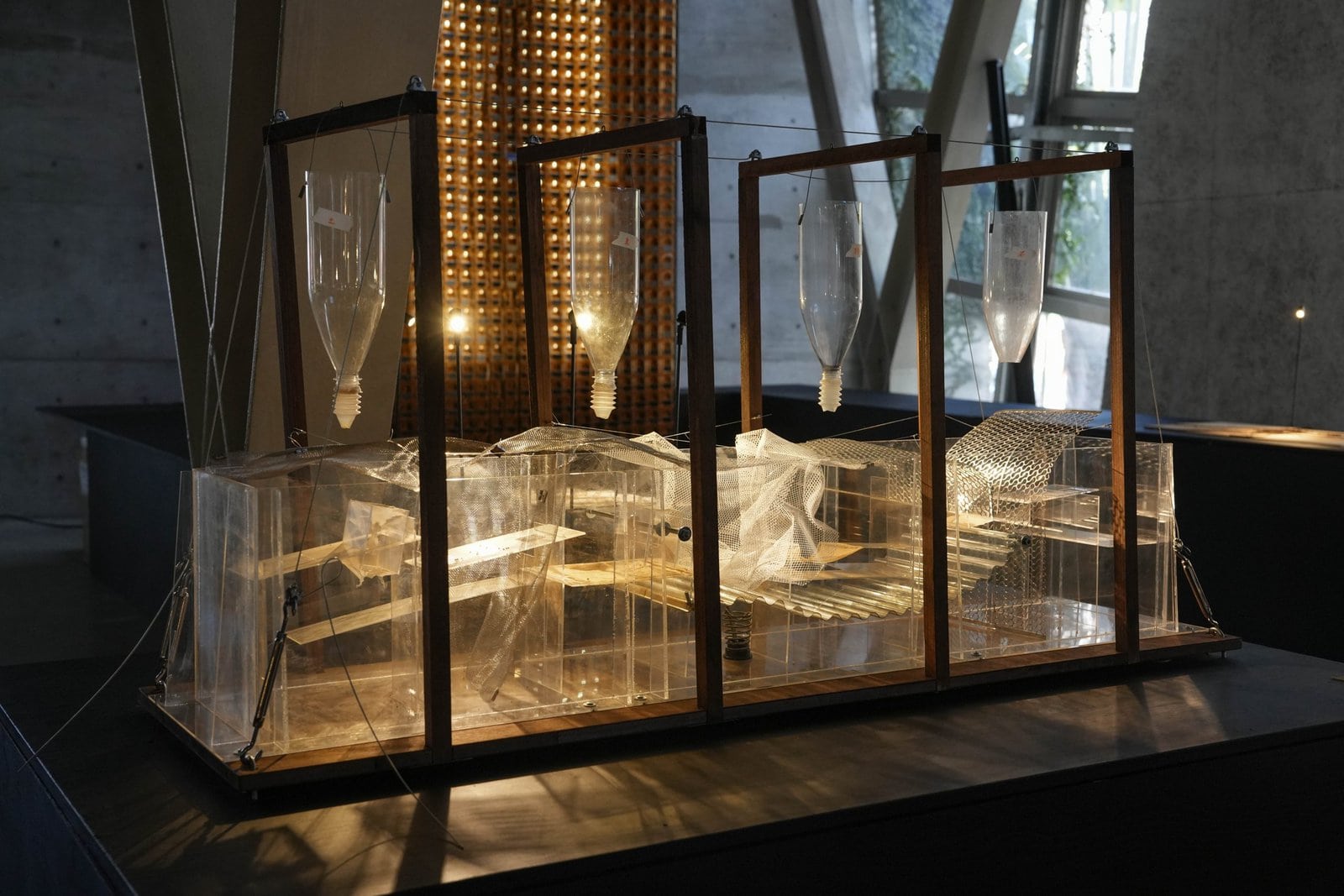
Urban Spectacle
Exhibitor Name: Wei TSENG, Jeong-Der HO
Exhibition Teams: Tunghai University Department of Architecture
Team Members: Yu-En HUANG, Hsuan-Ting CHEN, Hsu LI, Yi-Hsin CHEN, Li-Hsuan LIN, Ya-Wen YANG, You-Chen CHUANG, Pony WU, Chen-Wei LIN, Yuan-Chee LEE
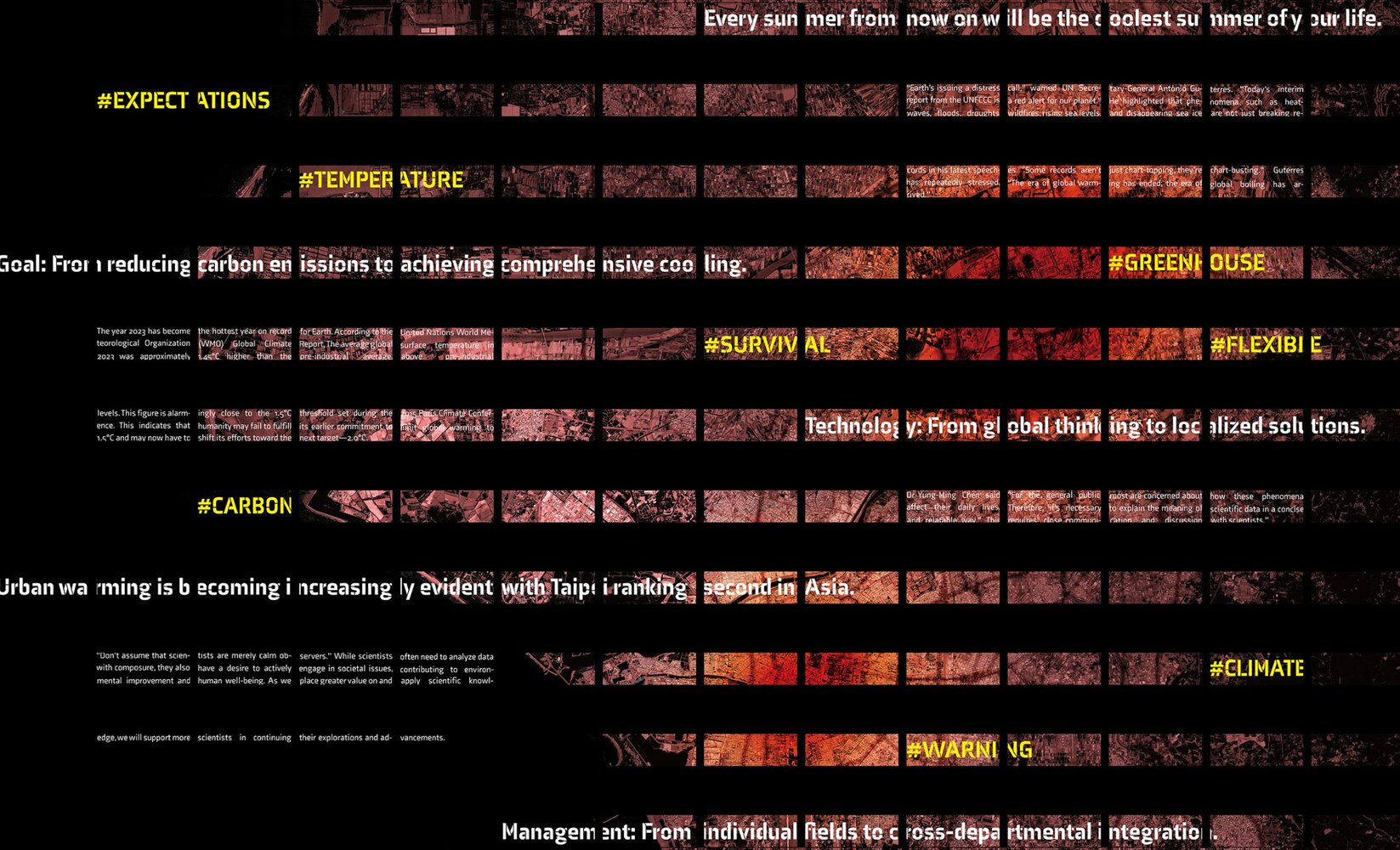
Climate Justice
Exhibitor Name: Tzu-Ping LIN
Exhibition Teams: BCLab
Team Members: Szu-Yi LEE
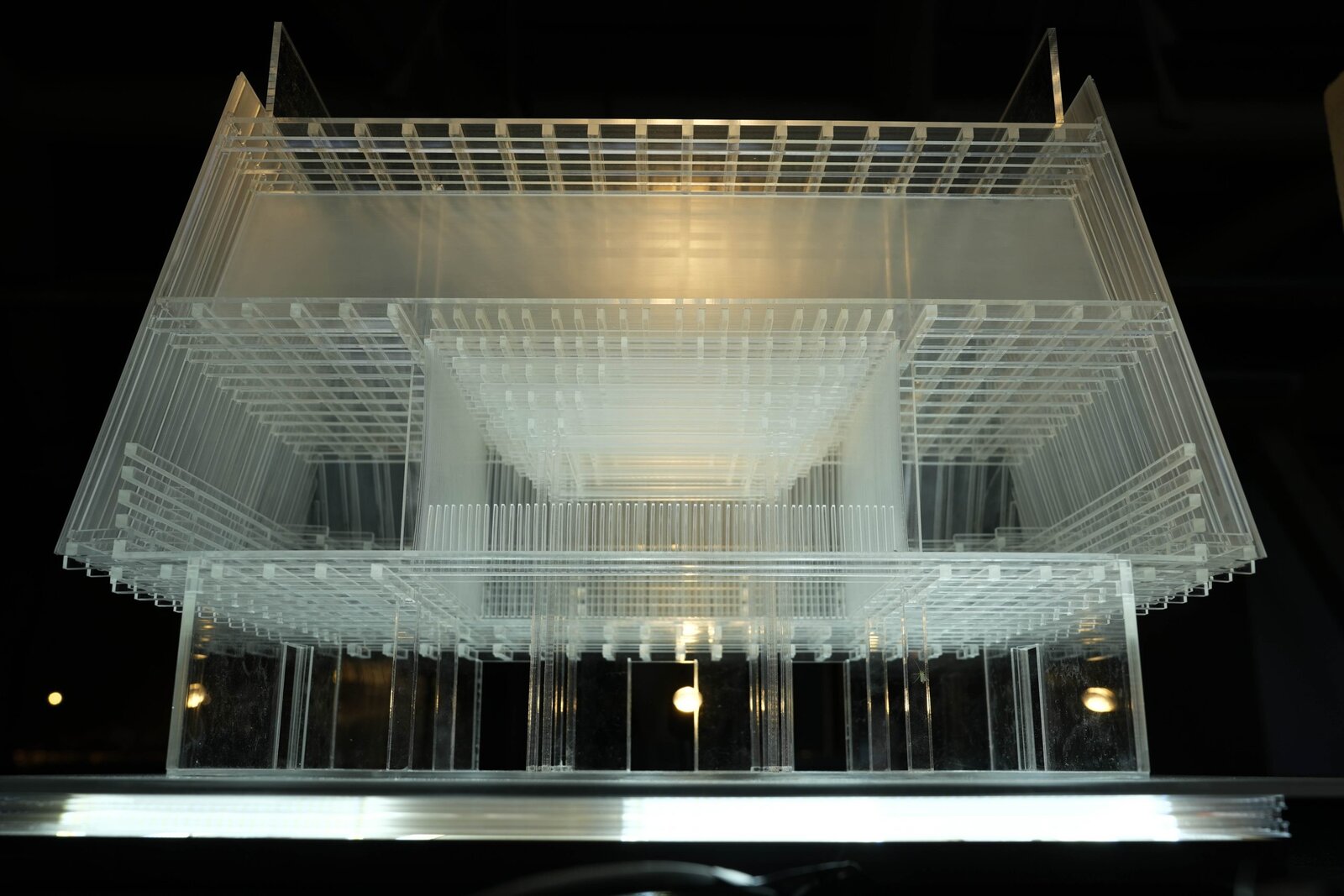
Mazu Techple
Exhibitor Name: Wan-Jen LIN, Ching-Mou HOU, Yu-Hsiang YEH, Po-Wei LAI
Exhibition Teams: Studio HOU x LIN + Yu-Hsiang Yeh + Po-Wei Lai
Team Members: Yu-Hua Tsai, Bing-Syun LI , Yu-Ya WANG , Jing-En CHOI
This exhibition is part of a global event—the Venice Biennale of Architecture. What message do you hope international audiences take away from Taiwan’s contribution?
“We hope visitors leave with a deeper sense of Taiwan’s identity as a place that exists in between—geographically, politically, and culturally. That idea of "in-betweenness" is something you feel not only through the 17 research projects we’re presenting but also in the physical experience of the pavilion itself, which transitions from a view of Venice to a vibrant installation inspired by Taiwan’s local temple traditions.
“We also want to encourage visitors to think critically about belief systems—especially how they shift over time, how ideas of progress and modernity aren’t always simply good or bad. Taiwan’s experience, living in this precarious position between larger forces, offers a kind of "adaptive intelligence" that feels especially important in today’s world of political and environmental uncertainty.
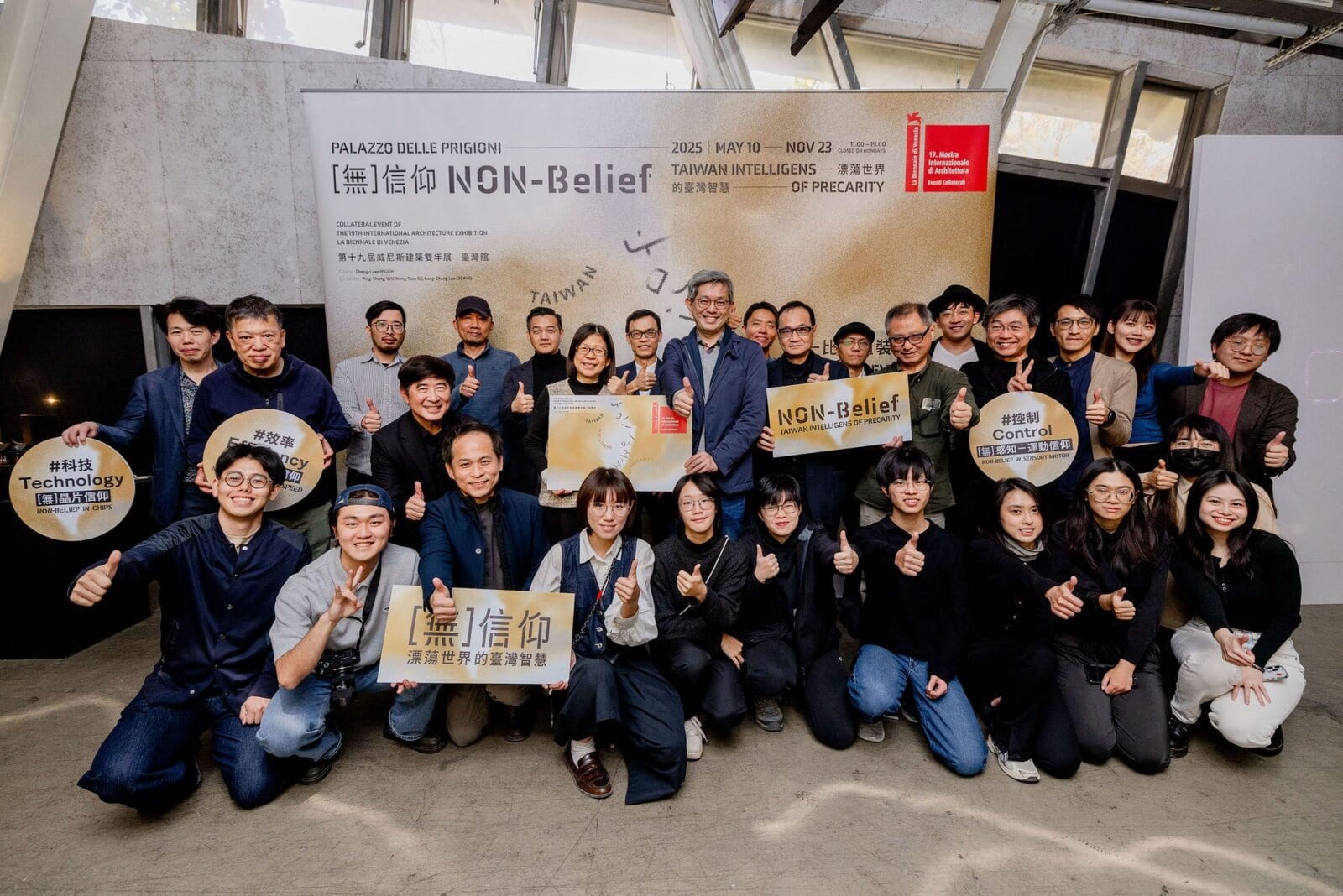
Members of the team behind the exhibition.
“At the same time, the exhibition has had a big impact at home. I’m currently the director of the architecture department at National Cheng Kung University (NCKU), and we used the Biennale as an opportunity to rethink architectural education in Taiwan. The 17 projects were developed by a mix of researchers, faculty members, and practicing architects, forming a sort of experimental lab that blends research and practice. We hope this approach helps transform the way we teach architecture going forward.”
Taiwan’s contribution promises to be one of the most thought-provoking exhibitions of the Biennale—rich in insight, beautifully curated, and emotionally resonant. NON-Belief: Taiwan Intelligens of Precarity will be on view from May 10 to November 23, 2025, at the Palazzo delle Prigioni in Venice.
La Biennale di Venezia-Taiwan Exhibition
URL: https://vab.arch.ncku.edu.tw/
Instagram: @taiwan.vab @ntmofa_tw @ncku.taiwan @haoliaocreative

