

 English
 日本語
日本語

The Japan Pavilion at the Giardini of the Venice Biennale
The 19th International Architecture Exhibition (10 May – 23 November 2025) explores the theme “Intelligens. Natural. Artificial. Collective.”, inviting diverse forms of intelligence to collaborate in reimagining the built environment. At the Giardini of the Venice Biennale, the Japan Pavilion responds with In-Between, a project in which generative AI inhabits the pavilion itself, giving the building a voice and transforming it into a living interlocutor with humans and visitors.
Drawing on the Japanese concept of ma, the dynamic tension between time and space, understood not as emptiness but as a connective “in-between”, the exhibition envisions a world where humans, AI, objects, and nature coexist in fluid relationships. By dissolving the traditional boundary between subject and object, In-Between invites both humans and non-humans to become active participants in a shared dialogue, creating a space of mutual exchange that gestures toward new forms of coexistence.

The Japan Pavilion, In-Between, Venice Biennale, ph. Amedeo Martines, August 2025
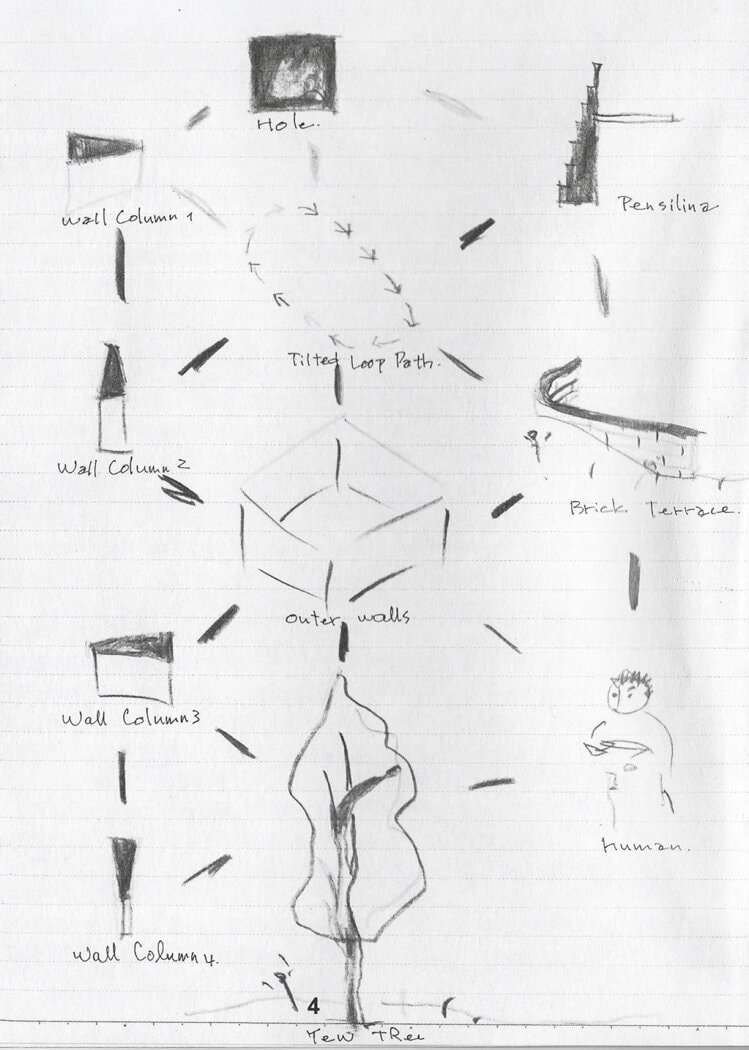
Drawing of the relationship between the elements of the Pavilion, scan from the Exhibition Booklet, August 2025
Curated by Jun Aoki (architect, director of the Kyocera Museum of Kyoto, and professor emeritus at Tokyo University of the Arts) and Tamayo Iemura (independent curator and professor at Tama Art University), the exhibition presents works by digital artist Asako Fujikura and architect Takahiro Ohmura, showcased in the Gallery space. On the ground floor, in the Pilotis space, the exhibition features projects by architect and digital design specialist Toshikatsu Kiuchi and artist-programmer Taichi Sunayama.
Imagined in a near-future scenario, each element of the Japan Pavilion gains awareness and consciousness, joining humans in a dialogue about the life, nature, and future of the Pavilion itself. Where an architecture exhibition is typically a stage for examining buildings or making design statements, here it is reimagined as a place for conversation, where relationships and their dynamics become tangible and directly experienceable by visitors. Generative AI makes this dialogue possible. It gives voice to elements of the pavilion (the Wall Columns, Outer Walls, Brick Terrace, Pensilina, Hole, Tilted Loop Path, and Yew Tree), transforming them into non-human actors that speak alongside humans.
Here, visitors do not stand as masters or spectators, but as participants in a multilayered conversation that evolves across the two spaces of the Japan Pavilion: the Gallery above and the Pilotis below. Each space provides a distinct yet interconnected layer of the overall experience.

The Galley, scan from the Exhibition Booklet, August 2025
The Gallery (exhibitors: Asako Fujikura and Takahiro Ohmura) is an indoor space, accessible from the outside by stairs. It showcases a scenario in which humans and non-human actors communicate through natural language and images. Two large projected videos face each other: one shows live-action footage of five humans sharing a meal (the Human Video), while the other presents a 3DCG visualisation of the dialogue happening between the humans and the non-human actors (the Construction Video). Between these two projections, two smaller wall-mounted monitors extend from the columns: one displaying subtitles of the ongoing dialogue, while the other showing a 3D rendering of the actor currently speaking (the Object Video).
Together, these videos, accompanied by AI-generated voices, allow humans and objects to converse in turn, following a 17-minute script reflecting on the future of the pavilion. As Asako Fujikura and Takahiro Ohmura explain: “It’s like building space through the dialogue itself: characters or objects that appear in the script become the next subjects to speak and explore the space. In this way, space becomes a system of description and observation, where humans and objects move within and in opposition to one another through dialogue”.

The Gallery, In-Between, Venice Biennale, ph. Amedeo Martines, August 2025

The Gallery, In-Between, Venice Biennale, ph. Amedeo Martines, August 2025
Although this scenario may appear fictional, the project inevitably raises fundamental questions about the very dichotomy between subject and object. As the curator Jun Aoki remarks: "For a long time, humans have viewed themselves as the sole subjects, and the world around them as objects to be used […] leading to environmental destruction and decline in biodiversity”. In the Japan pavilion, those boundaries blur. Human and non-human, nature and artifact engage on equal terms, discarding the notion that any is superior.
At the heart of this narrative is the Hole, a physical aperture in the floor of the Gallery that links the pavilion’s interior and exterior spaces. To render this incorporeal presence visible as an actor, a beam of light is reflected from outside into the Gallery, illuminating the ceiling at the moment the Hole speaks. In doing so, the Hole is transformed, from a troublesome architectural feature without apparent function, into a central protagonist, the sole medium of communication and mediator between two realms: the fictional interior of the Gallery and the natural exterior of the Pilotis.

The Hole and the Saucer, In-Between, Venice Biennale, ph. Amedeo Martines, August 2025

The Saucer, In-Between, Venice Biennale, ph. Amedeo Martines, August 2025
This dialogue between inside and outside is powered by a large concave copper mirror placed at the centre of the Pilotis. Named the Saucer, measures 2,828 by 2 metres, proportions derived from the Japanese silver ratio, it strategically reflects a beam of light upward through the Hole. The piece was realised in collaboration with Alcarol, a design atelier from Belluno, Italy, renowned for its experimental approach to materials. The name Saucer also carries a historical resonance, referring to fragments of maiolica pottery unearthed during the construction of the pavilion in 1956, remnants of the communities that once lived in the area before the Giardini.

The Pilotis, scan from the Exhibition Booklet, August 2025
In the Pilotis, the layering of meanings takes precedence over the purely functional or explanatory aspects of the objects. Tangible and historically grounded structural elements (Columns, Walls, Pensilina, Yew Tree, Brick Terrace, and Saucer) are juxtaposed with elements that lack a physical form yet are nonetheless present. Alongside the Hole, a key example is the Tilted Loop Path, defined as the elliptical movement traced by visitors as they circulate the pavilion, through the Pilotis and the garden.
The Tilted Loop Path is a virtual trail, designed as a 28.28 by 20 metres ellipse, based on the silver ratio, ten times the size of the reflective Saucer. At times, it becomes tangible through 3D-printed terracotta rails, fabricated in collaboration with Gergely Péter Barna of the Kyoto Institute of Technology, filled with surplus soil and plants. Exposed to weather, the unglazed ceramic gradually deteriorates. As the artists describe: “Together with the Hole, the Tilted Loop Path and clay rails bring elements that transcend time and scale into the dialogue of this exhibition, into an in-between space.”

The Tilted Loop Path, In-Between, Venice Biennale, ph. Amedeo Martines, August 2025

The Tilted Loop Path, In-Between, Venice Biennale, ph. Amedeo Martines, August 2025
This in-between space is one of mutual transformation: both among the actors, who continuously reconfigure themselves through interaction, and between the visitors and the exhibition, who become entangled in the web of objects. Here, time, space, and encounter are in a state of becoming, fluid and in motion, rather than fixed or predefined in roles.
Another expression of this in-betweenness within the Pilotis is the Automated Dialogue. While the Gallery presents a scripted audio recording, here the conversation is continually reimagined through generative AI. It produces alternative dialogues while preserving the timing and word count of the original 17-minute script. A smartphone displays the generated text, which is read aloud by a speaker in real time. Over the course of the Biennale (10 May – 23 November 2025), the Automated Dialogue will generate 20,000 parallel worlds, unfolding in synchrony with the Japan Pavilion.

The Automated Dialogue, In-Between, Venice Biennale, ph. Amedeo Martines, August 2025
In this unfolding, each actor, human and non-human, with its own unique perspective, embodies an intelligence fundamentally different. These differences are so profound that genuine understanding or empathy can seem almost impossible. Yet by embracing the inevitable miscommunications that arise, the pavilion suggests that creativity itself emerges from these encounters, opening paths toward new forms of coexistence. “What we need is a third form of “Intelligens”, Jun Aoki reflects, one that avoids the extremes of control and helplessness, and rejects the binary view that the environment is either fully controllable or entirely beyond influence.” a form that affirms this condition of in-between.

The Japan Pavilion, In-Between, Venice Biennale, ph. Amedeo Martines, August 2025
Links
Digital Handout: https://hovab2025jp.in-between.jp/en/
Official Website: https://in-between.jp/
Japan Foundation: https://venezia-biennale-japan.jpf.go.jp/e/architecture/2025
La Biennale Official Website: https://www.labiennale.org/en/architecture/2025/japan
Alcarol: https://www.alcarol.com/
Automated Dialogue: https://dialogue.in-between.jp/

