English
 日本語
日本語

Mould Exhibition at ARAM store in London
A material’s inherent properties and qualities guide a designer to select it (or not) and make design changes to alter the ultimate output. When I was first introduced to the Panton Chair, designed in the 1960s by Verner Panton, I could not help but wonder how the form and structure were achieved from a single material. After some digging and research into how the chair was designed and manufactured, I discovered that the injection moulding technique was utilised to make this design happen. Without using this technique, the sweeping curve, no hardware or parts, ergonomically hugging the human body, and plastic with light flexibility yet structurally sound qualities of the Panton Chair could not be realised.
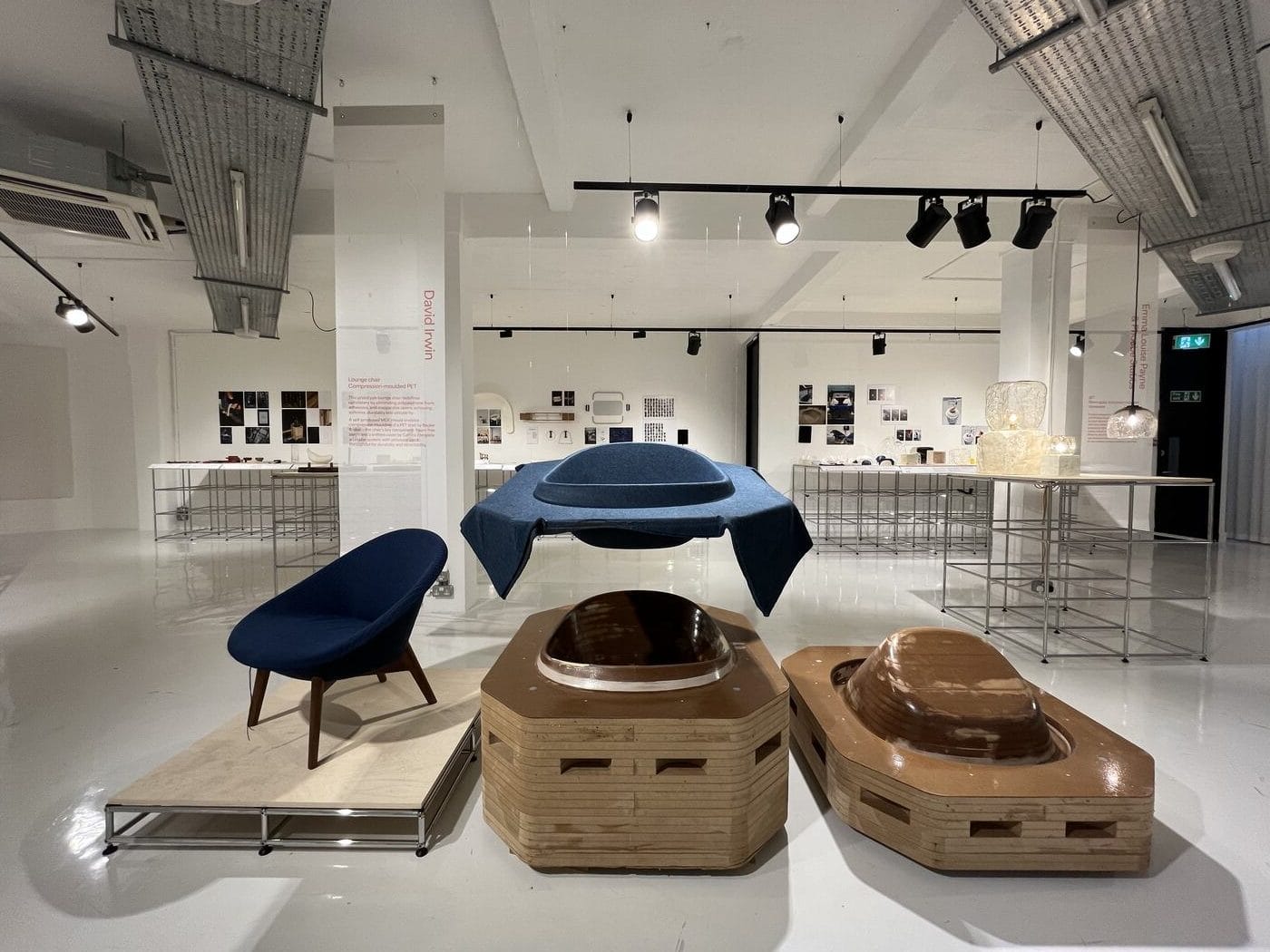
David Irwin’s exhibit at the Mould exhibition at the Aram store. Image by Von Chua
Understanding the qualities of how a material is worked on, including the processes that derive specific qualities and performances, is an important part of creating crafted pieces. Whether it is a small-scale industrial design object or a large-scale architectural facade, the natural properties of materials often become an undeniable driving force in the design process. From March 2026 to mid-April 2026, the Aram store in Covent Garden, London, United Kingdom, alongside the Proof of Concept platform, collaborated to present an exhibition titled Mould. The industrial process of moulding was showcased in various forms in the exhibition, revealing the unseen process of moulding in contemporary design.
Looking at a piece of industrial design, furniture design, or architectural design, the final form is usually presented to viewers. The design process involves undergoing iterations and refinements before it is shaped to its final form, which is not often widely shared or understood to fully appreciate the thoughtfulness in design. We do not often have the privilege of seeing what goes on behind the scenes; the exhibition shines a light on the behind-the-scenes challenges and reveals the processes leading up to the final design. Within the exhibition’s display, there are crafted pieces made out of ceramic, plastics, metals and more materials. Original casts, scaled models, and trials of finishes are openly displayed for viewers to gain a glimpse of the design process using moulds. The test pieces on display showcase a variety of experiments too, including variations in tooling, timing, adjoining material, plus a few more. There are so many possibilities, and in each step and in each further design iteration, the design decisions are made by the designer(s). Within the tens or hundreds of decisions made during the design process lies the design intelligence of the final piece.
The image attached to this article is David Irwin’s lounge chair, which is made out of a compression-moulded PET shell. The proof of concept mould was made out of cost-effective MDF, after some scaled tests in paper and 3D printing. With its designed lipped edge, it naturally forms the chair’s armrests and provides rigidity to the chair. In my opinion, the moulding technique coupled with its design considerations, such as the material choice, uniquely presents a foam-free chair that reduces the use of polyurethane foam or similar. Users of the chair can still enjoy the comfort of a supportive base and back of a chair, with reduced use of materials and hardware. This singular expression of the material, similar to the Panton Chair, makes David Irwin’s lounge chair easier to recycle. Indeed, the chair was successfully independently validated by Design Confirmity. Fitting to the proof of concept theme, in the design exhibit’s texts, it was mentioned that ‘a future production mould will be machined in aluminium to enable repeated manufacture’.
Other notable exhibits include moulds made in Swedish pine wood to act as the form for blown glass by Martina Claesson, and a hand-cast epoxy resin with translucent finish created through application of a coating within the silicon moulds by Tabatha Pearce Chedier. With Martina Claesson’s piece, the textural qualities found in nature are transferred onto the hard, glass surface. There is an interesting tension between nature’s rhythm and pace versus glass’s quick set and typically pristine surface. As for Tabatha Pearce Chedier’s piece, the technique developed eliminates the post-casting need to further work on the surface by sanding or polishing to create the translucency - at the moment of de-cast, the surface of the piece already takes on a uniform translucent finish. The design intelligence of these pieces resonated with me because there is something beautiful about nature’s creations that are not present in man-made products, as well as a previous experience of sanding pieces in a workshop to create a model’s translucent finish.
The Mould exhibition at the Aram store in London ended on 18th April 2026. Exhibits include works by 12 designers / design teams, who are as follows:
Alt Studio, Atelier Thirty Four, Chris Martin, David Irwin, Elliot Denny, Emma Louise Payne and Phoebe Stubbs, Josh South, Martina Claesson, Mentsen, Smith Matthias, Supergroup, and Tabatha Pearce Chedier.