

 English
 日本語
日本語

Redefining Dwelling as Careful Engagement with the World
Some houses are not designed but remembered. Casa Tao emerged not from drawings but from memory and experience by HW Studio. It is less a response to an image than to a way of living.

Facade Southeast
Photo credit: Hugo Tirso Domínguez

Pool
Photo credit: Gustavo Quiroz

Dining Room
Photo credit: César Belio
Gustavo’s early life in Puerto Vallarta, on Mexico’s Pacific coast, shaped the house’s essence. Raised in a modest home by farming and craft-working parents, he learned that shade was more than physical relief: it was an essential spatial resource, a condition of rest and protection. Casa Tao therefore translates this need for shelter and coolness into architectural form, treating shadow as both environmental device and emotional presence.

Stairs
Photo credit: Gustavo Quiroz

Master Bedroom
Photo credit: Gustavo Quiroz

Guest Bedroom
Photo credit: Gustavo Quiroz
Gustavo’s intellectual curiosity further influenced the design. A self-taught polymath, his library—spanning Campo Baeza, Fan Ho, and Tarkovsky—reveals his attraction to clarity, geometry, and courtyards that work with void and light. These values informed the house’s spatial order.

Guest Bedroom
Photo credit: César Belio

Bedroom Courtyard
Photo credit: César Belio

Southwest Façade
Photo credit: Hugo Tirso Domínguez
Travel to Japan with his partner Cynthia and their daughters added another layer. Their wish “to live inside a Japanese museum” referred not to solemnity but to spaces where time slows, light filters gently, and silence becomes tangible. This sensibility shaped both material and spatial strategies.
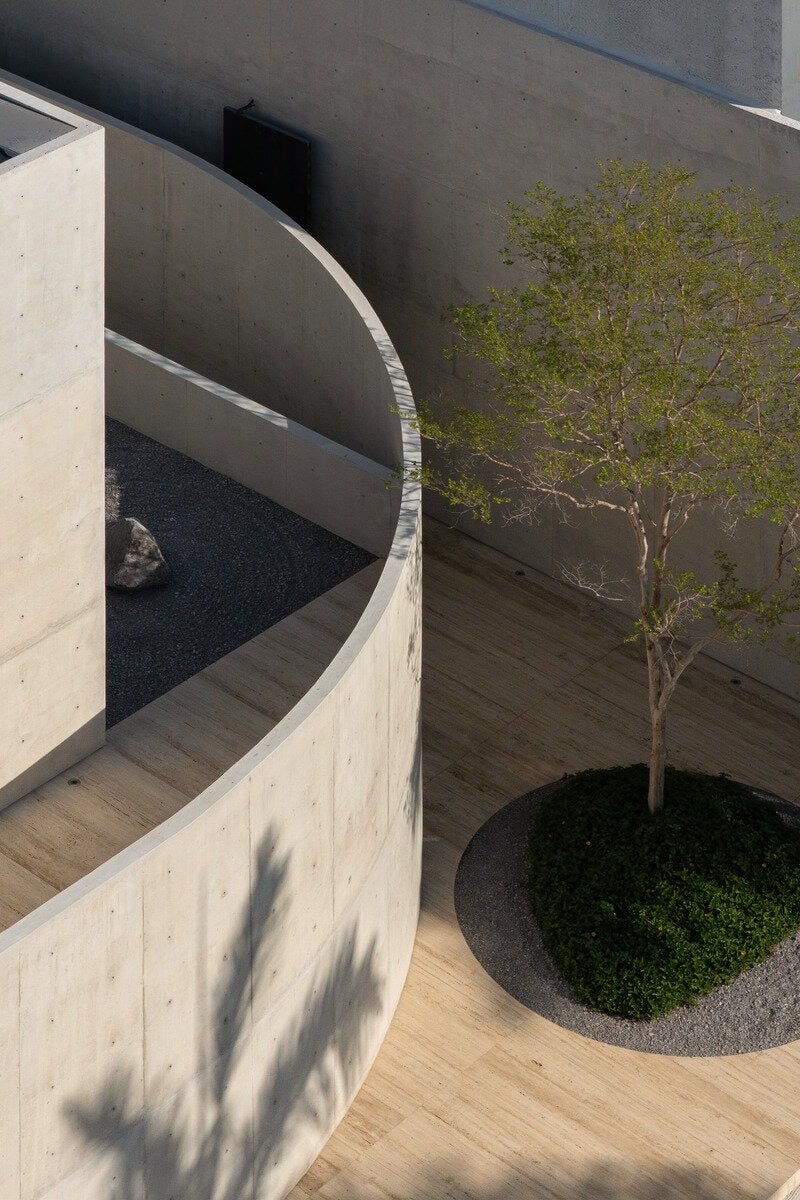
Aerial View of Southeast Façade
Photo credit: Hugo Tirso Domínguez

Pedestrian Entrance
Photo credit: Hugo Tirso Domínguez

Top Aerial View of Pedestrian Entrance and Courtyards
Photo credit: Hugo Tirso Domínguez
HW Studio interpreted these narratives within an unremarkable neighborhood, where a tree-lined plaza offered the only environmental richness. Rather than exposing the house directly with large glass façades, the architects established an oblique orientation, admitting wind and filtered views while avoiding harsh sunlight.

Pedestrian Access Corridor
Photo credit: Hugo Tirso Domínguez
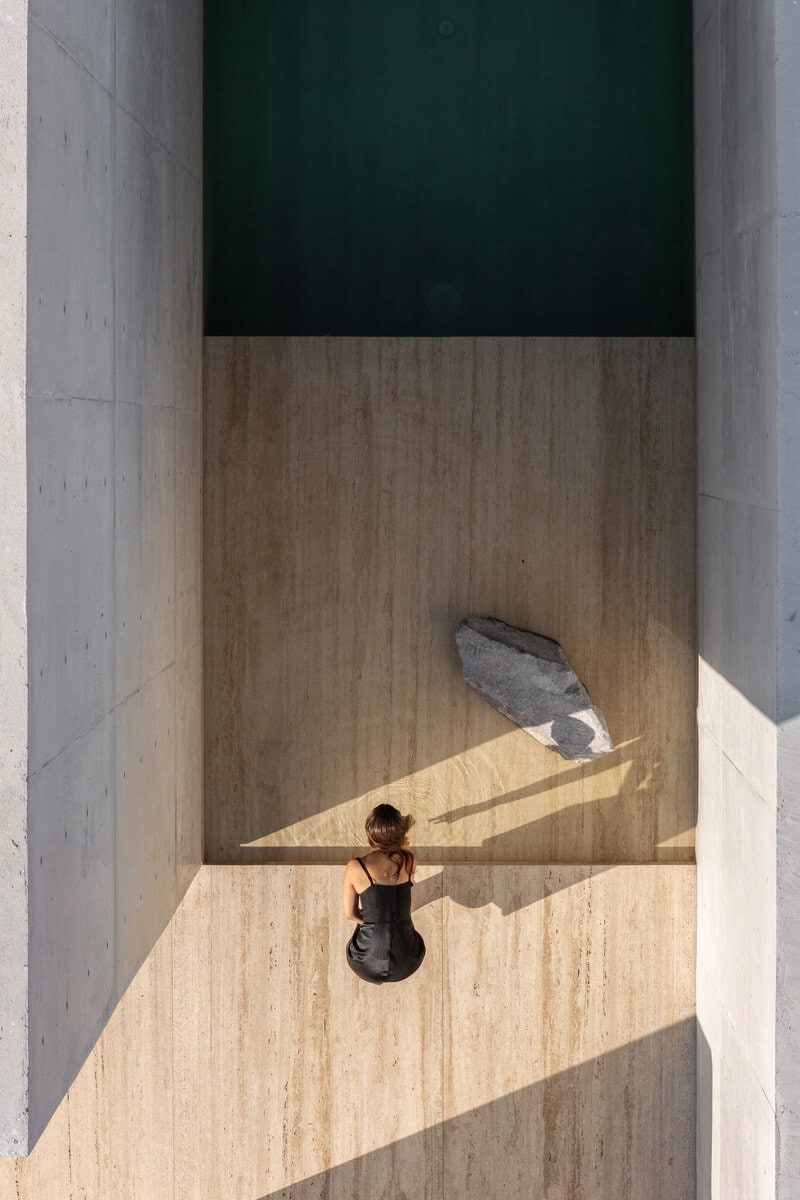
Top Aerial View of Pool
Photo credit: Hugo Tirso Domínguez

Outdoor Patio
Photo credit: Hugo Tirso Domínguez
The program was stratified: bedrooms, garage, and services in the base; above them, a light double-height box containing social areas. This elevated volume separates communal life from the street, opens toward trees and breeze, and connects to small patios that act as contemplative terraces. Private rooms cluster around a patio, emphasizing silence and air. A curved wall forms a gentle threshold, while a tree marks the entry sequence. The house turns inward for refuge yet opens selectively to sky and plaza, encouraging slower, more attentive inhabitation.

Pool
Photo credit: César Belio

Photo credit: César Belio

Living Room
Photo credit: Hugo Tirso Domínguez
Materiality heightens sensory effect. White surfaces respond to coastal sun, while concrete absorbs light with subtlety, gaining warmth through use and time. Concrete becomes not only structure but a medium of atmosphere.

Bedroom Corridor
Photo credit: Gustavo Quiroz

Bedroom Courtyard
Photo credit: César Belio

Bedroom Courtyard
Photo credit: César Belio
Casa Tao ultimately redefines dwelling as careful engagement with the world. Its spaces are discreet, offering atmospheres for memory and reflection. Each corner invites stillness; every shadow promises well-being.

Study
Photo credit: Gustavo Quiroz
This focus on shadow recalls Jun’ichirō Tanizaki’s In Praise of Shadows, where darkness is not absence but a subtle lens that deepens perception. Likewise, Casa Tao does not assert light but filters it gently, allowing beauty to emerge slowly. Here, time thickens, silence expands, and life acquires a contemplative dimension.
HW Studio
HW Studio is an architecture studio that emerged in a time of great violence in Mexico, with the purpose of creating spaces that evoke and promote threatened peace. The firm's design process focuses on the deep study and understanding of what they call the three universes: the universe of the future inhabitant, the universe of the place, and our own inner universe as designers.

